What if consciousness isn’t just neurons firing? What if the thing that makes you “you” runs on the same physics that powers quantum computers?
That idea sounded like science fiction for decades. Most neuroscientists dismissed it. The brain is too warm, too wet, and too messy for quantum effects. End of story.
Except the story didn’t end. A 2025 paper published in Neuroscience of Consciousness pulled together three separate experiments. And all three point in the same direction. Quantum effects don’t just survive in your brain. They might be the actual substrate of consciousness itself.[1]
The Theory That Wouldn’t Die
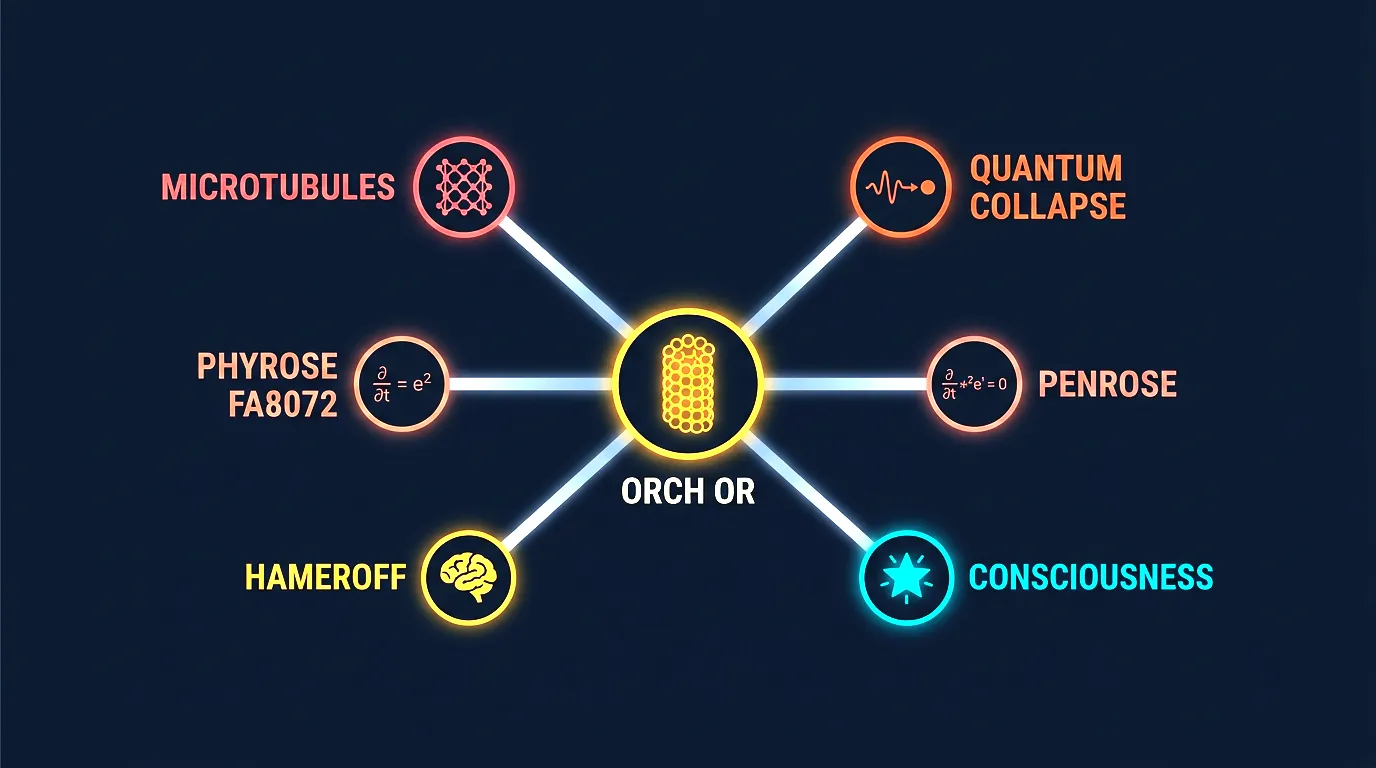
In the mid-1990s, physicist Roger Penrose and anesthesiologist Stuart Hameroff proposed something radical. They called it Orchestrated Objective Reduction, or Orch OR for short.[2]
Here’s the basic claim. Inside every neuron in your brain, there are tiny protein tubes called microtubules. They’re part of the cell’s skeleton. But Penrose and Hameroff argued they do something far more important. They perform quantum computations.
According to Orch OR, consciousness happens when quantum states inside these microtubules reach a threshold and collapse. Not randomly. In an “orchestrated” way that’s connected to the geometry of spacetime itself. Each collapse is a moment of conscious experience.
The idea was elegant. It was also immediately attacked from every direction.
- Physicist Max Tegmark calculated that quantum states in the brain would collapse in femtoseconds. That’s a millionth of a billionth of a second. Far too fast to matter for thought.[3]
- Biologists argued that microtubules are structural scaffolding. Not computing devices.
- Philosophers called it “using one mystery to explain another.”
For twenty years, Orch OR was treated as fringe science. Interesting but almost certainly wrong.
Then the experiments started rolling in.
Three Experiments That Changed Everything
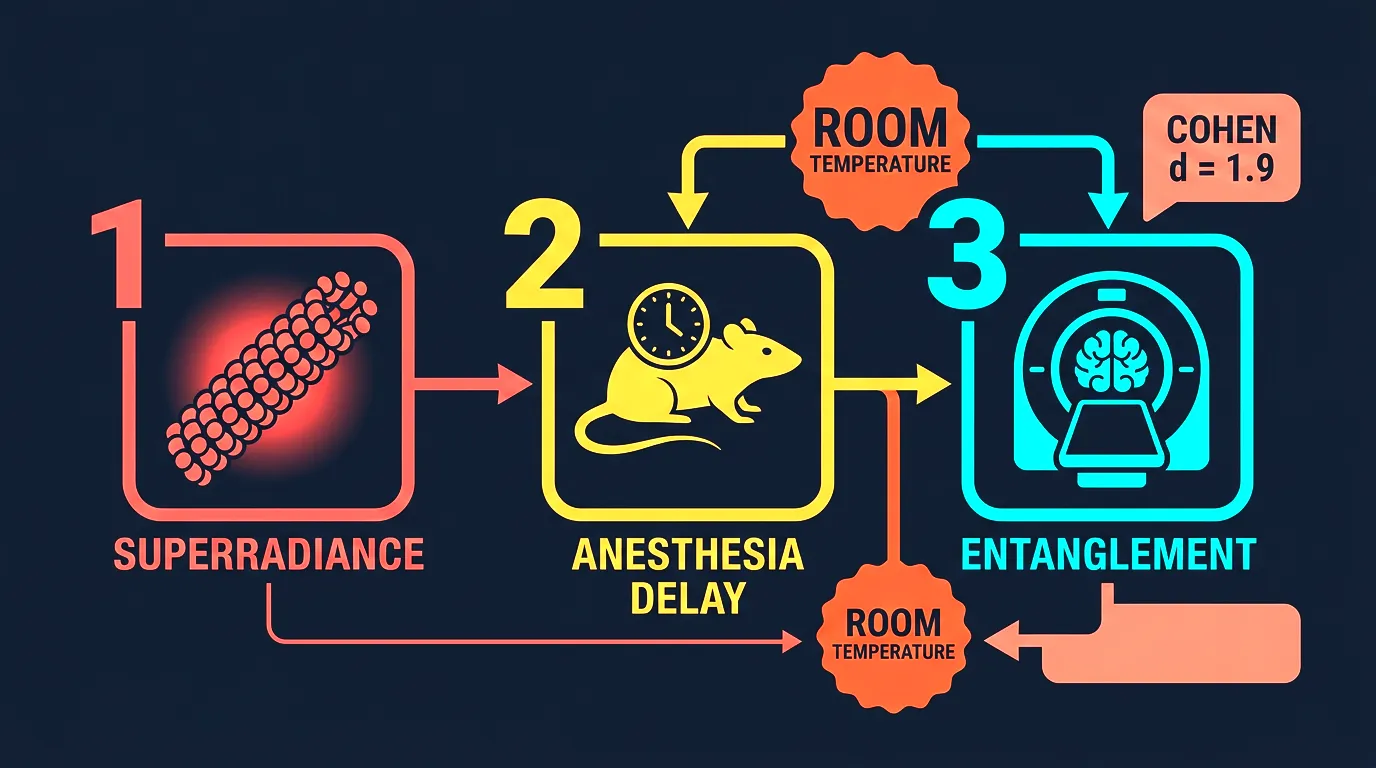
Michael Wiest’s 2025 paper doesn’t present one experiment. It reviews three separate lines of evidence that converge on the same conclusion.[1]
Quantum Effects Survive at Body Temperature
The biggest criticism of quantum consciousness was always temperature. Quantum effects need extreme cold. Your brain runs at 37 degrees Celsius. Case closed.
Except in 2024, Babcock and colleagues at Howard University observed something nobody expected. They found quantum superradiance in microtubules at room temperature.[4]
Here’s what that means. Tryptophan molecules are arranged in a precise lattice inside microtubules. When these molecules interact collectively, they emit light faster and stronger than they would individually. That’s a distinctly quantum behavior called superradiance. And it gets stronger in larger microtubule structures, not weaker.
This was selected as an Editor’s Choice by Science magazine. It directly contradicts Tegmark’s decoherence argument.
Anesthetics Target Microtubules, Not Just Membranes
For decades, scientists assumed anesthetics worked by binding to receptor proteins on the outside of neurons. But something never added up. The Meyer-Overton correlation shows that anesthetic potency tracks perfectly with how well a drug dissolves in fat. Across multiple orders of magnitude. That pattern suggests one single conserved target, not dozens of different receptors.[5]
In 2024, Khan and colleagues at Wellesley College gave rats a drug called epothilone B that stabilizes microtubules. Then they exposed the rats to isoflurane anesthetic gas.[6]
The result was dramatic. Rats with stabilized microtubules took an average of 69 seconds longer to lose consciousness. The effect size was Cohen’s d = 1.9. In psychology research, anything above 0.8 is considered large. This was enormous.
| Finding | What It Means |
|---|---|
| Microtubule drug delays unconsciousness | Anesthetics likely work by disrupting microtubules |
| Cohen’s d = 1.9 effect size | One of the largest effects in consciousness research |
| Meyer-Overton correlation preserved | Single conserved target, not scattered receptors |
| Quantum models predict drug potency | Binding affinity in microtubules matches anesthetic strength |
“This finding supports the quantum model of consciousness. When it becomes accepted that the mind is a quantum phenomenon, we will have entered a new era.” — Professor Mike Wiest, Wellesley College
Quantum Entanglement Detected in Living Brains
In 2022, Christian Kerskens and David Perez at Trinity College Dublin used a novel MRI technique to look for quantum entanglement in conscious human brains.[7]
They scanned 40 participants and found something unexpected. MRI signals that shouldn’t have been detectable through standard physics. Signals that mimicked heartbeat-evoked potentials. The simplest explanation? The proton spins in the brain were entangled.
What made this even more compelling:
- The entanglement signal correlated with working memory performance
- It was present during waking consciousness
- When two subjects fell asleep during the scan, the signal faded and disappeared
- A follow-up study with 60 participants confirmed the pattern[8]
No classical explanation has been offered for these signals. They are exactly what you’d expect if quantum entanglement plays a functional role in conscious experience.
If you’re fascinated by the strange quantum properties your brain might have, you’ll want to read about how your brain literally glows in the dark. Biophotons, the light your neurons emit, may even be part of this quantum story.
Recommended read: The Experience Machine by Andy Clark. A groundbreaking look at how your brain constructs reality through prediction, and why quantum models might explain the process better than anyone thought.
Solving the Two Hardest Problems in Consciousness
The reason Wiest’s paper matters isn’t just the experiments. It’s what those experiments allow us to solve. Two problems that have stumped scientists and philosophers for decades.
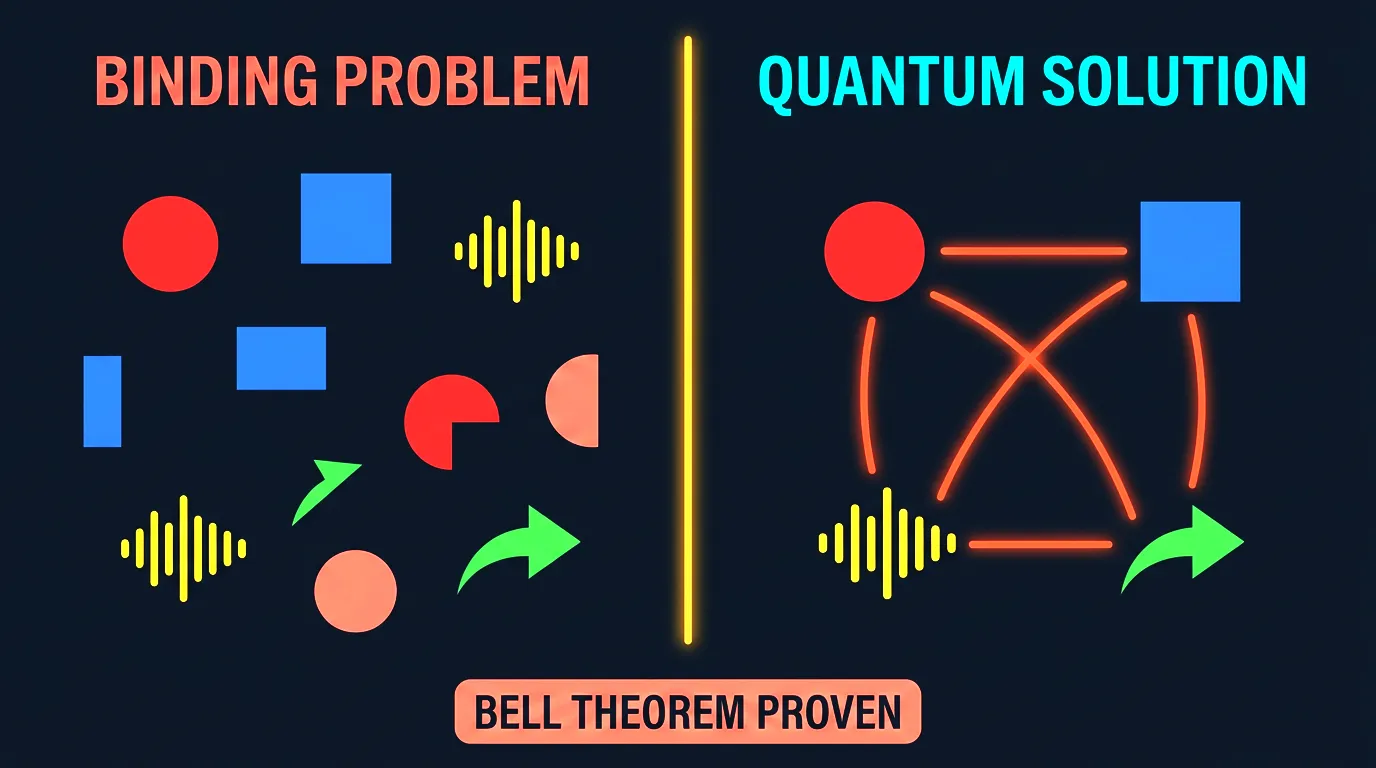
The Binding Problem
Right now, your brain is processing color in one region. Shape in another. Sound in a third. Motion somewhere else. Yet your experience is unified. You see one seamless world, not a scattered mess of disconnected signals.
That’s the binding problem. How does the brain combine distributed signals into a single unified experience?[9]
Classical physics can’t solve this. In classical models, any large-scale property of a system can always be mathematically reduced to the behavior of its individual parts. If you can describe every neuron individually, you’ve described the whole brain. There’s nothing left over. No holistic “unity” that exists above and beyond the parts.
Quantum entanglement is different. An entangled quantum state is a genuine whole that contains parts but cannot be reduced to those parts. This is proven by Bell’s theorem, one of the most tested results in all of physics.[10] Two entangled particles share properties that neither possesses individually. The whole is literally more than the sum of its parts.
If consciousness relies on entangled states in microtubules, the binding problem dissolves. Your unified experience corresponds to an objectively unified physical state. Not a convenient illusion generated by classical neurons firing in sync.
The Epiphenomenalism Problem
Here’s another puzzle. If consciousness is just a side effect of brain activity with no causal power, how did it evolve? Natural selection only preserves traits that help organisms survive. A causally powerless byproduct would have no survival advantage.[1]
Classical models make consciousness look epiphenomenal. Reducible. Eliminable from the physical description without changing any predictions about behavior. That makes evolution hard to explain.
Quantum consciousness fixes this too. Entangled states give organisms access to computational advantages that classical systems lack:
- Quantum associative memory can store exponentially more patterns than classical neural networks[1]
- Quantum path-integral optimization evaluates all possible futures simultaneously
- Quantum decision-making processes the “whole situation” rather than isolated parts
These aren’t abstract possibilities. Research in quantum cognition has shown that human decision-making actually violates classical probability rules in ways that match quantum probability predictions. The conjunction fallacy. Order effects in surveys. Violations of the sure-thing principle. All of these anomalies fit quantum models better than classical ones.[11]
Recommended read: Third Millennium Thinking by Saul Perlmutter, John Campbell, and Robert MacCoun. Nobel laureate Perlmutter shows how scientific reasoning can cut through the confusion when facing questions at the frontier of knowledge.
Why Most Scientists Still Aren’t Convinced
Let’s be clear. Quantum consciousness is not mainstream neuroscience. Most researchers studying the brain don’t think quantum mechanics is necessary to explain consciousness. And they have real reasons for skepticism.[3]
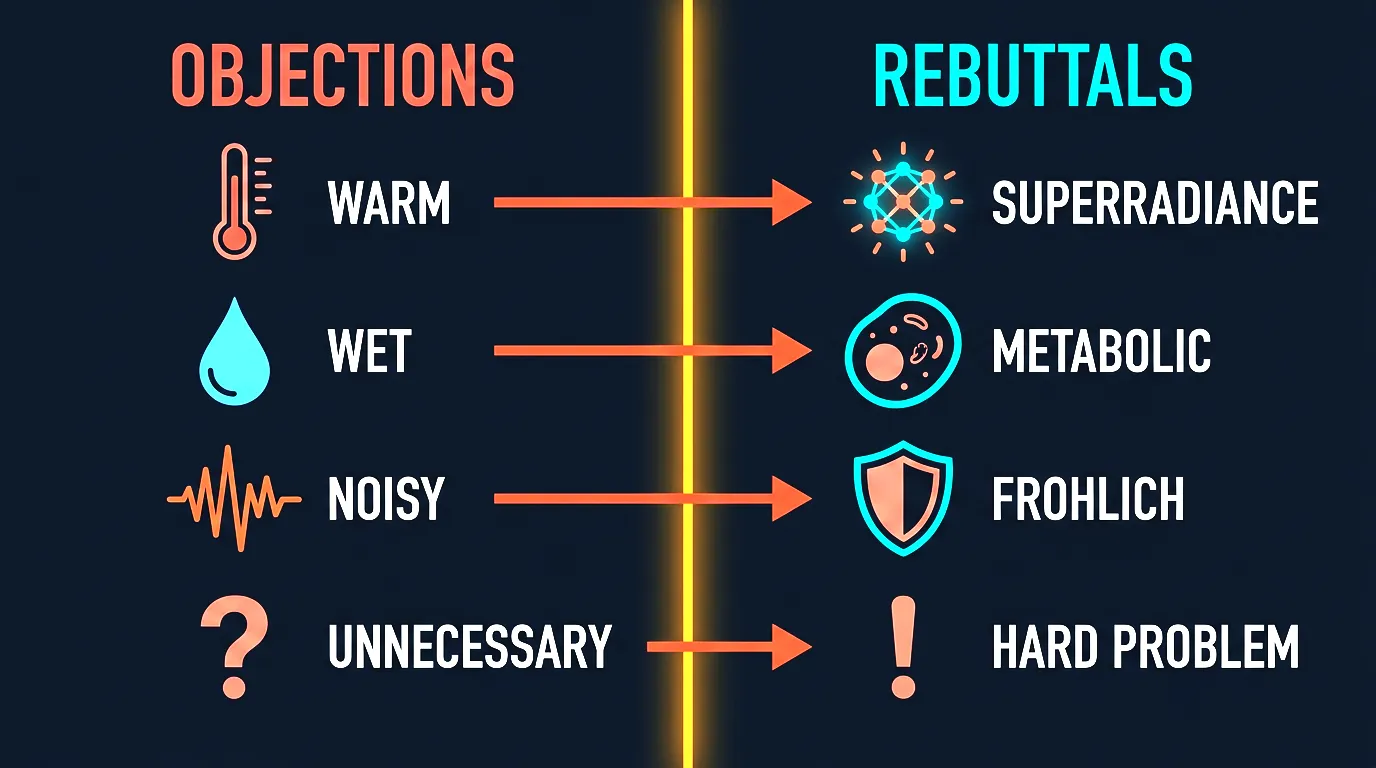
The decoherence objection is the biggest. Quantum states are fragile. Heat, vibration, and random molecular interactions destroy them. The brain is warm, wet, and incredibly noisy at the molecular level. Standard decoherence calculations suggest quantum states should collapse almost instantly in biological tissue.
Supporters counter that living cells aren’t at thermal equilibrium. They’re metabolically active, constantly pumping energy. Theoretical models show that Frohlich condensates, metabolically sustained coherent states, could maintain quantum effects at body temperature.[4] And the Babcock superradiance experiment provides direct experimental support for this.
The “too complicated” objection. Even if quantum effects exist in microtubules, connecting them to consciousness requires leaps across multiple levels of explanation. From quantum physics to molecular biology to neural computation to subjective experience. Each leap introduces uncertainty.
The “not needed” objection. Classical neuroscience has made enormous progress explaining perception, memory, learning, and behavior without invoking quantum mechanics. Why add complexity when simpler models work? This is a fair point. But classical models have also utterly failed to explain the hard problem of consciousness: why there is subjective experience at all.[9]
| Criticism | Counter-Evidence |
|---|---|
| Brain is too warm for quantum effects | Babcock 2024: superradiance observed at room temperature |
| Decoherence happens in femtoseconds | Living cells operate far from thermal equilibrium |
| Microtubules are just structural | Anesthetics target them, stabilizing them delays unconsciousness |
| Quantum effects are not needed | Classical models fail to explain binding or subjective experience |
| Two mysteries explaining each other | Quantum entanglement provides the specific missing property: holism |
If this kind of scientific controversy fascinates you, check out what happens when neuroscience tries to explain the simulation theory your brain wants to believe. The overlap between these questions is deeper than you think.
Recommended read: These Strange New Minds by Christopher Summerfield. An Oxford neuroscientist explores where human consciousness ends and artificial intelligence begins, and why the boundary is blurrier than we assumed.
What This Means for the Hard Problem of Consciousness
The hard problem of consciousness, named by philosopher David Chalmers in 1995, asks the deepest question in all of science. Why does subjective experience exist at all?[12]
You can explain how neurons fire. You can map every circuit. But nothing in that explanation tells you why there’s “something it’s like” to see red or taste chocolate. The physical description seems complete without consciousness. And yet, here you are. Experiencing.
Wiest argues that quantum consciousness opens a door that classical physics cannot. The key concept is panprotopsychism. This isn’t the claim that rocks and electrons are conscious. It’s the idea that the fundamental building blocks of physics carry proto-conscious properties, precursors to experience that only become full consciousness in the right configuration.[1]
Quantum entanglement provides the missing ingredient. In a classical world, you’d need to explain how separate physical parts generate a unified experience. You can’t. In a quantum world, entangled states are unified wholes. The binding of experience corresponds to the entanglement of quantum states. The causal power of consciousness corresponds to the computational advantages of quantum processing.
This doesn’t solve the hard problem completely. We still can’t prove why quantum collapse feels like something. But it narrows the gap between physics and experience more than any classical theory has managed.
Three things to watch for in the next few years:
- Replication of the Kerskens-Perez MRI entanglement findings in larger samples and by independent labs
- Quantum anesthesia research testing whether other microtubule-targeting drugs affect consciousness in predictable ways
- Direct measurement of quantum coherence in living neural tissue using advances in quantum sensing technology
If your brain really is a quantum computer, it changes everything we think about consciousness, free will, artificial intelligence, and what it means to be alive. The evidence isn’t conclusive yet. But for the first time, the experiments are catching up to the theory.
And that’s the most exciting thing happening in neuroscience right now.
The idea that reality itself might be a simulation suddenly feels a little less crazy when the substrate of your consciousness operates on the same physics that makes quantum computers work.
Sources
The Theory That Wouldn’t Die
2. Consciousness in the Universe: A Review of the ‘Orch OR’ Theory (Physics of Life Reviews, 2014)
3. Importance of Quantum Decoherence in Brain Processes (Physical Review E, 2000)
Three Experiments That Changed Everything
6. Microtubule-Stabilizer Epothilone B Delays Anesthetic-Induced Unconsciousness in Rats (eNeuro, 2024)
7. Experimental Indications of Non-Classical Brain Functions (Journal of Physics Communications, 2022)
Solving the Two Hardest Problems in Consciousness
10. On the Einstein Podolsky Rosen Paradox (Physics, 1964)
What This Means for the Hard Problem of Consciousness
12. Facing Up to the Problem of Consciousness (Journal of Consciousness Studies, 1995)