Elon Musk says the odds we’re in “base reality” are one in billions. Neil deGrasse Tyson puts the chance at 50-50. Nick Bostrom, an Oxford philosopher, wrote a famous paper arguing that if advanced civilizations can run simulations, we’re almost certainly inside one right now.[1]
These aren’t fringe voices. They’re some of the most recognized names in tech and science. And millions of people find their arguments surprisingly convincing.
But here’s the thing. The simulation hypothesis doesn’t feel true because the evidence is strong. It feels true because your brain is built to believe it.
The Pattern Machine Inside Your Head
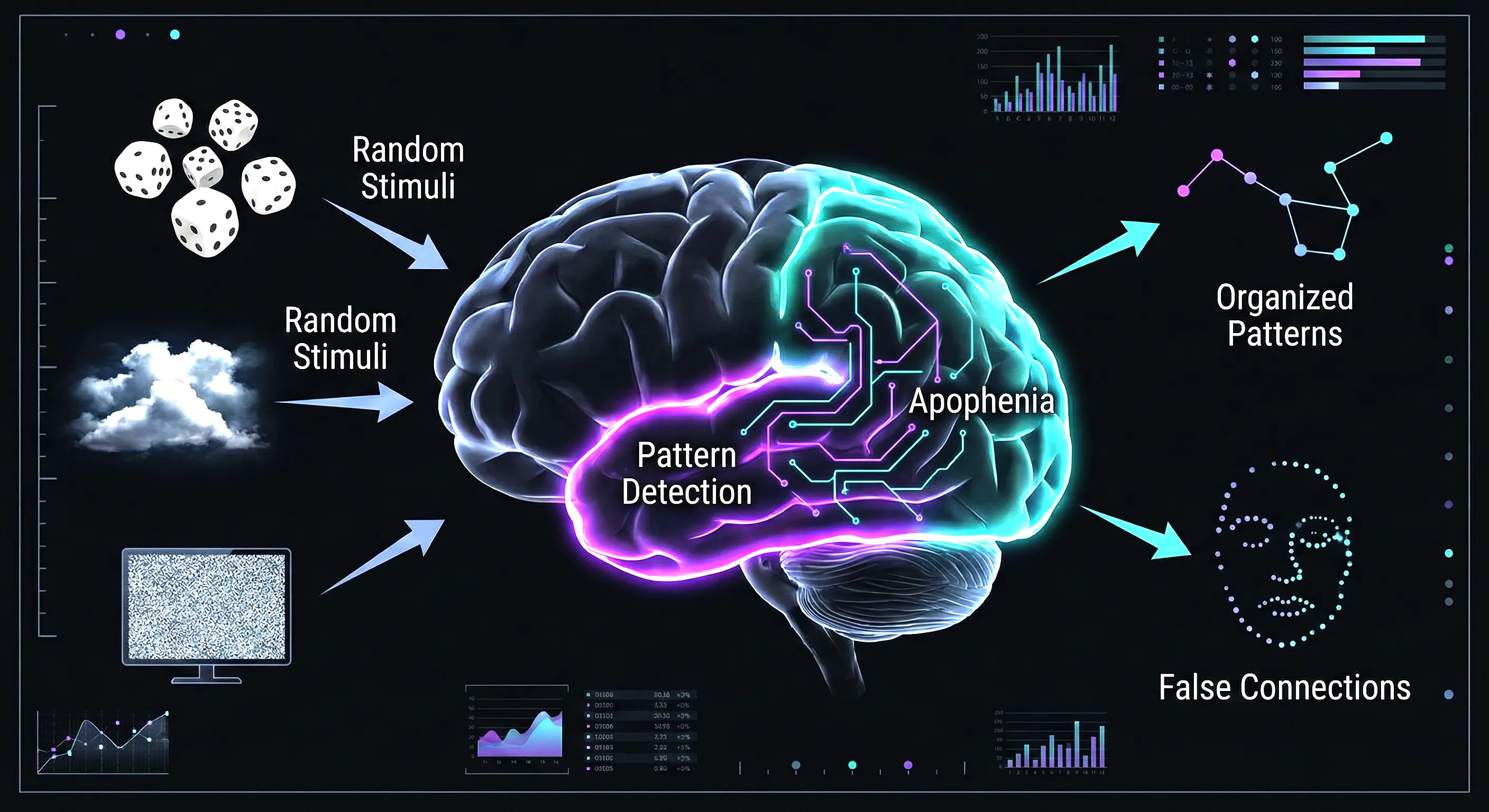
Your brain is not a camera that records reality. It’s a prediction engine that constantly looks for patterns, even when none exist.
Psychologists call this apophenia. It’s the tendency to perceive meaningful connections between unrelated things. You see a face in a piece of toast. You notice the number 23 keeps showing up everywhere. You think of an old friend, and then they call you an hour later.
David McRaney, author of You Are Not So Smart, explains it this way. Your brain is pre-organized to notice order. When you connect the dots in your life and interpret the story to have special meaning, that’s apophenia in action. The pattern feels real because your brain made it feel real.
This wiring exists for a good reason. Our ancestors who noticed patterns survived. The rustle in the grass might be wind. Or it might be a predator. As Brian Klaas writes in Fluke, “In a world in which false positives are annoying but false negatives are deadly, our brains have evolved to be hyper-attuned to pattern detection.”
The problem? This same wiring fires when there’s nothing there. And simulation theory is the ultimate pattern. It takes every strange coincidence, every moment of deja vu, every “glitch in the matrix” and connects them into one giant narrative. Your brain loves that narrative. It was designed to.
Evolutionary psychology confirms that we are wired to prioritize threat detection over accuracy.[2] What once helped us survive may now distort our reality. The same pattern-seeking that kept our ancestors alive makes us see design where there’s only randomness.
“We’ve evolved to overdetect patterns. It’s safer to mistakenly assume that a rustling noise is caused by a lurking predator than to ignore a lion by dismissing the rustling as a random bit of wind.” - Brian Klaas, Fluke
Recommended read: Fluke by Brian Klaas. A fascinating deep dive into how randomness shapes everything and why our pattern-seeking brains refuse to accept it.
Five Cognitive Biases That Make Simulation Theory Irresistible
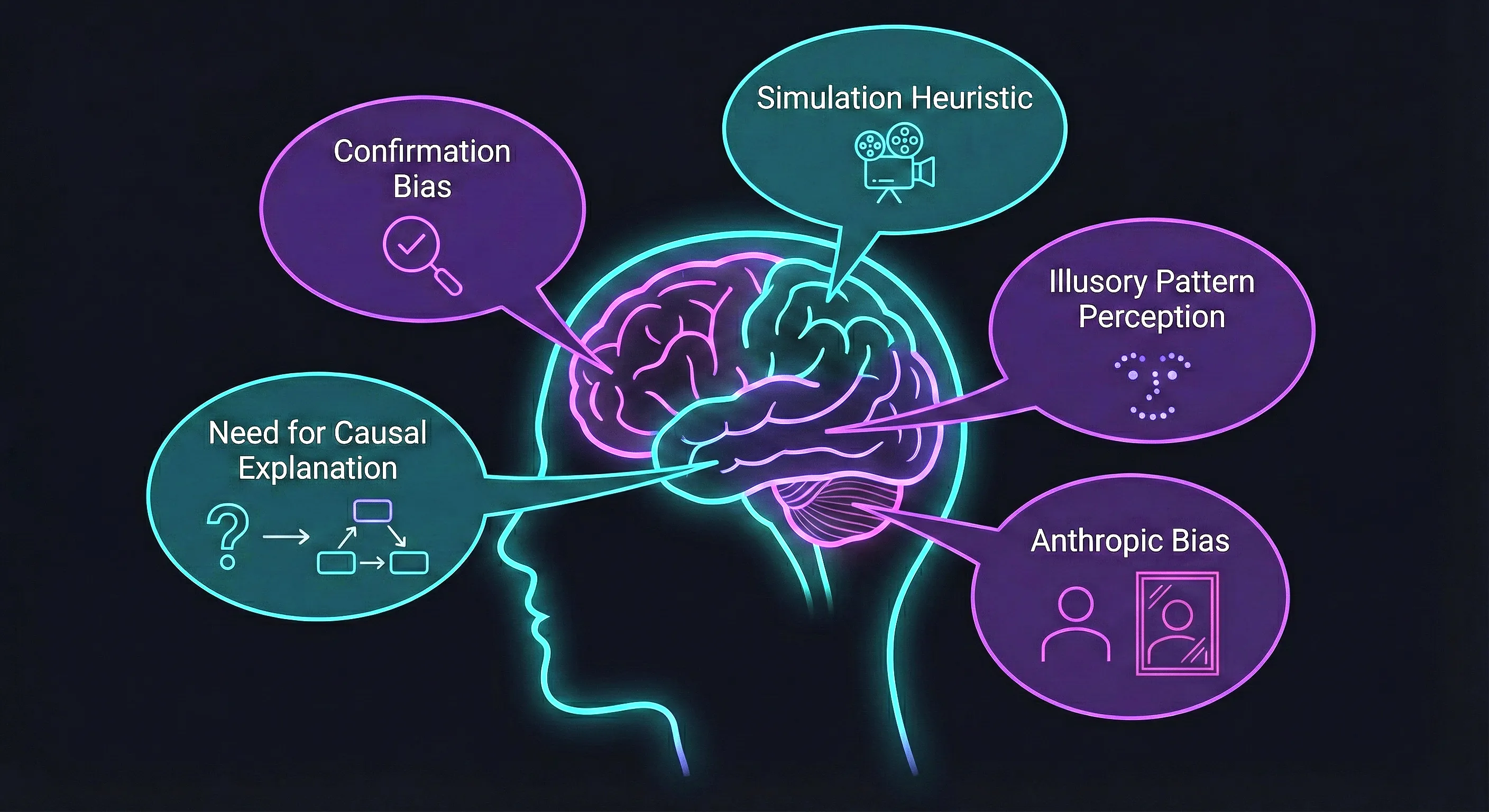
Apophenia is just the starting point. There’s a whole toolkit of cognitive biases working together to make the simulation hypothesis feel airtight. Here are the big five.
Confirmation Bias
Once you start entertaining the idea that reality might be simulated, you start noticing “evidence” everywhere. A weird coincidence? Proof. Deja vu? A glitch. A physics equation that looks like code? Obviously.
You ignore all the moments where nothing weird happens. You only count the hits and forget the misses. This is confirmation bias at work. As Dan Ariely describes in Misbelief, “Looking backward in time for chapters in a story we want to prove, it is easy to find some details that support our story.” This same bias fuels everything from conspiracy thinking to fake news.
The Simulation Heuristic
Your brain has a shortcut called the simulation heuristic. If you can easily imagine something happening, you assume it’s more likely to be true. Hollywood has given you The Matrix, Black Mirror, and dozens of virtual reality stories. You can vividly picture being in a simulation. So your brain quietly adjusts the probability upward.
Illusory Pattern Perception
Psychologist Jan-Willem van Prooijen’s research on conspiracy thinking shows that people who see patterns in random stimuli are also more likely to believe in conspiracies.[3] Simulation theory works the same way. Random events get knitted into a coherent story of “someone designed this.”
The Need for Causal Explanation
Humans are obsessed with “why.” Thomas Gilovich’s research shows we’re so good at inventing explanations that we can justify almost anything after the fact. Simulation theory gives the ultimate “why” for everything. Why does the universe have physical constants that seem fine-tuned for life? Because someone programmed it that way.
The Anthropic Bias
You exist. You’re conscious. You’re aware of the question. This feels special, and special things need explanations. The fact that you’re here asking “is this a simulation?” feels like evidence that it must be. But that’s circular reasoning dressed up as insight.
| Bias | How It Works | Simulation Theory Example |
|---|---|---|
| Confirmation bias | Noticing evidence that supports your belief, ignoring the rest | Counting “glitches” while ignoring normal moments |
| Simulation heuristic | If you can imagine it, it feels probable | The Matrix made simulation easy to picture |
| Illusory pattern perception | Seeing meaningful patterns in randomness | ”The universe looks like code” |
| Need for causal explanation | Demanding “why” even when randomness is the answer | ”The constants are fine-tuned because someone set them” |
| Anthropic bias | Feeling special for being conscious | ”I exist, so someone must have designed this” |
Recommended read: Misbelief by Dan Ariely. Explains how rational people end up believing irrational things through a predictable cascade of cognitive errors.
Why Smart People Are the Most Susceptible
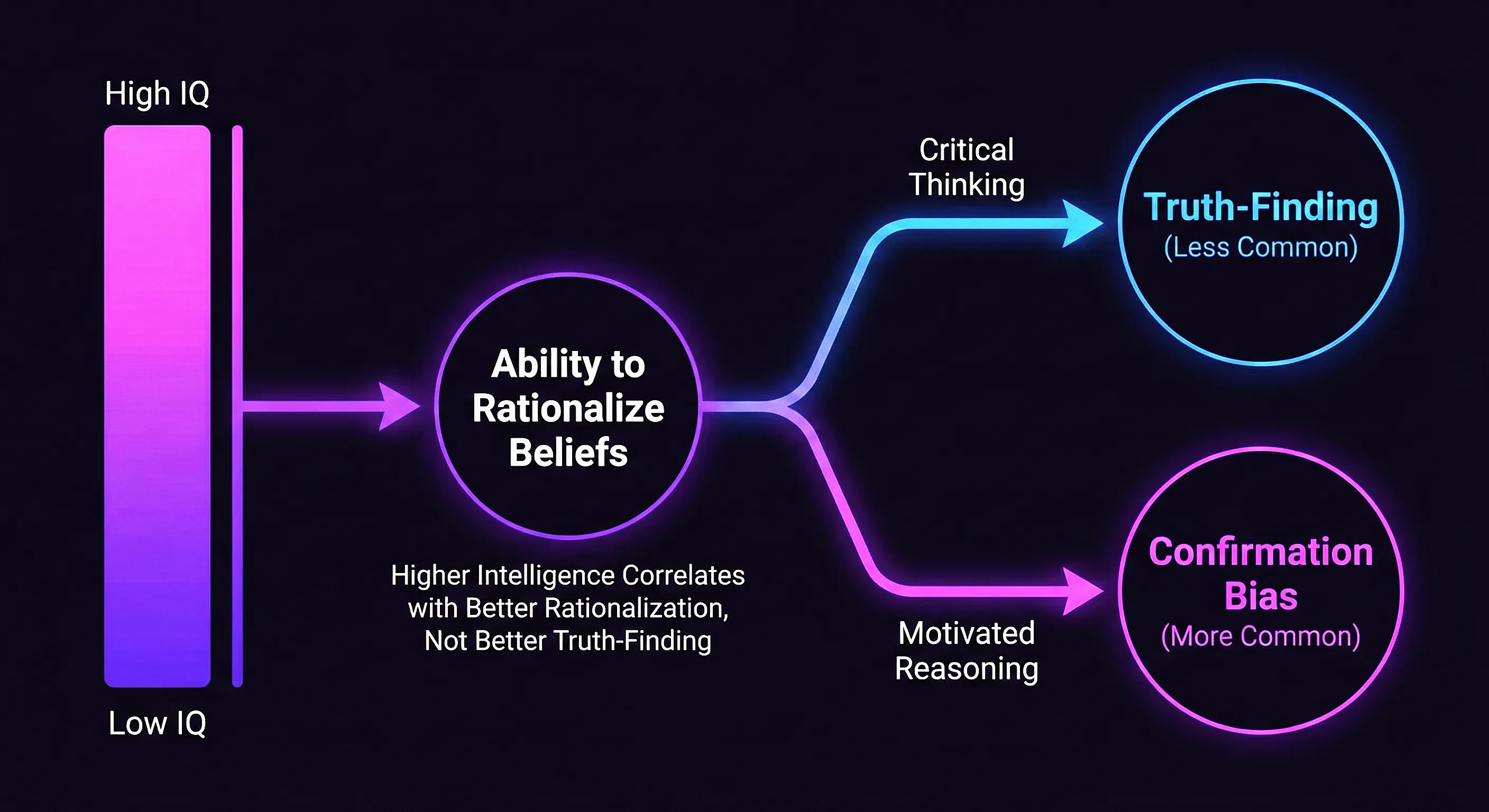
Here’s something that surprises people. Intelligence doesn’t protect you from simulation theory. It might actually make you more vulnerable.
Smart people are better at constructing logical arguments. That means they’re also better at motivated reasoning. They can build a more convincing case for whatever they already want to believe. And simulation theory is dressed in the language of logic, math, and probability. It feels like a rational conclusion, not a gut feeling.
Nick Bostrom’s original simulation argument is a perfect example.[1] It’s structured as a logical trilemma. It uses probability theory. It references computational power and ancestor simulations. It looks like science, but computer science itself has significant constraints on whether such a simulation is even physically achievable.[6] Bostrom himself acknowledges it rests on assumptions about consciousness and computation that we can’t verify.
Philosopher David Chalmers, in his book Reality+, admits we can never prove we’re not in a simulation. Any evidence against it could itself be simulated. But he also points out that this unfalsifiability is exactly what makes it unscientific. You can’t disprove it. And you can’t prove it either. Chalmers later went even further, arguing that life is real and meaningful even if we do live in a simulation.
Here’s what the research shows about who’s most drawn to simulation theory:
- People high in openness to experience. They enjoy abstract thinking and novel ideas. This same trait is one of the strongest predictors of why some people are naturally more creative.
- People who consume a lot of science fiction and tech media. Pop culture primes the concept.
- People experiencing existential uncertainty. Major life changes or anxiety can trigger a search for meaning.
- People in tech and STEM fields. The computational framing feels familiar and “obvious.”
A 2025 review examined how advancing virtual reality and AI technology has made simulation theory more psychologically compelling.[4] As our own technology creates increasingly realistic virtual worlds, Bostrom’s argument feels more plausible. Not because the evidence changed. But because your reference point did. The better our simulations get, the easier it is to imagine being inside one. That’s the simulation heuristic doing its job.
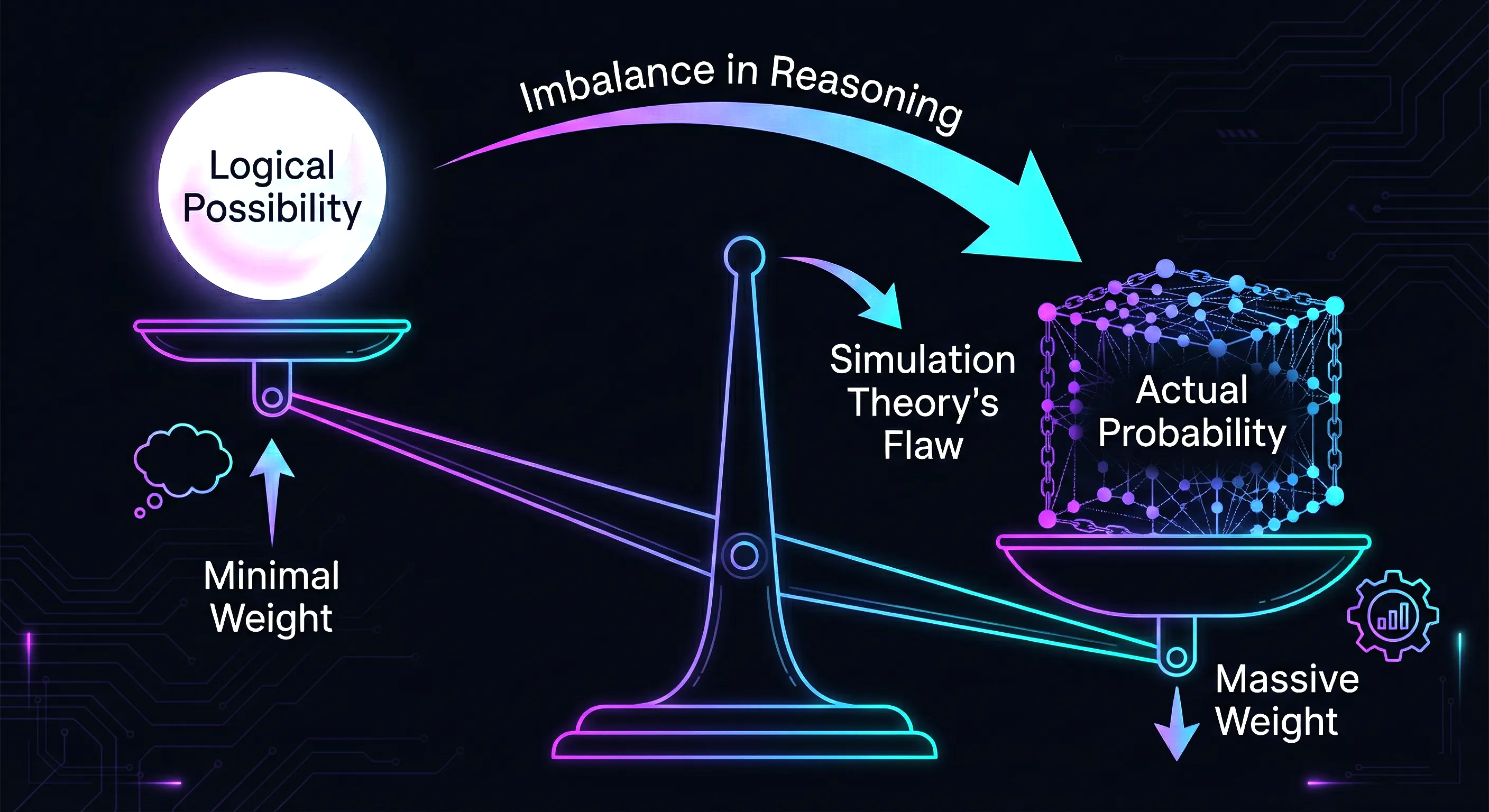
The danger isn’t believing the hypothesis. It’s confusing logical possibility with probability. Just because something is logically possible doesn’t mean it’s likely. It’s logically possible that invisible unicorns exist. That doesn’t make it a 50-50 bet. The same cognitive biases that sabotage your everyday decisions are working overtime here.
How to Think Clearly About Simulation Theory
You don’t have to reject simulation theory entirely. But you can learn to think about it without letting your biases run the show. Here are five steps.
-
Separate fascination from belief. It’s fine to find the idea interesting. Interesting doesn’t mean true. You can enjoy the thought experiment without treating it as a conclusion.
-
Notice your confirmation bias. When you see a “glitch in the matrix,” ask yourself how many non-glitchy moments you ignored today. Mathematician J.E. Littlewood calculated that you experience about one million events every 35 days. A one-in-a-million coincidence should happen roughly once a month.
-
Check the unfalsifiability trap. If no evidence could ever disprove your belief, that’s not a strength of the argument. It’s a weakness. Real scientific hypotheses make predictions that can be tested and potentially shown wrong. Astrophysical analysis suggests the computational resources required to run a realistic simulation of our universe would exceed anything physically possible.[5]
-
Question the authority appeal. Elon Musk believes it. So what? Smart people believe wrong things all the time. Evaluate the argument on its own merits, not on who said it.
-
Distinguish logical possibility from probability. Many things are logically possible. Very few are probable. The simulation hypothesis is an interesting philosophical thought experiment. But “interesting” and “likely” are two completely different things.
“The monthly miracle is called Littlewood’s Law. More often than not, apophenia is the result of the most dependable of all delusions: the confirmation bias.” - David McRaney, You Are Not So Smart
Recommended read: You Are Not So Smart by David McRaney. A witty and eye-opening tour of 48 cognitive biases you didn’t know you had.
What Your Brain Really Wants Is Meaning
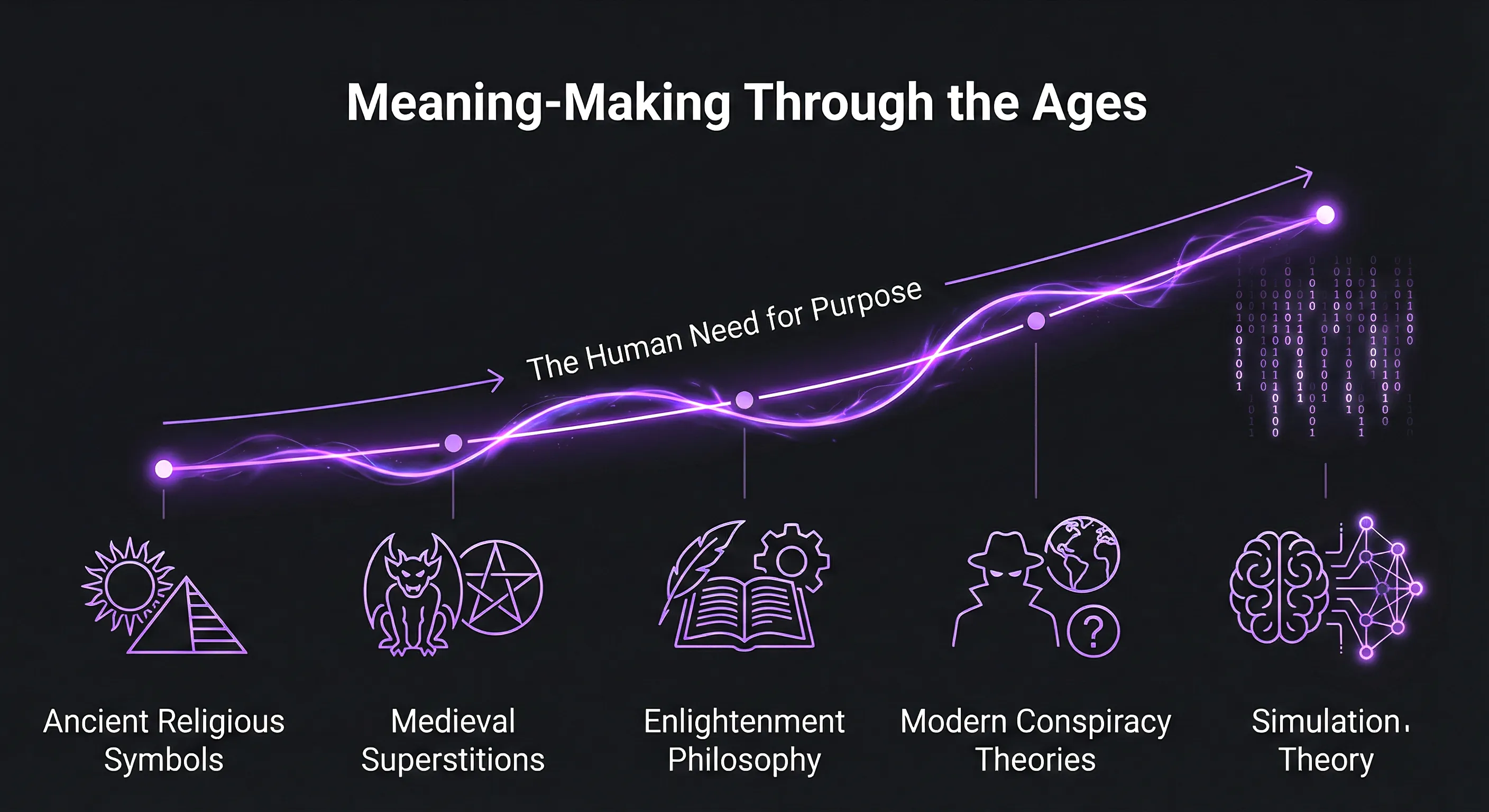
The deepest reason simulation theory appeals to us has nothing to do with logic or evidence. It’s about meaning.
If we’re in a simulation, someone built this. Someone designed it. Your life isn’t random. It’s part of a program, a plan, a purpose. That idea is incredibly comforting in a universe that doesn’t hand out easy answers.
This is the same psychological need that drives religious belief, superstition, and conspiracy theories. As Brian Klaas writes, “Superstition is the daughter of the unexplained and the apparently random. We invent it to deal with causal uncertainty.” Simulation theory is the 21st century version of this ancient impulse. It’s creationism for the tech-savvy.
Research on the psychological effects of simulation belief found both upsides and downsides.[4] For some people, the idea reduces existential anxiety. If reality is designed, there’s a kind of comfort in that. For others, it increases nihilism. If nothing is “real,” nothing matters. The same belief can heal or harm depending on your psychological starting point.
That doesn’t make you foolish for finding it compelling. It makes you human. Your brain evolved to seek patterns, construct stories, and demand explanations. Those traits helped your ancestors survive. They also make you vulnerable to believing things that feel true but aren’t.
The most honest position? We don’t know if this is a simulation. We probably can’t know. And that uncertainty is okay. You don’t need the universe to be “designed” for your life to have meaning. The patterns you create, the connections you build, the choices you make. Those are real, regardless of what’s running underneath.
Recommended read: Nobody’s Fool by Daniel Simons and Christopher Chabris. Practical tools for recognizing when your intuitions are deceiving you and what to do about it.
Sources
Introduction
1. Are You Living in a Computer Simulation? (Philosophical Quarterly, 2003)