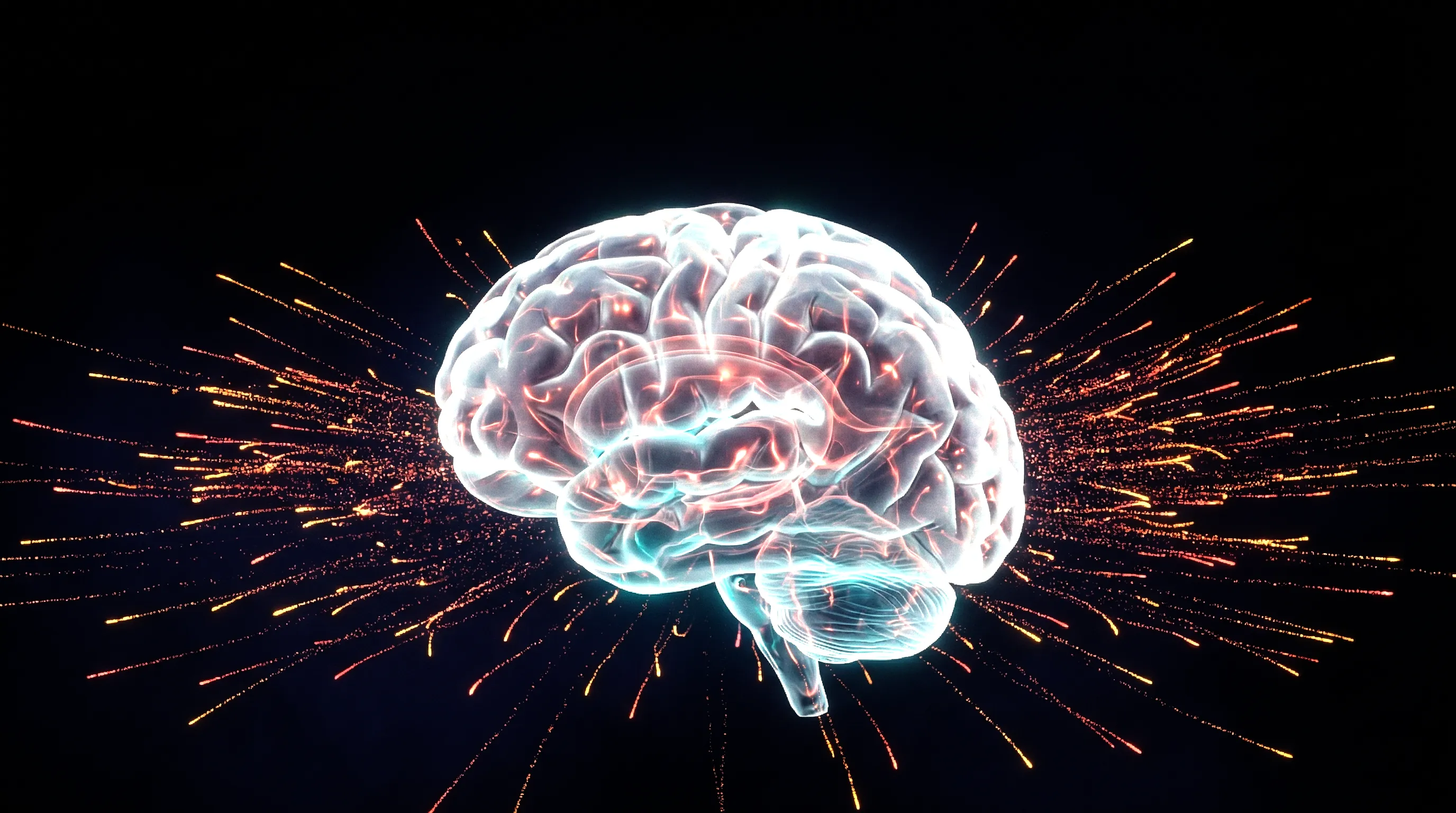
Your brain is literally glowing right now. Not in some poetic, motivational-poster way. It’s producing real, measurable light.
In 2025, a team of researchers did something nobody had pulled off before. They detected tiny bursts of light coming from the human brain, passing right through the skull. The light changed depending on what the person was thinking about.
This isn’t science fiction. It’s a peer-reviewed study published in the journal iScience. And it could change how we understand the brain forever.
Your Brain Produces Light, and We Can Finally See It
Every living cell in your body produces a faint glow. These tiny particles of light are called biophotons. They’re a byproduct of the chemical reactions happening inside your cells, especially in your mitochondria, the tiny power plants that keep you alive.
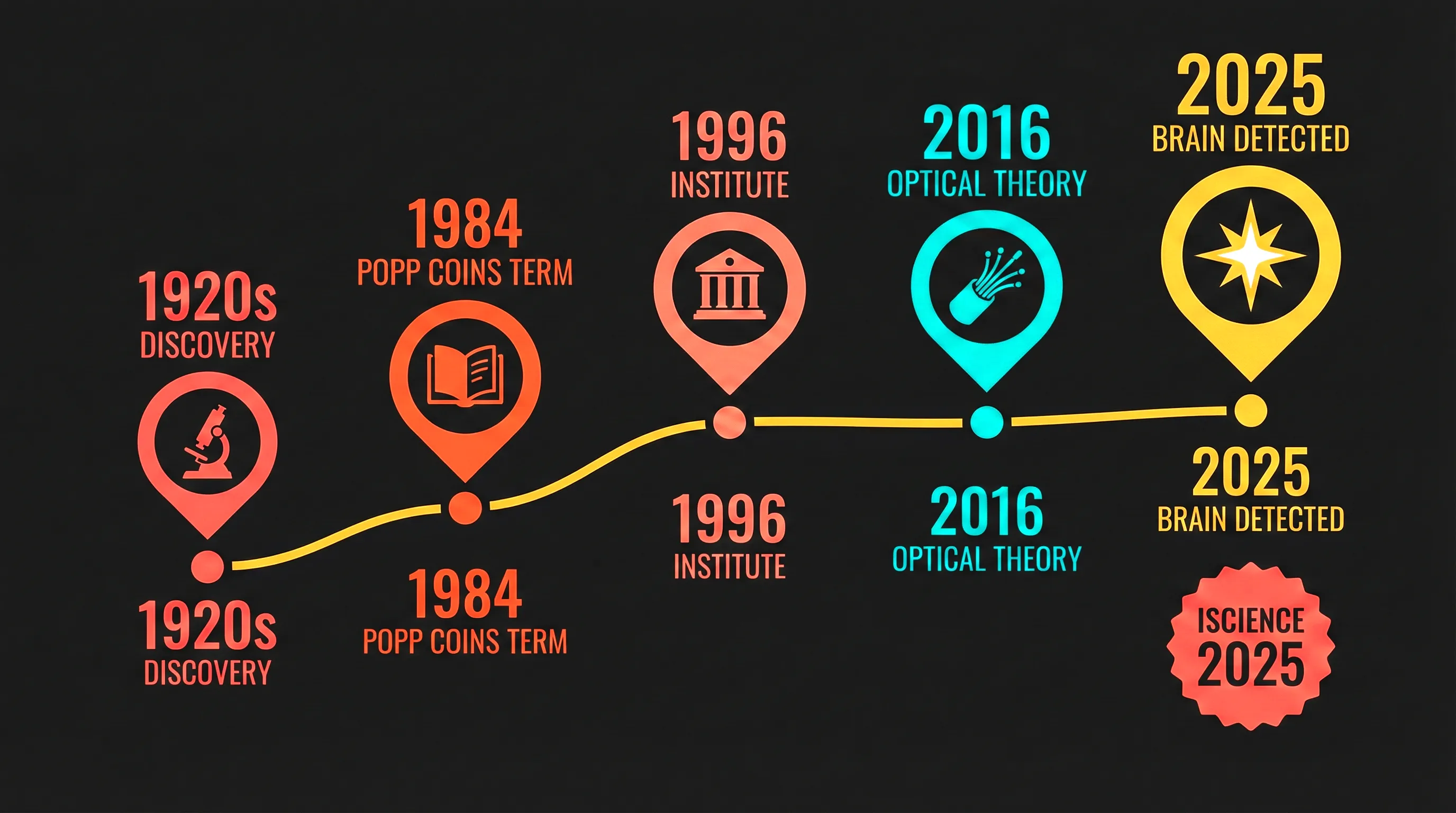
Scientists have known about biophotons since the 1920s. The German biophysicist Fritz-Albert Popp coined the actual term “biophoton” in 1984 and spent decades proving that all living organisms emit this ultraweak light.[1]
But here’s the thing. Nobody had ever measured these photons coming from a living human brain. Not through the skull. Not in real time.
That changed in February 2025. A research team led by Nirosha Murugan at Algoma University published a groundbreaking study in iScience.[2] They called their new technique photoencephalography. Think of it like an EEG, but instead of measuring electrical signals, it measures light.
Here’s what makes this such a big deal:
- 20 volunteers sat in a completely dark room
- They wore EEG caps to measure brainwaves
- Photomultiplier tubes (devices sensitive enough to detect a single photon) were aimed at their skulls
- A control detector pointed at a blank wall to capture background light
- The brain’s photon emissions were statistically different from background noise
The photons were real. They were coming from the brain. And they weren’t random.
“Brain UPEs differ from background light in spectral and entropic properties, respond dynamically to tasks and stimulation, and correlate moderately with brain rhythms.” - Casey et al., iScience, 2025
Recommended read: The Experience Machine by Andy Clark. A deep dive into how your brain constantly predicts and constructs reality from signals just like these.
What Makes Your Brain Glow
So where does this light actually come from? The answer lives inside your cells.
Your brain is the most energy-hungry organ in your body. It uses about 20% of your total energy despite being only 2% of your body weight. All that energy processing creates byproducts, including light.
The primary source is oxidative metabolism in your mitochondria. When your cells burn fuel to produce energy, they generate molecules called reactive oxygen species (ROS). These are unstable molecules with extra electrons. When those electrons return to their normal energy state, they release tiny bursts of light.
Think of it like sparks flying off a grinding wheel. The grinding wheel is your brain’s metabolism. The sparks are biophotons.
Here’s a breakdown of how it works:
| Step | What Happens | Result |
|---|---|---|
| 1 | Mitochondria produce energy (ATP) | Reactive oxygen species form |
| 2 | ROS interact with cell molecules | Electrons get excited to higher energy levels |
| 3 | Excited electrons return to normal | Energy released as photons (light) |
| 4 | Photons pass through neural tissue | Detectable outside the skull |
The light your brain produces falls in the 200 to 800 nanometer wavelength range.[3] That covers ultraviolet through visible light. But it’s incredibly faint. We’re talking about individual photons, far too dim for your eyes to detect.
Your brain emits significantly more biophotons than many other cell types in your body. That makes sense when you consider how metabolically active neural tissue is. More energy burned means more reactive oxygen species. More reactive oxygen species means more light.
- Neurotransmitter release triggers biophoton spikes
- Biophysical stimulation of neurons increases emissions
- Even neurons at rest produce a baseline glow
- The emissions are coherent, meaning they share properties with laser light[3]
That last point is especially interesting. Coherent light carries information in a highly organized way. Some researchers think this isn’t just metabolic waste. It might actually mean something.
Different Thoughts Produce Different Light
Here’s where the study gets really wild. The light patterns changed depending on what the person was doing.
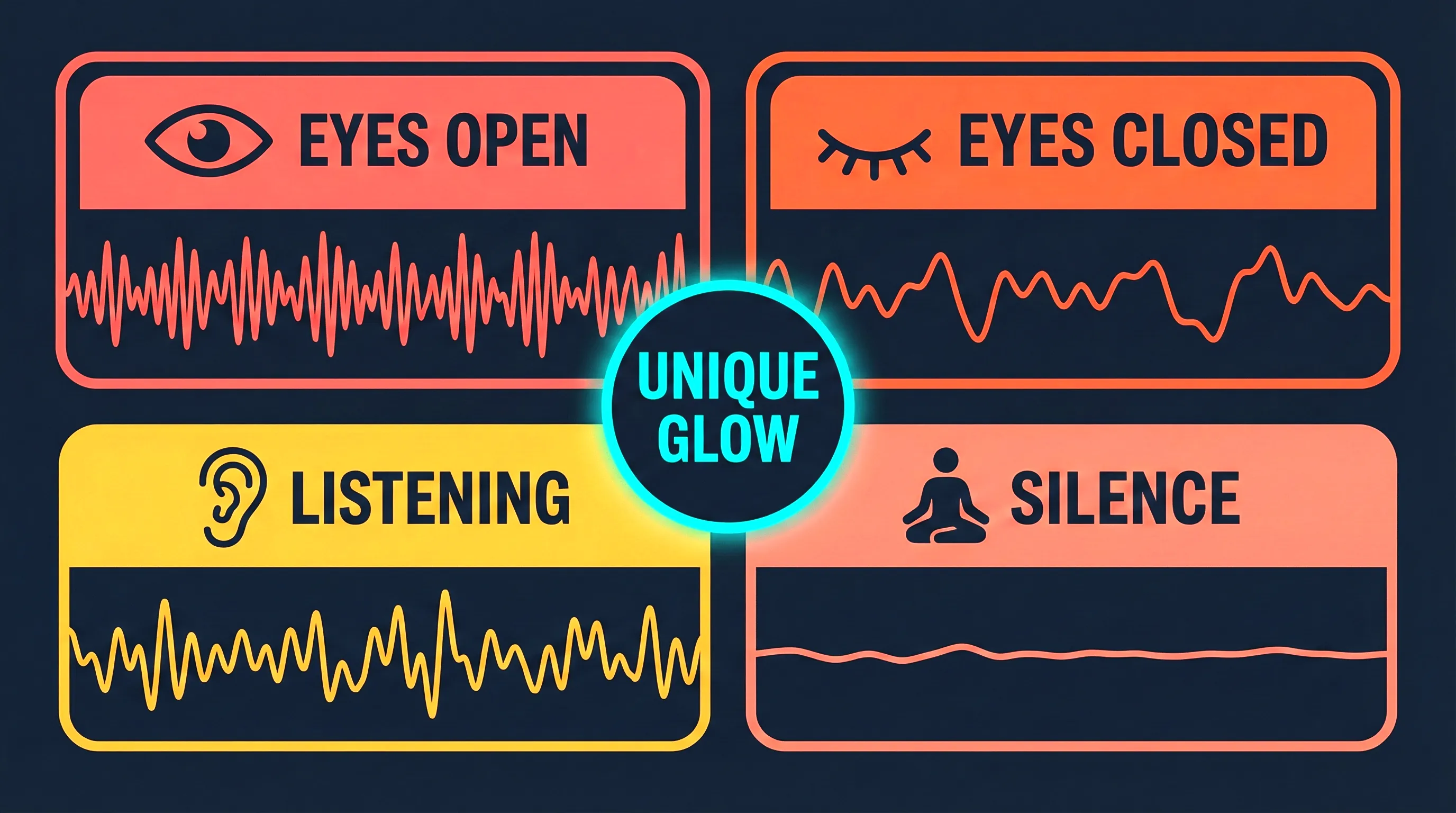
In the experiment, participants cycled through several cognitive tasks while sitting in total darkness. They sat quietly with their eyes open. Then closed. Then they listened to rhythmic sounds.
Each time the task changed, the biophoton emissions changed too.
The temporal lobe showed one activity pattern when subjects listened to music. It showed a completely different pattern when they sat in silence. The occipital lobe (your visual processing center) behaved differently depending on whether eyes were open or closed.
But the relationship wasn’t simple. More electrical activity in a brain region didn’t automatically mean more light from that area. The researchers noted that the pattern was more complex than a direct one-to-one mapping.
This tells us something important. Biophotons might be tracking a different kind of brain activity than what EEG measures. Electrical signals show us neural firing patterns. Biophotons show us metabolic activity. These are related but not identical processes.
Some key findings from the study:
- Eyes open vs. closed produced measurably different photon patterns
- Auditory tasks changed emissions in the temporal region
- Emissions correlated moderately with EEG brainwave rhythms
- The relationship between electrical and optical activity is non-linear
Your brain is already the most complex object we know of in the universe. It processes information through electrical signals, chemical neurotransmitters, and magnetic fields. Now we can add light to that list. Your thoughts don’t just spark electrical impulses. They might also cast a faint glow.
Your brain constructs different experiences from the same physical reality. The mechanisms behind that are just as strange as the biophotons themselves.
Recommended read: The Balanced Brain by Camilla Nord. This neuroscientist explains how your brain’s metabolic processes shape everything from mood to mental health.
Could Brain Light Unlock the Mystery of Consciousness
The biophoton discovery has some researchers asking a much bigger question. Could light be part of how the brain actually processes information?
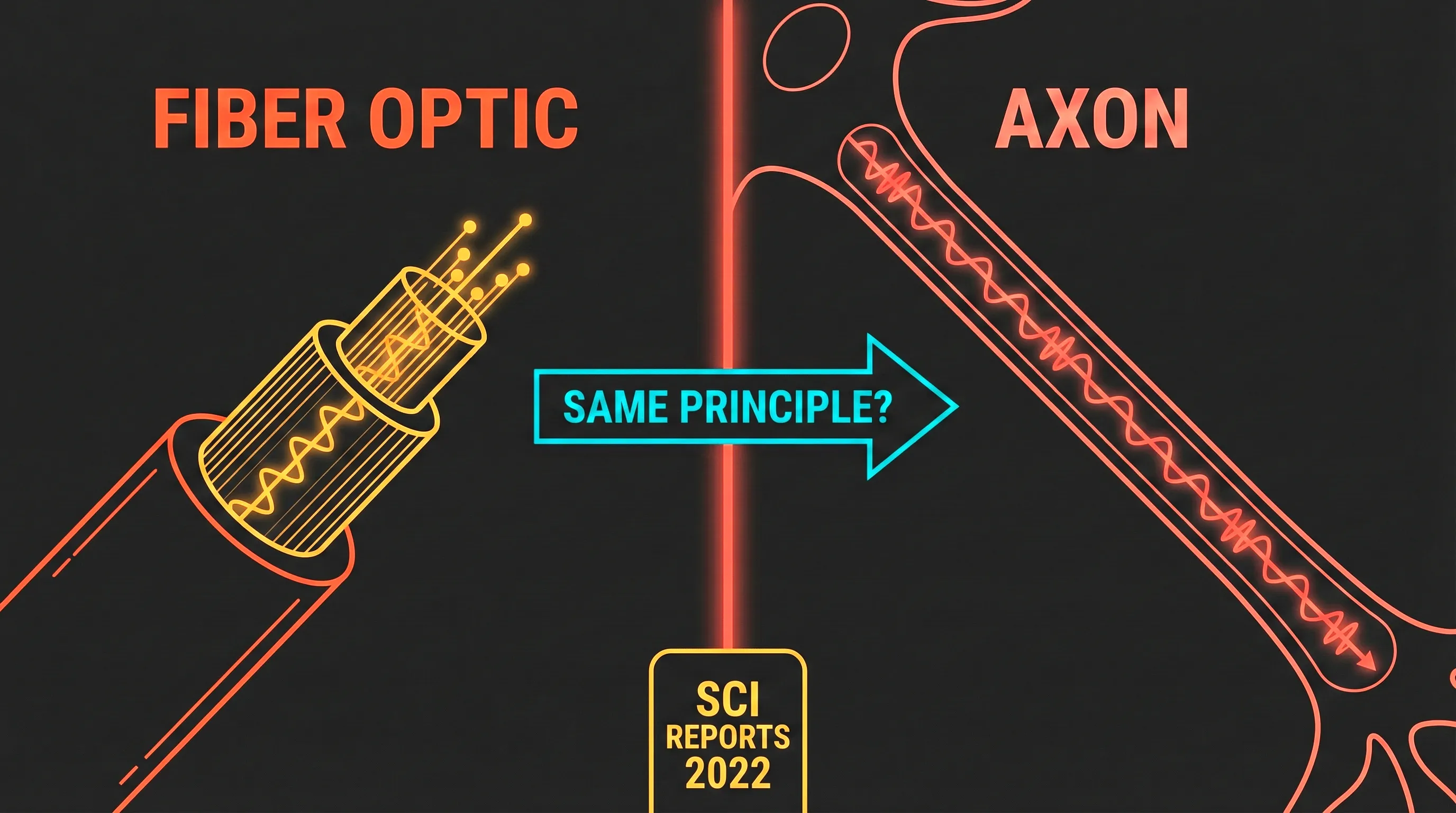
This isn’t as far-fetched as it sounds. A 2022 study published in Scientific Reports explored whether photons could travel through axons (the long fibers connecting neurons) the same way signals travel through fiber optic cables.[4] The researchers found that neural tissue has the right properties to guide light.
If biophotons can travel through neural pathways, they could theoretically carry information between brain regions. This would add an entirely new communication channel on top of the electrical and chemical signaling we already know about.
Some researchers connect this to theories about quantum biology and consciousness. The fact that biophotons exhibit coherence, a property they share with laser light, suggests they could carry information in a highly ordered form. This opens the door to ideas about quantum effects playing a role in how your brain creates conscious experience.
A 2025 review article in Frontiers in Systems Neuroscience proposed a working model of biophotonic signaling in the brain.[5] The authors suggested that coherent electromagnetic energy could be transmitted through connective tissue, which has a liquid crystal structure capable of conducting electromagnetic signals.
Here’s what scientists are currently debating:
- Signal or noise? Are biophotons carrying information, or are they just metabolic exhaust?
- Optical communication channels. Could neurons use light to communicate alongside electrical signals?[6]
- Quantum coherence. Does the organized nature of biophotons hint at quantum processes in the brain?
- Consciousness substrate. Could light-based signaling explain aspects of awareness that electricity alone can’t?
This is still early-stage science. We don’t know if biophotons play any functional role in cognition. But the fact that they exist, change with mental activity, and show coherence properties is enough to warrant serious investigation.
The idea that your brain might use light to process information connects to some of the deepest questions about why your brain wants to believe certain things about reality.
Recommended read: Why We Remember by Charan Ranganath. This memory researcher explores the brain mechanisms behind how we encode and retrieve experiences, processes that might involve more than just electrical signals.
What Comes Next for Brain Light Research
The researchers who coined the term photoencephalography see a future where measuring brain light becomes a standard clinical tool. But we’re not there yet.
Right now, there are some serious practical hurdles. The photon emissions are incredibly faint. You need a completely dark room and extremely sensitive detectors. The signal-to-noise ratio is still challenging. And we need much larger studies to confirm these early findings.
But the potential applications are exciting:
- Non-invasive brain monitoring. Unlike fMRI, photoencephalography doesn’t require a massive magnet or expensive equipment. It’s completely passive.
- Oxidative stress tracking. Since biophotons are linked to reactive oxygen species, they could serve as a real-time window into brain health and aging.[7]
- Neurodegeneration detection. Diseases like Alzheimer’s involve increased oxidative stress. Biophoton monitoring might catch early warning signs.
- Consciousness monitoring. Tracking brain light during sleep and anesthesia could reveal new insights about awareness.
- Mental health applications. Depression and anxiety are linked to oxidative stress. Light-based monitoring could complement existing diagnostic tools.
There are also therapeutic possibilities. Photobiomodulation, which involves using specific wavelengths of light to stimulate cellular function, already shows early promise for treating depression, anxiety, and PTSD. Understanding biophotons better could make these treatments more targeted. In a related breakthrough, researchers found that flickering light at 40Hz can actually slow Alzheimer’s progression by triggering the brain’s waste-clearance system.
The field of biophoton research is small but growing. The iScience study was a proof of concept. It showed that brain light can be detected from outside the skull and that it responds to cognitive activity. Future studies will need to figure out exactly what the light is telling us.
What we know for sure is this. Your brain is doing something remarkable right now that has nothing to do with electricity or chemistry. It’s producing light. Faint, measurable, task-dependent light. And we’re just beginning to understand what that means.
If you’re curious about other surprising ways your brain creates sensory experiences, check out why music gives you literal chills.
Recommended read: The Creative Brain by Anna Abraham. A neuroscience-based look at how creative thinking works in the brain, including the metabolic processes that fuel it.

Sources
Your Brain Produces Light, and We Can Finally See It
1. Fritz-Albert Popp (Wikipedia)
2. Exploring Ultraweak Photon Emissions as Optical Markers of Brain Activity (iScience, 2025)
What Makes Your Brain Glow
3. Ultra Weak Photon Emission: A Brief Review (Frontiers in Physiology, 2024)
Could Brain Light Unlock the Mystery of Consciousness
6. Possible Existence of Optical Communication Channels in the Brain (Scientific Reports, 2016)
What Comes Next for Brain Light Research
Additional References
8. Exploring Ultraweak Photon Emissions as Optical Markers of Brain Activity (PubMed, 2025)
9. Your Brain Is Glowing, and Scientists Can’t Figure Out Why (Scientific American, 2025)
10. Biophotons May Shed New Light on Body and Brain Activity (Psychology Today, 2025)
11. The Illuminating Science of Biophotons (Psychology Today, 2025)
12. Fascinating New Neuroscience Study Shows the Brain Emits Light Through the Skull (PsyPost, 2025)