You’ve probably heard the claim a hundred times. Your brain finishes developing at 25. Parents repeat it. Teachers cite it. TikTok therapists build entire careers around it.
There’s just one problem. It was never true.
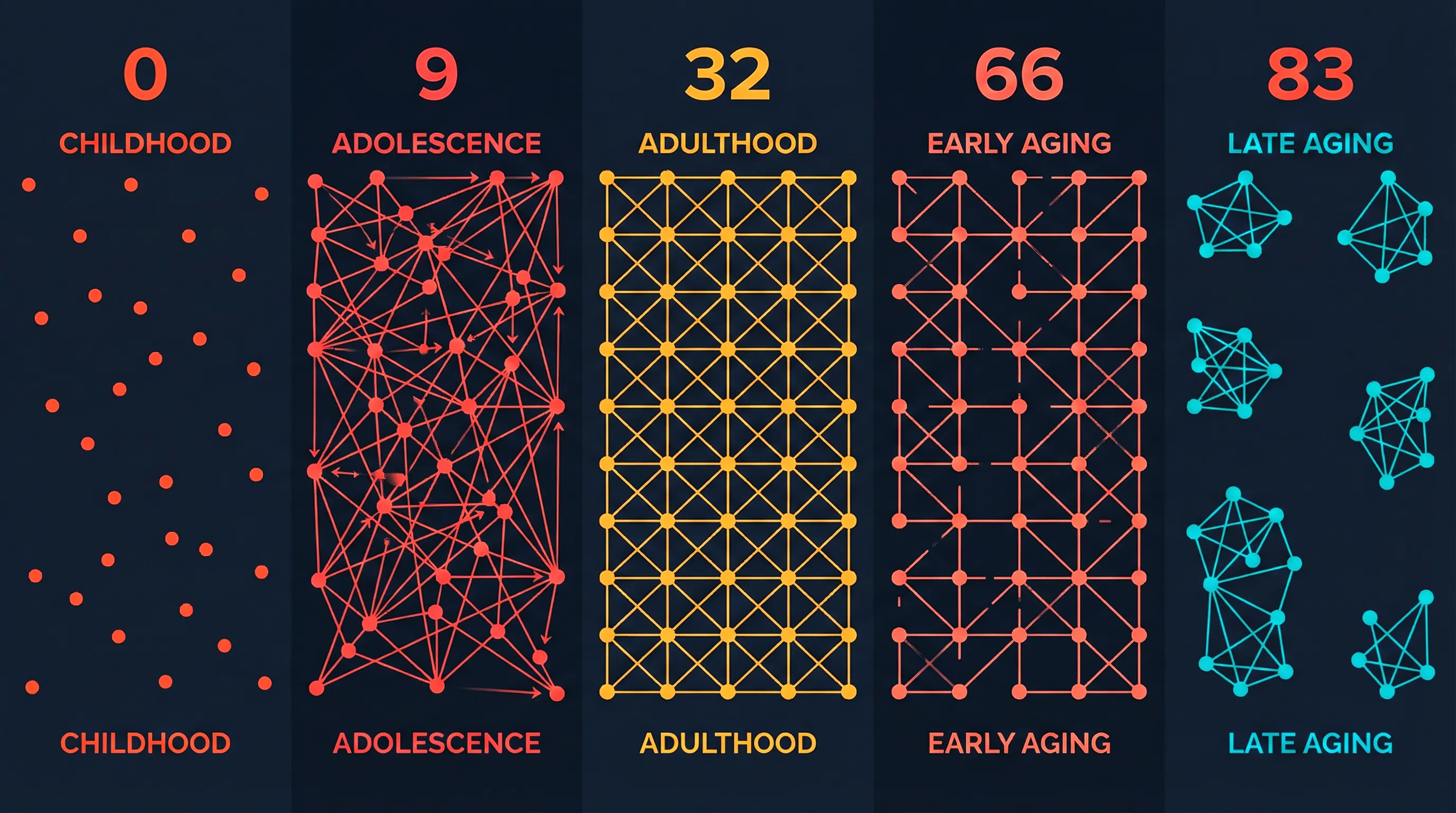
A massive 2025 study from the University of Cambridge scanned the brains of over 4,200 people from birth to age 90.[1] What they found rewrites everything you thought you knew about when your brain grows up. The real number isn’t 25. It’s 32. And the implications are staggering.
The Largest Brain Wiring Study Ever Conducted
Dr. Alexa Mousley and her team at Cambridge’s MRC Cognition and Brain Sciences Unit pulled off something nobody had done before. They mapped the brain’s structural wiring across the entire human lifespan, from newborns to 90-year-olds.[2]
The study used diffusion MRI scans from 4,216 people.[1] This type of brain imaging tracks how water molecules move through brain tissue. That movement reveals the hidden architecture of your neural connections, the wiring that makes you who you are.
Researchers analyzed 12 different measures of brain organization using a mathematical approach called graph theory.[3] Think of it like mapping a city’s road network. Some roads connect neighborhoods locally. Others are highways linking distant regions. The researchers tracked how both types of connections changed across every age.
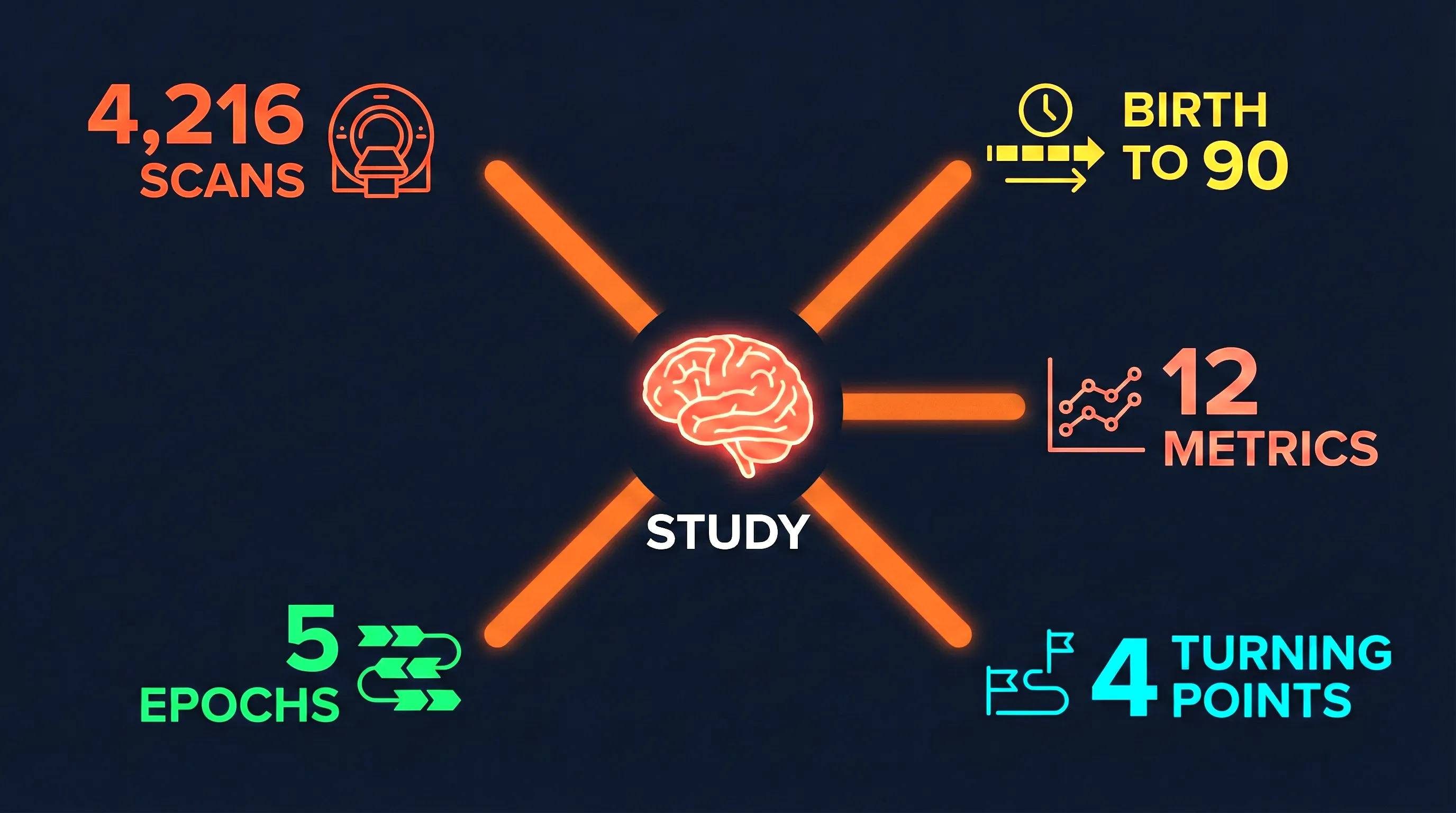
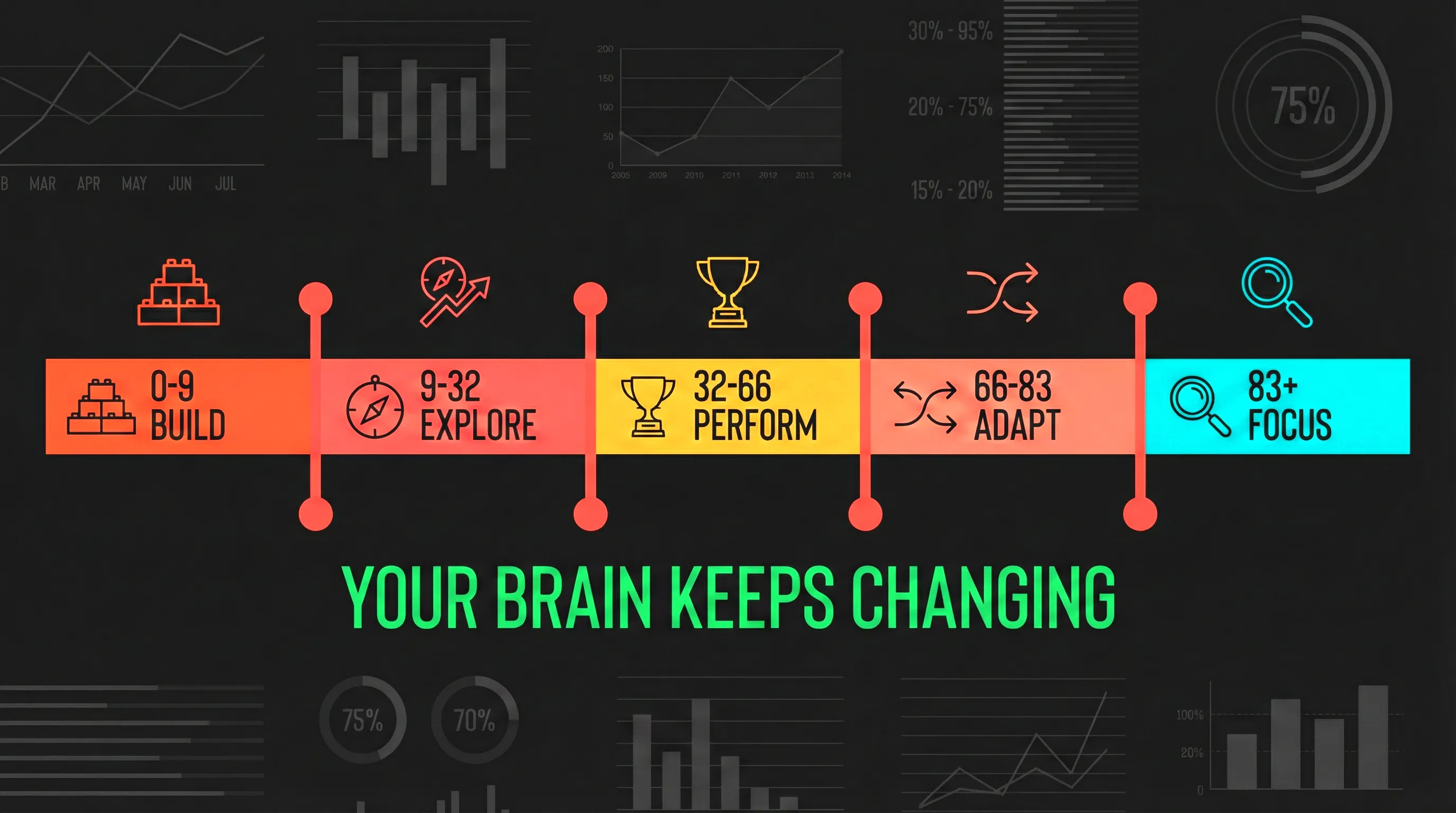
What they found wasn’t a smooth, gradual curve. Your brain doesn’t slowly build up and then slowly decline. Instead, it goes through five distinct epochs, separated by four dramatic turning points.[4]
- Turning point 1: Around age 9
- Turning point 2: Around age 32, the strongest shift of all
- Turning point 3: Around age 66
- Turning point 4: Around age 83
“Around the age of 32, we see the most directional changes in wiring and the largest overall shift in trajectory, compared to all the other turning points.” — Dr. Alexa Mousley, University of Cambridge
This isn’t a minor adjustment at 32. It’s the single biggest structural reorganization your brain will ever undergo.[5] And almost nobody is talking about it.
Recommended read: The Balanced Brain by Camilla Nord — A neuroscientist explains what’s actually happening inside your brain at every stage of life and how it shapes your mental health.
The Five Eras of Your Brain
Your brain doesn’t age on a gentle slope. It moves through five distinct phases, each with its own signature wiring pattern. Here’s what happens in each era.
| Brain Era | Age Range | What’s Happening |
|---|---|---|
| Childhood | Birth to ~9 | Rapid connection building, local networks forming fast |
| Adolescence | ~9 to ~32 | Rising efficiency, global connectivity increasing |
| Adulthood | ~32 to ~66 | Peak stability, longest and most stable era |
| Early Aging | ~66 to ~83 | Gradual reorganization, white matter begins declining |
| Late Aging | ~83+ | Shift from global to local connectivity |
Childhood, Birth to Age 9
Your brain starts life by building connections at a furious pace. Local networks form rapidly as you learn to walk, talk, and make sense of the world around you. The wiring is chaotic but essential. Every new experience creates new pathways. This is also the period most vulnerable to environmental factors. Research shows that poverty can physically shrink developing brain regions responsible for language, impulse control, and memory.
Adolescence, Age 9 to 32
Here’s the finding that shocked the researchers. The adolescent era doesn’t end in your teens. It stretches all the way to your early thirties.
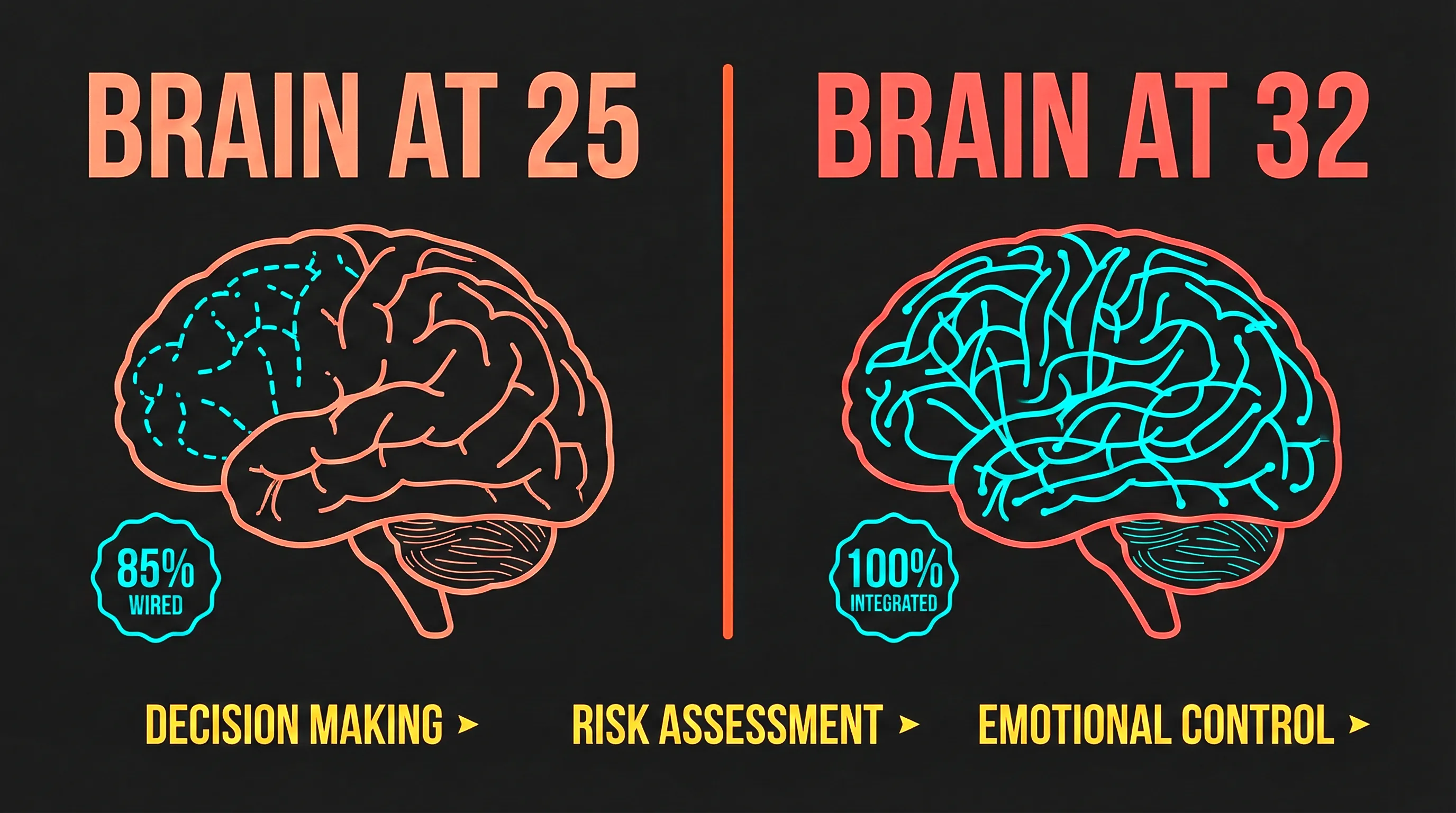
During this era, your brain is doing something it will never do again. Neural efficiency is increasing.[6] Signals move faster both within specific brain regions and across the entire brain. Your wiring is getting optimized for complex thinking, emotional regulation, and long-term planning.
This is the only era where efficiency is actively rising. After 32, your brain maintains what it’s built. But the building phase is done.
- White matter connections continue strengthening through your 20s[12]
- The prefrontal cortex doesn’t fully integrate until around 32
- Decision-making networks are still being fine-tuned past 25
- Emotional regulation circuits keep developing into the early 30s[11]
Adulthood, Age 32 to 66
Once your brain hits 32, something remarkable happens. It stabilizes. This is the longest era, stretching over three decades with no major turning points. Your brain’s architecture holds steady, supporting peak cognitive performance, career achievements, and deep relationships.
As research on aging and the brain shows, this plateau phase is actually good news. Your brain isn’t declining in your 30s and 40s. It’s coasting at full power.
Early Aging, Age 66 to 83
Around 66, your brain starts a gradual reorganization. White matter begins to degenerate, and overall connectivity slowly decreases. But this isn’t the catastrophic decline that popular culture warns about. It’s a measured transition that unfolds over nearly two decades.
Late Aging, Age 83 and Beyond
The final turning point arrives around 83. Your brain shifts from relying on global, whole-brain networks to leaning more heavily on local, regional connections. Long-distance communication highways weaken. But local circuits can still function well.
Recommended read: Why We Remember by Charan Ranganath — A memory neuroscientist reveals why your brain holds onto certain experiences and lets others go, and how each life era shapes what you remember.
The “Brain Matures at 25” Myth, Debunked
So where did the number 25 come from? And why has it been so hard to kill?
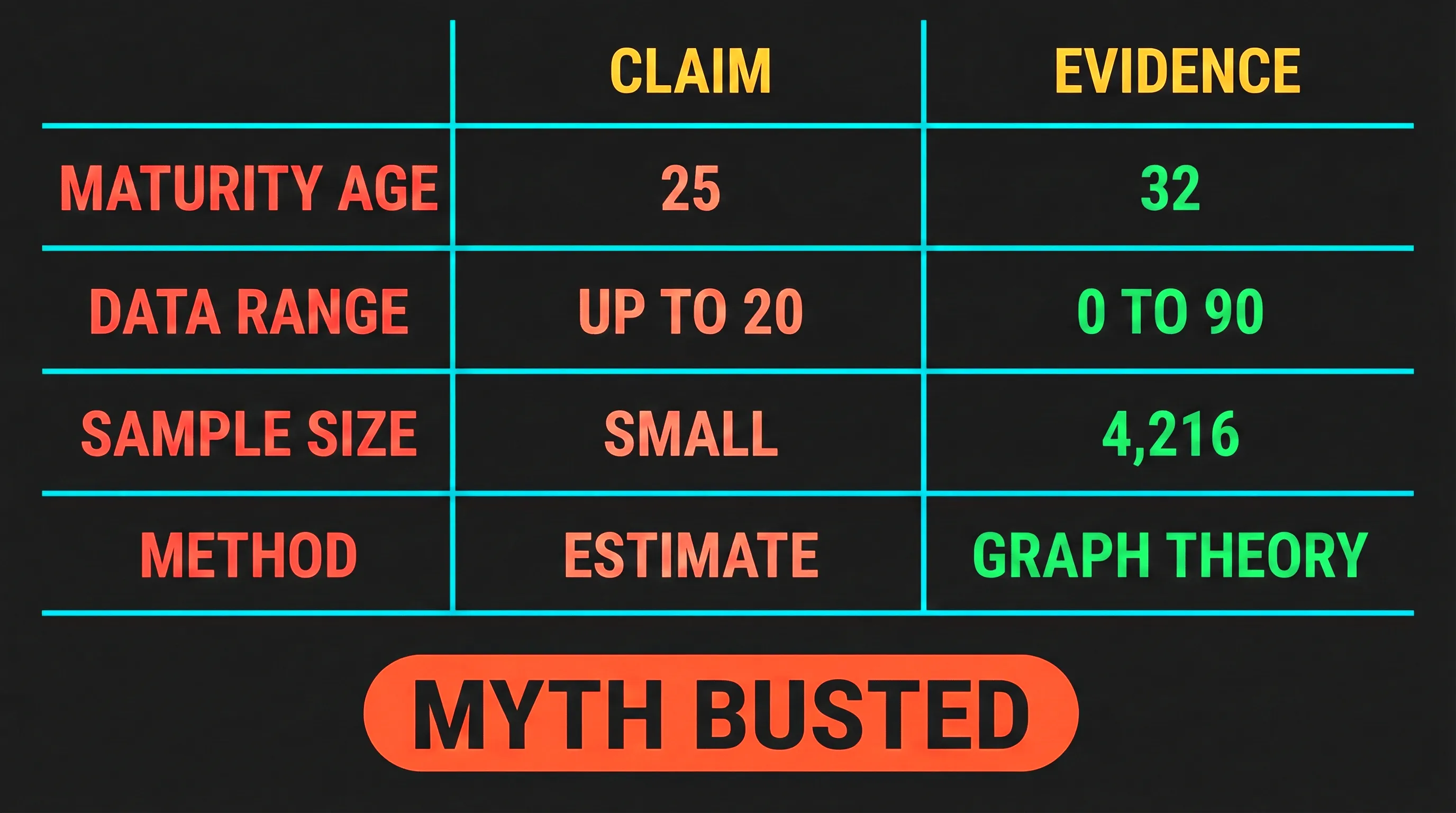
It traces back to brain imaging studies from the late 1990s and early 2000s. Neuroscientist Nitin Gogtay led an influential study that scanned children’s brains every two years starting at age four.[9] The team found that brain regions mature from back to front. More primitive areas develop first. The prefrontal cortex, responsible for judgment, impulse control, and planning, developed last.
But here’s the critical detail everyone ignores. The study stopped scanning participants around age 20. The researchers couldn’t say when development actually finished. They estimated it might be around 25. That estimate became a fact in popular culture.
- The original studies ended data collection around age 20
- Researchers estimated development continued to about 25
- Pop culture turned the estimate into a hard deadline
- Social media amplified the myth until it became “common knowledge”
- No major study has ever confirmed 25 as a precise cutoff
A 2022 article in Slate traced how the “25 myth” spread.[7] As researchers’ cautious estimates got passed from news articles to blog posts to TikTok videos, the nuance evaporated entirely. A rough guess became gospel.
McGill University’s Office for Science and Society called the 25 number “an oversimplification based on incomplete data.”[8] They pointed out that brain maturation is not a single event that happens at one age. Different systems mature at different rates. And individual variation is enormous.
The Cambridge study finally puts numbers behind what neuroscientists have suspected for years.[10] Your brain’s structural wiring doesn’t reach its peak configuration until about 32. The 25 myth was off by seven years, and it was based on studies that never even measured what they claimed to prove.
“Understanding that the brain’s structural journey is not a question of steady progression, but rather one of a few major turning points, will help us identify when and how its wiring is vulnerable to disruption.” — Prof. Duncan Astle, University of Cambridge
Research on personality change confirms what the Cambridge team found. Your personality traits continue shifting well into your 30s because the brain structures underlying them are still developing.
What This Means for Your Life
This isn’t just an academic debate about brain scans. The gap between 25 and 32 has real consequences for how you make decisions, handle emotions, and plan your future.
Your 20s Aren’t What You Think
If your brain is still in its adolescent wiring phase until 32, it explains a lot about the chaos of your 20s. The impulsive career switches. The on-and-off relationships. The feeling that you should have everything figured out but somehow don’t.
You don’t have it figured out because your brain is literally still under construction. And that’s normal.
- Career decisions before 32 are made with an incomplete neural architecture
- Risk assessment networks are still being optimized in your late 20s
- Emotional regulation circuits don’t reach peak integration until your early 30s
- The pressure to “have it all together by 25” is based on bad science
Decision-Making Gets Better With Time
Your prefrontal cortex handles complex judgment calls. Since it doesn’t fully integrate into your brain’s network until around 32, your best decision-making years start later than you think.
This doesn’t mean people under 32 can’t make good decisions. But it does mean the neural infrastructure for weighing long-term consequences against short-term rewards reaches its peak configuration in the early 30s.
Legal and Policy Implications
The 25 myth has influenced criminal justice, insurance rates, military policy, and car rental rules. If the actual turning point is 32, we may need to rethink some of these frameworks.
| Area | Current Standard | What the Science Suggests |
|---|---|---|
| Brain maturity benchmark | 25 | 32 |
| Full car rental eligibility | 25 | Could shift higher |
| Criminal sentencing considerations | Under 25 mitigated | May need to extend |
| Insurance risk assessment | 25 threshold | 32 is more accurate |
Mental Health Windows
The turning points at 9 and 32 are periods when your brain is most actively reorganizing. That means these ages may also represent windows of vulnerability for mental health conditions. Understanding when your brain is in transition can help you seek the right support at the right time.
Recommended read: Rewire by Nicole Vignola — A neuroscientist’s practical toolkit for rewiring your brain at any age, with techniques grounded in how neural plasticity actually works.
As research on how memory works has shown, even your ability to form accurate memories shifts across these brain eras.
Your Brain Is Never Finished Changing
The Cambridge study reveals something both humbling and hopeful. Your brain is never truly “done.” It’s always in one of five eras, always reorganizing, always adapting.
The adolescent era stretches to 32. But that doesn’t mean everything stops after that. Your adult brain remains remarkably stable for three decades. And even as aging reshapes your neural networks after 66, your brain finds new ways to compensate.
What matters most isn’t hitting some magic age. It’s understanding where you are in your brain’s journey and working with it, not against it.
- Under 32? Your brain is still building. Give yourself grace. Take risks. Your neural efficiency is still climbing.
- 32 to 66? You’re in the longest stable era. This is your peak operating window. Use it.
- Over 66? Your brain is reorganizing, not collapsing. Local networks can compensate for global changes.
The old story was simple. Your brain grows, peaks, and declines. The real story is far more interesting. Your brain transforms through distinct chapters, each with its own strengths, each with its own purpose.
The researchers at Cambridge gave us a new map. Now it’s up to you to navigate it.
Recommended read: Me, But Better by Olga Khazan — An award-winning journalist tests whether you can actually change your personality, drawing on the latest brain science about neural plasticity and personal growth.
Sources
The Largest Brain Wiring Study Ever Conducted
1. Topological turning points across the human lifespan (Nature Communications, 2025)
2. Scientists identify five ages of the human brain over a lifetime (University of Cambridge, 2025)
3. Scientists Identify Five Distinct Eras of Human Brain Aging (Scientific American, 2025)
4. Scientists identify 4 key turning points for your brain as you age (National Geographic, 2025)
5. Human brains have 5 distinct epochs in a lifetime (NBC News, 2025)
The Five Eras of Your Brain
6. Your Brain Goes Through Five Distinct Epochs (Smithsonian Magazine, 2025)
The “Brain Matures at 25” Myth, Debunked
7. Brain development: The myth the brain matures when you’re 25 (Slate, 2022)
8. Is 25 Really the Magic Number? (McGill University, 2024)
9. No, your brain doesn’t suddenly fully develop at 25 (The Conversation, 2025)
10. Your Brain Quietly Rewires Itself at 9, 32, 66 and 83 (Neuroscience News, 2025)
What This Means for Your Life
11. Brain development may continue into your 30s (ScienceDaily, 2026)
12. White matter connections may drive adolescent cognitive gains (Nature Neuroscience, 2025)