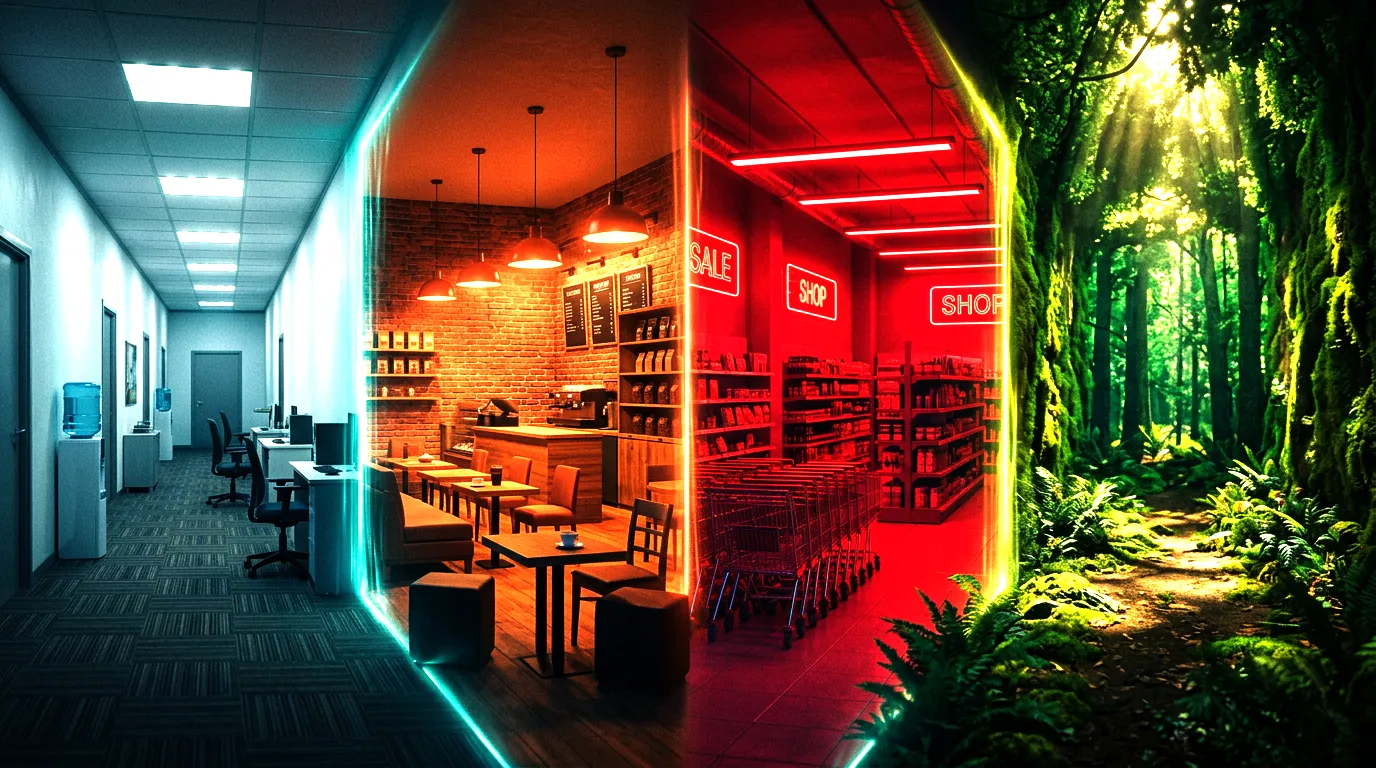
You walk into a coffee shop and immediately feel relaxed. You enter a big box store and start grabbing things you never planned to buy. You sit in a windowless conference room and can’t think straight.
None of this is random. Every one of those reactions was engineered.
Environmental psychology is the study of how physical spaces shape your thoughts, feelings, and actions. And once you understand it, you’ll never look at a room the same way again. The colors on the walls, the height of the ceiling, the direction of the light. All of it is nudging your brain in ways you don’t notice.
The Hidden Power of the Rooms You Sit In
Your brain is constantly reading your environment. It does this automatically, below conscious awareness. And what it finds changes everything about how you think and feel.
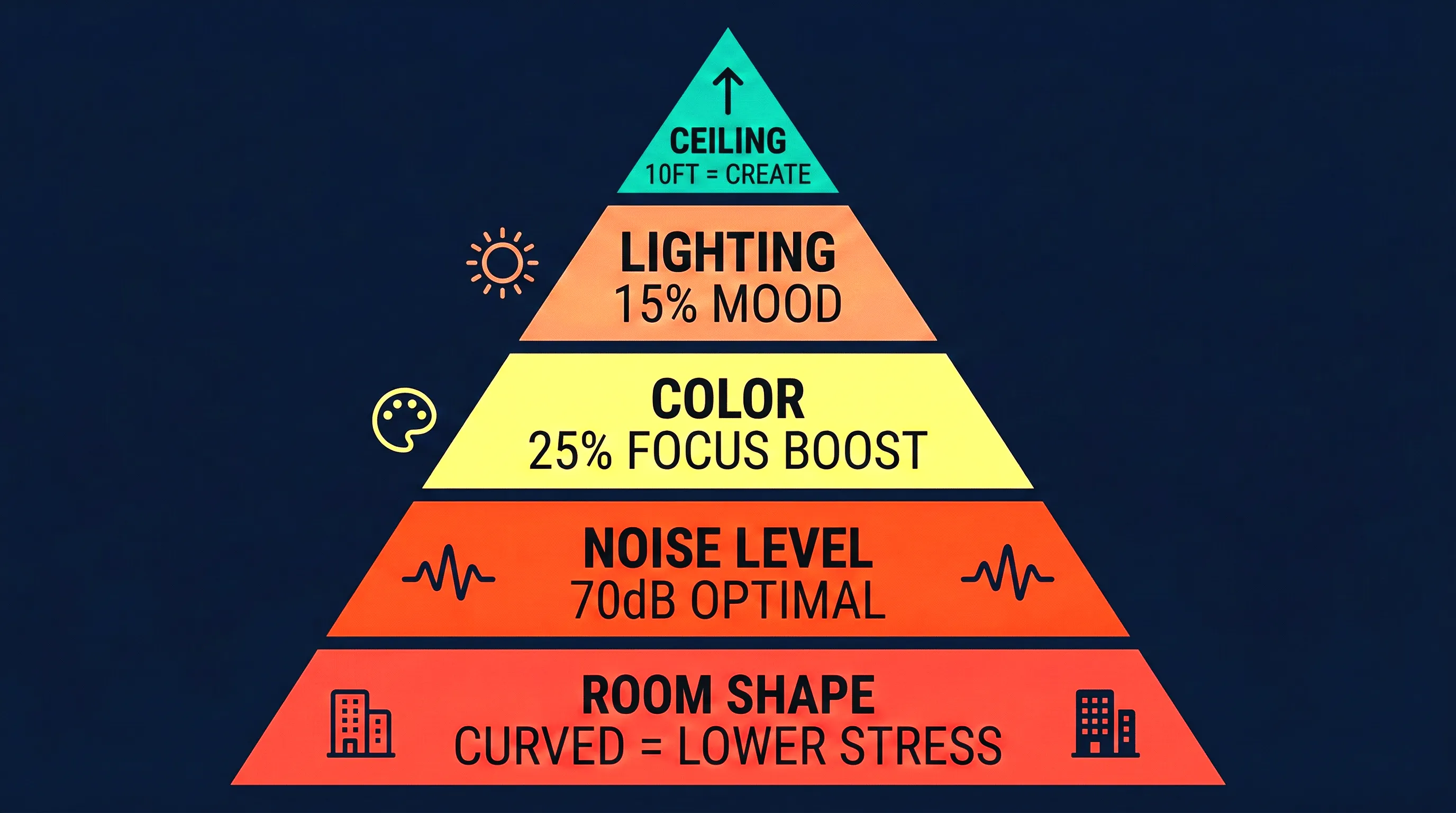
A 2024 study published in Frontiers in Psychology found that even the shape of a room affects your emotions. Rectangular rooms increased negative mood, while rooms with curved geometry boosted positive mood and lowered stress. You didn’t decide to feel that way. The room decided for you.[1]
Here’s what your environment is doing to you right now:
- Lighting controls your circadian rhythm, which controls your mood. Low natural light triggers stress and anxiety.
- Color changes your cognitive performance. Blue rooms boost focus. Yellow rooms spark creativity. Red rooms increase heart rate.
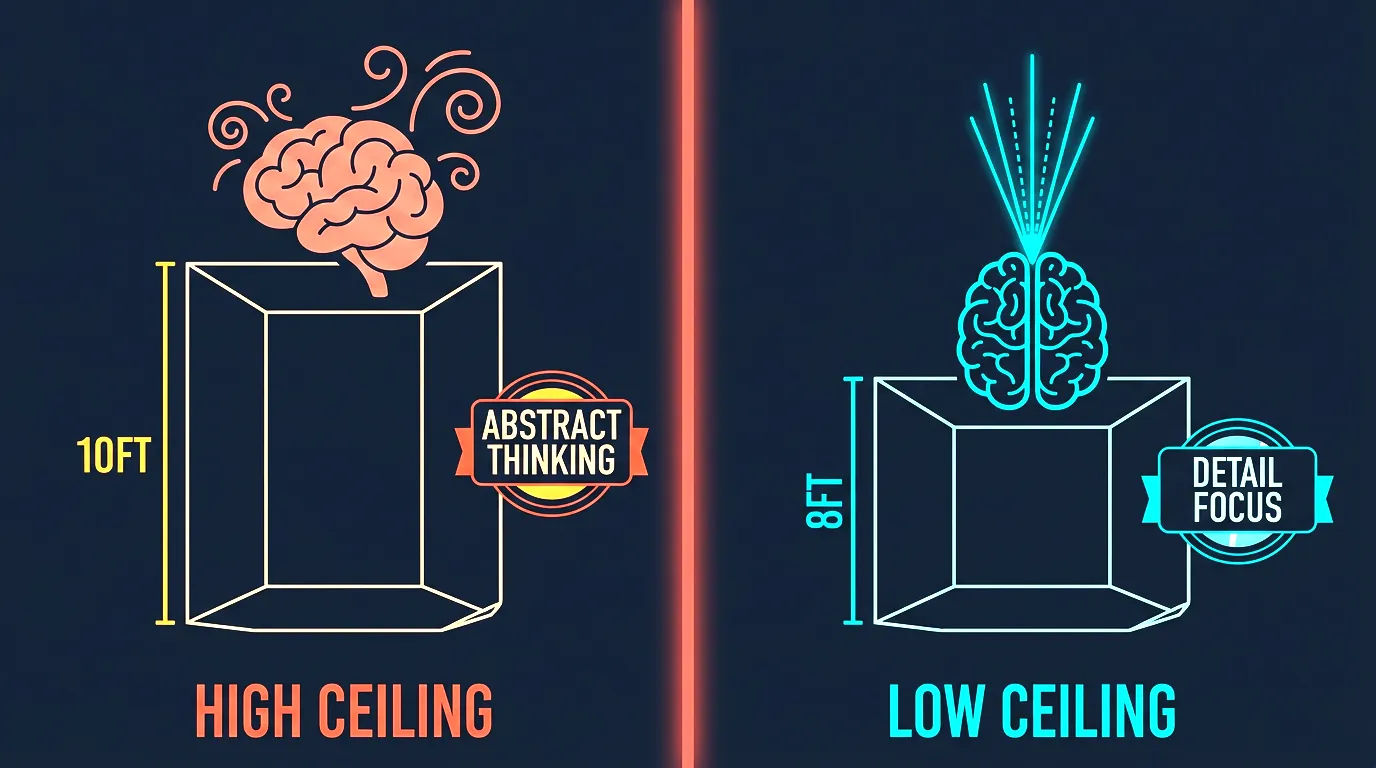
- Ceiling height shifts your thinking style. High ceilings promote abstract, creative thought. Low ceilings improve detail-oriented focus.
- Clutter drains your working memory. A messy desk literally makes you dumber by competing for your brain’s limited attention.[8][9]
- Noise levels affect concentration. Moderate ambient noise (around 70 decibels, like a coffee shop) actually enhances creative thinking.
“The colors on our walls, the amount of natural light we receive, the layout of our furniture, and even the noise levels around us all impact our mood, stress levels, productivity, and health.” — Ness Labs, Environmental Psychology Review
Most people assume their feelings come from inside. But research keeps showing the opposite. Your environment is one of the biggest drivers of your emotional state. And most of the time, you have no idea it’s happening.
How Color and Light Hijack Your Brain
Color psychology isn’t some vague design trend. It’s backed by hard neuroscience.
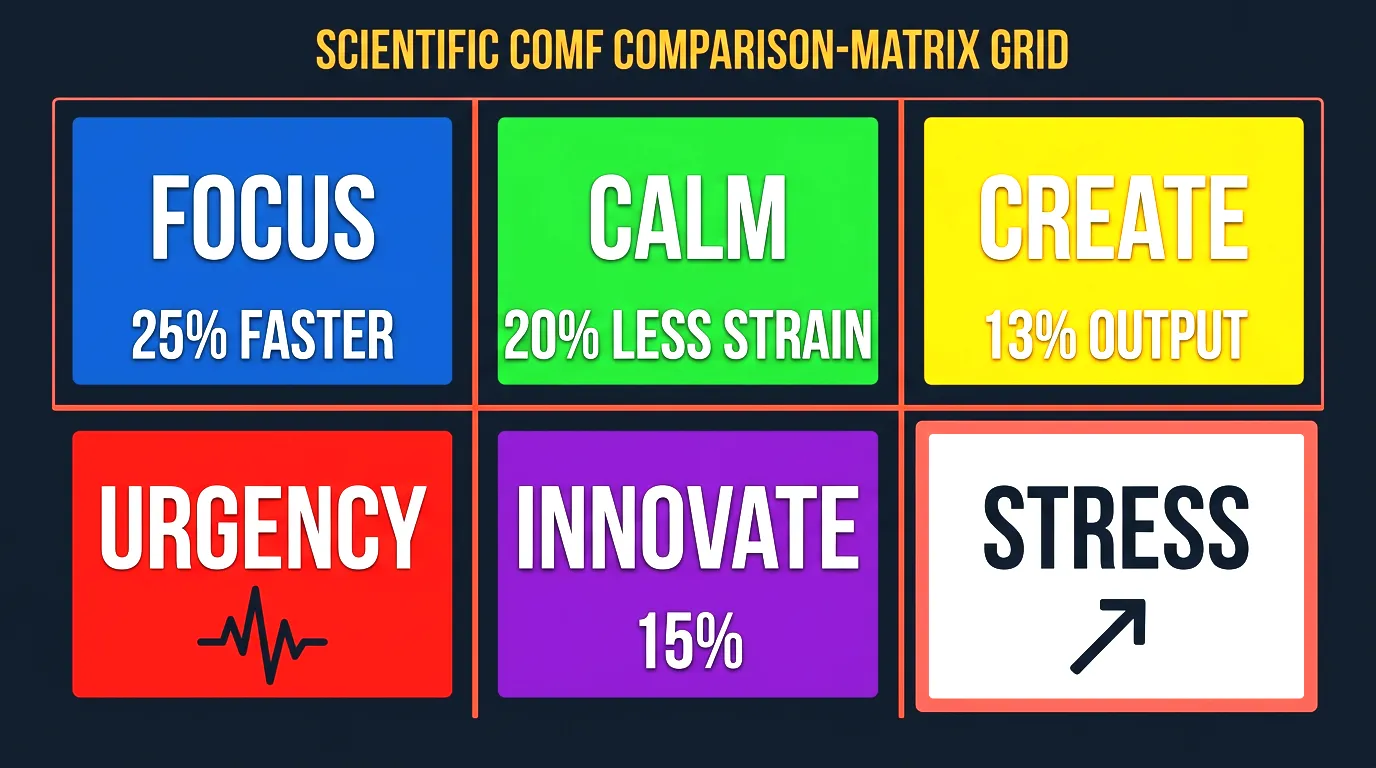
Research from Creighton University found that workers in blue offices completed tasks 25% faster with fewer errors compared to those in white environments. That’s not a subtle difference. That’s the difference between a productive day and a wasted one.[2]
| Color | Effect on Behavior | Best Use |
|---|---|---|
| Blue | Boosts focus, reduces errors by 25% | Offices, study spaces |
| Green | Reduces eye strain by 20%, sustains concentration | Workspaces near windows |
| Yellow | Increases creative output by 13% | Brainstorming rooms, studios |
| Red | Raises heart rate, increases urgency | Sales environments, clearance sections |
| Purple | Enhances creative thinking by 15% | Design studios, innovation labs |
| White | Feels sterile, can increase anxiety | Medical settings (often counterproductive) |
Natural light is even more powerful than color. Studies show that natural light in the workplace improves mood by up to 15%, boosts productivity by 25%, and lowers absenteeism by 18%. Your brain literally performs differently depending on whether it’s getting photons from the sun or from a fluorescent tube.
Recommended read: Stolen Focus by Johann Hari — explores how your environment, both physical and digital, is designed to fragment your attention.
This is why windowless offices feel so draining. It’s not just psychological. Your circadian rhythm gets disrupted, cortisol levels stay elevated, and your prefrontal cortex. the part of your brain responsible for complex decisions. operates at reduced capacity.
Why Stores Are Designed to Make You Buy
Every major retailer has an environmental psychologist on staff or on retainer. Their job is to design a space that makes you spend more money. And they’re very good at it.
Paco Underhill, one of the founders of retail anthropology, spent decades studying how people move through stores. His findings are uncomfortable. Almost nothing about a store’s layout is accidental.
The Tricks Retailers Use
- The decompression zone. The first 5-10 feet inside a store entrance is a transition space. Your brain is still adjusting from outside. Retailers know you won’t notice anything placed here, so they keep it open.
- Right-turn bias. Most people naturally turn right when entering a store. That’s why the most profitable departments are usually on the right side.
- Slow-down tactics. Wide aisles, interesting displays, and speed bumps (product islands in the middle of walkways) all reduce your walking pace. Slower shoppers buy more.
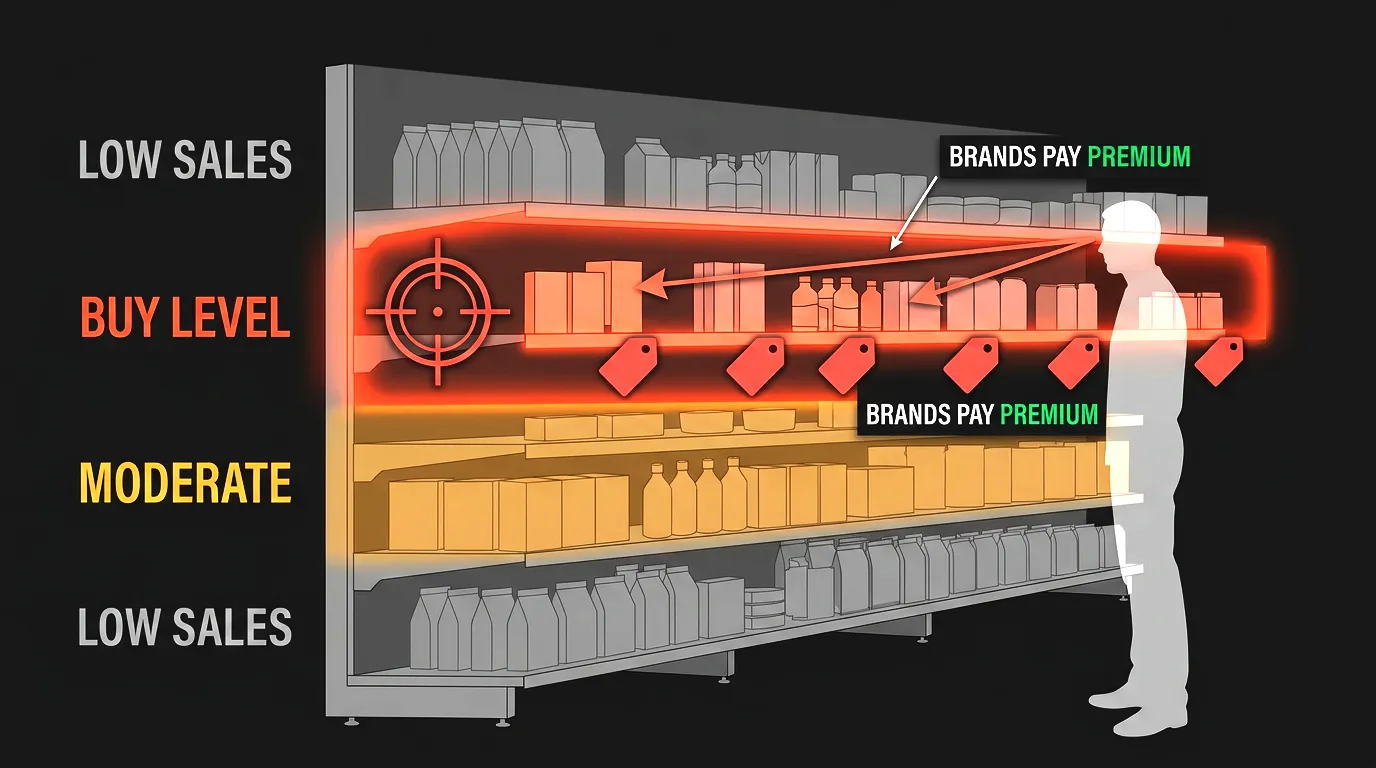
- Eye-level is buy-level. Products at eye height sell far more than those on lower or upper shelves. Brands pay premium prices for this shelf placement.
- The checkout trap. Impulse items near the register exploit decision fatigue. By the time you’re checking out, your willpower is depleted.
Supermarkets put essential items like milk and bread at the back of the store. That forces you to walk past thousands of other products to get what you came for. Every extra second in the store increases the probability that something ends up in your cart.
Recommended read: Why We Buy by Paco Underhill — the definitive guide to how retail environments manipulate your shopping brain.
This isn’t limited to stores. Casinos remove clocks and windows to destroy your sense of time. Restaurants use warm lighting and soft music to make you linger and order more. Airports funnel you through duty-free shops after security. The built environment is a manipulation machine.
Your Workspace Is Programming Your Brain
The ceiling above your head is doing more than keeping rain out. It’s changing how you think.
Joan Meyers-Levy, a marketing professor at the University of Minnesota, conducted a landmark study on ceiling height and cognition. She found that rooms with 10-foot ceilings activated abstract, creative thinking. Rooms with 8-foot ceilings activated detail-oriented, focused processing.[3]
The mechanism is surprisingly simple. High ceilings create a feeling of freedom, which primes your brain to think broadly. Low ceilings create a feeling of confinement, which primes your brain to focus narrowly.
How to Design a Space That Works for Your Brain
- For creative work. High ceilings, natural light, plants, moderate ambient noise, warm colors. Think coffee shop vibes.
- For focused work. Lower ceilings, cooler colors (blue or green), minimal clutter, quiet. Think library vibes.
- For meetings. Curved furniture arrangements, warm lighting, natural elements. Avoid rectangular conference tables. They trigger adversarial positioning.
- For relaxation. Green tones, natural materials, views of nature or plants, soft lighting, comfortable seating.
Even small changes matter. Adding a single plant to a workspace can improve well-being and productivity. Repositioning your desk so you face a window changes your cortisol levels. Decluttering reduces cognitive load and frees up working memory.
Recommended read: Nudge by Richard Thaler and Cass Sunstein — explains how choice architecture in physical and digital environments shapes every decision you make.
People who design workspaces understand this. Open-plan offices, despite being sold as “collaborative,” actually reduce face-to-face interaction by 70% according to a Harvard study. People put on headphones and withdraw. The environment meant to connect people does the opposite.[4]
How to Take Back Control of Your Environment
You can’t control every space you enter. But you can become aware of how spaces are controlling you. And you can redesign the spaces you do control.
Here’s what the research says works:
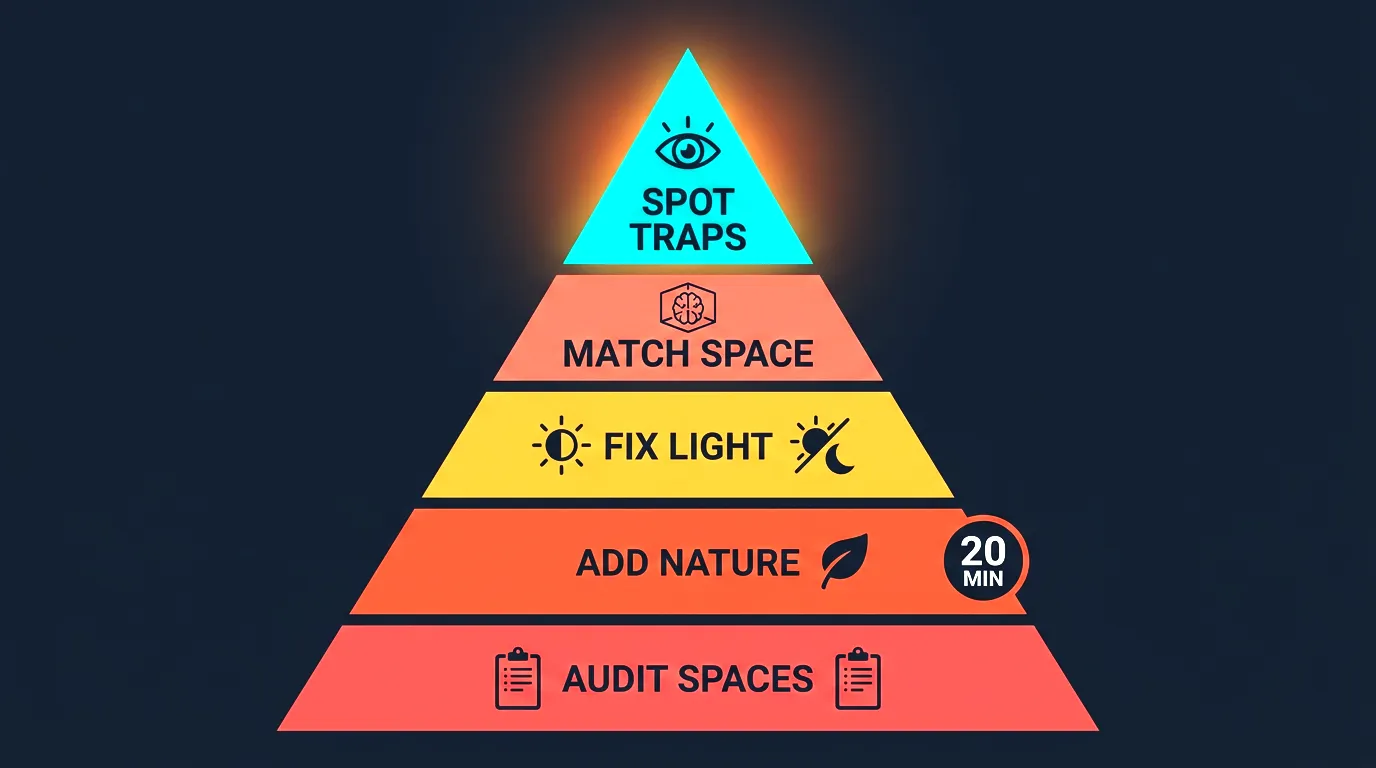
- Audit your daily environments. Notice how you feel in different rooms. Track your energy, mood, and focus across locations for a week. Patterns will emerge.
- Add nature. Even looking at photos of nature reduces stress. Real plants are better. Views of trees are best. A 2025 study showed that nature exposure reduces impulsive decision-making and improves mood within 20 minutes.[5] [6]
- Control your light. Get natural light in the morning. Use warm, dim light in the evening. Avoid harsh fluorescent lighting. Your circadian rhythm will thank you.
- Match your space to your task. Don’t try to brainstorm in a cramped cubicle. Don’t try to focus in a noisy open office. Move to environments that support what you’re trying to do.
- Watch for manipulation. When you’re in a store, restaurant, or any designed commercial space, remind yourself that the environment is trying to influence your behavior. That awareness alone reduces its power.
The most important thing to understand is this: your environment isn’t neutral. It never was. Every space you enter was designed by someone, for some purpose. Sometimes that purpose aligns with your interests. Often it doesn’t.
The difference between being controlled by your environment and controlling it is awareness. Now you have it.
Sources
The Hidden Power of the Rooms You Sit In
1. The Impact of Room Shape on Affective States, Heartrate, and Creative Output (Heliyon, 2024)