You took it a few times at festivals. Maybe more than a few times in college. The nights were electric. The connections felt deeper than anything you’d experienced before. And then you moved on with your life.
But your brain didn’t move on. Not fully. A growing body of research suggests that MDMA leaves marks on your memory and learning ability that linger for years. Maybe permanently. And the most unsettling part? Quitting doesn’t seem to fix it.
The Research That Rewrites What We Know
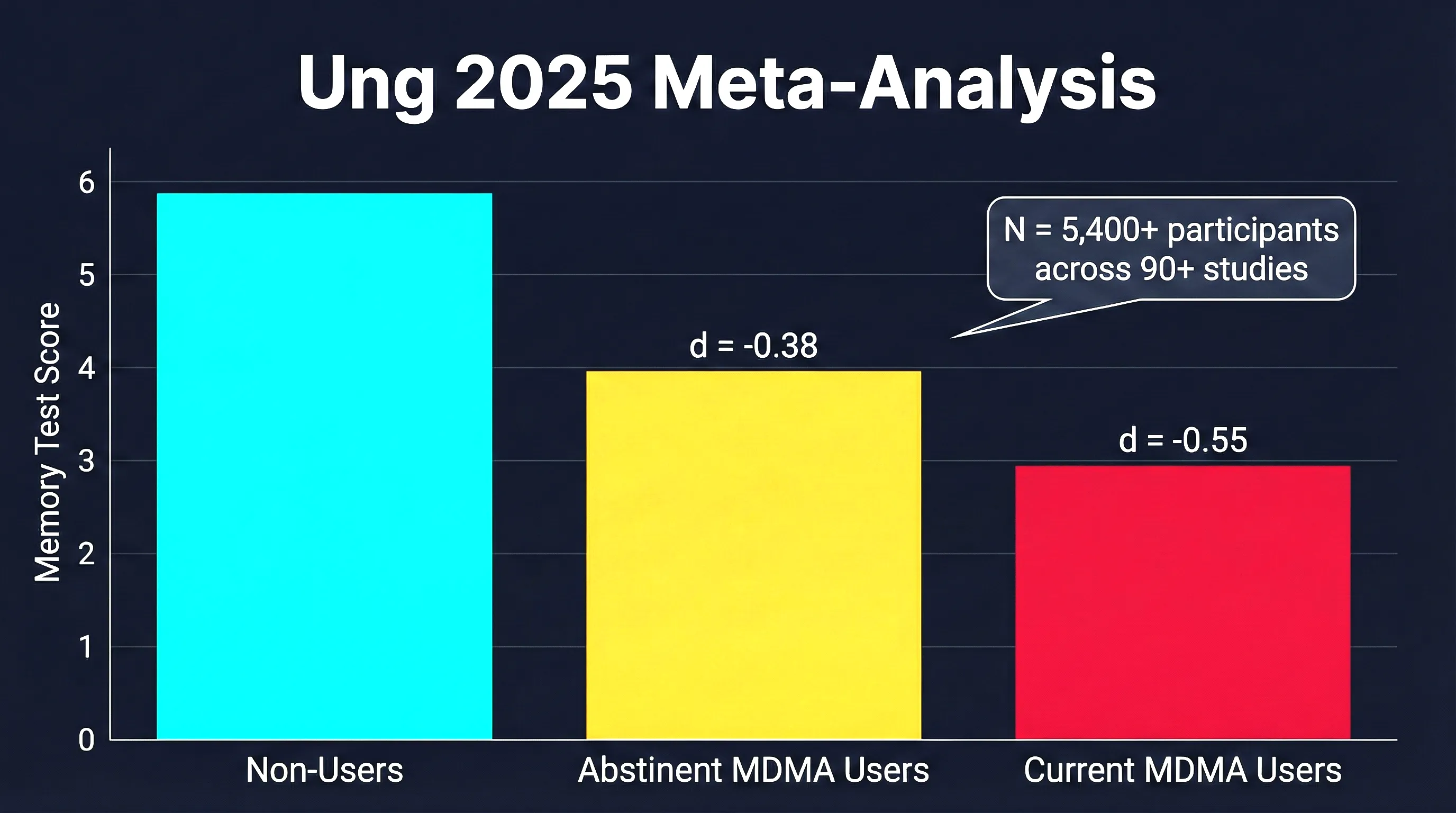
A 2025 systematic review and meta-analysis published in the Journal of Psychopharmacology pulled together the strongest evidence yet. Led by Hillary Ung and colleagues at the University of Queensland, the study examined 14 research articles on long-term cognitive effects of recreational MDMA use.[1]
The focus was on people who had stopped using the drug. Not active users. Former users who had been abstinent for months or years.
Here’s what they found:
- Learning and memory were significantly worse in both current and former MDMA users compared to people who never used it
- Current users showed a large effect size (Hedges’ g = -1.06) on memory tests
- Former users showed an even larger effect size (Hedges’ g = -1.37)
- The difference between current and abstinent users was essentially zero (Hedges’ g = 0.03)
That last number is the one that matters most. It means quitting MDMA doesn’t appear to reverse the cognitive damage. Whether you stopped last month or five years ago, the memory deficits look the same.[1]
“People with current and previous MDMA use had poorer learning and memory performance compared to people who were MDMA-naive.” — Ung et al., Journal of Psychopharmacology, 2025
This wasn’t a single small study. The meta-analysis synthesized findings across multiple research groups, controlling for polydrug use and other confounding factors. The signal was consistent across studies.
Recommended read: Why We Remember by Charan Ranganath — A neuroscientist explains how memory actually works and why it matters more than you think.
What MDMA Actually Does to Your Brain
To understand why the damage persists, you need to understand what MDMA does at the chemical level. It’s not just a mood booster. It’s a serotonin bomb.
When you take MDMA, it floods your brain with three neurotransmitters:
- Serotonin. Massive release. This creates the euphoria, emotional warmth, and feeling of deep connection.
- Dopamine. A surge that drives the energy and pleasure.
- Norepinephrine. Increases heart rate and arousal.
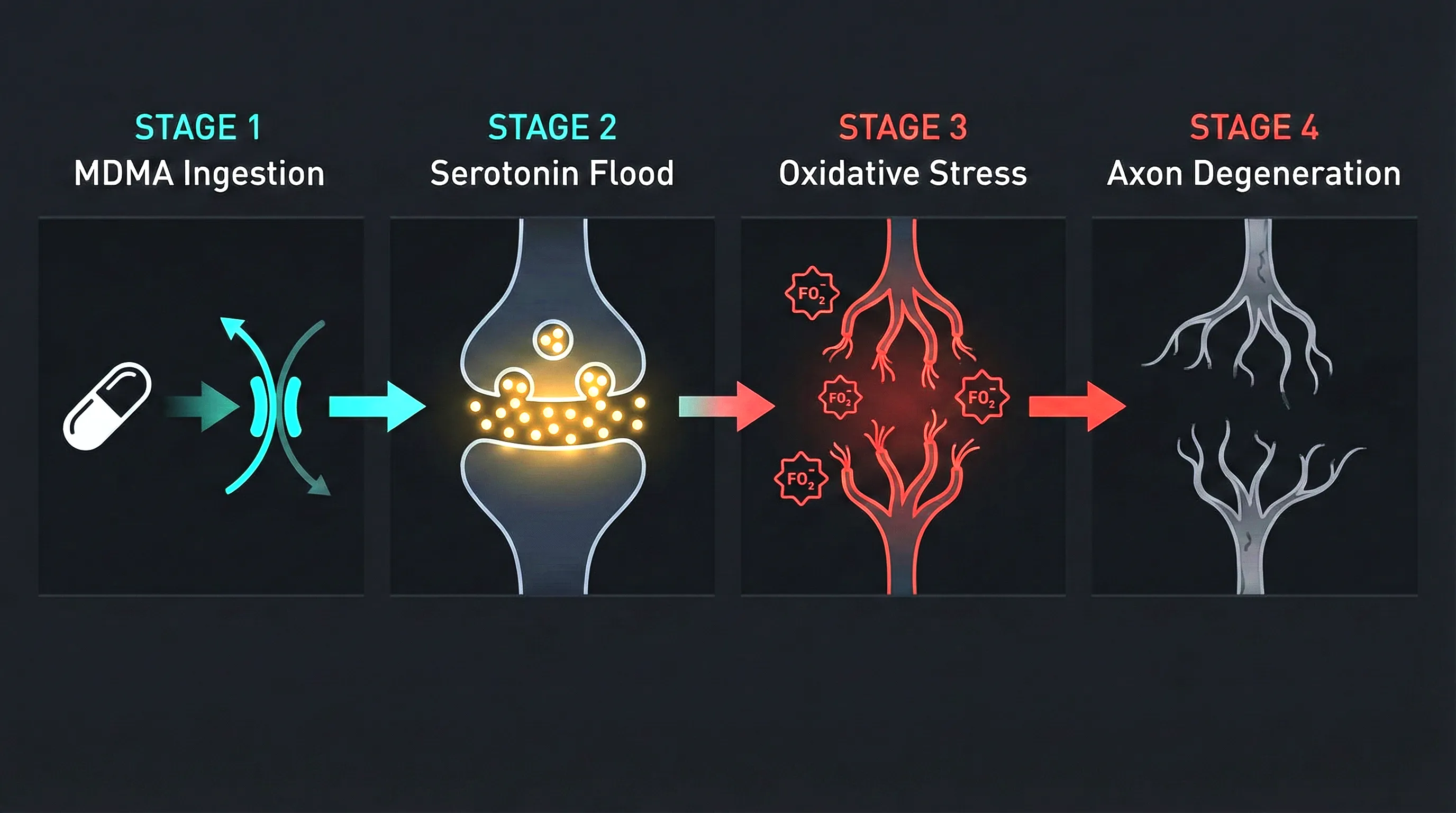
The serotonin release is the problem. MDMA doesn’t just encourage your neurons to release more serotonin. It forces them to dump their entire supply at once. Then it blocks the recycling process that would normally refill those reserves.
The Neurotoxicity Problem
Research from the National Institute on Drug Abuse shows that moderate to high doses of MDMA damage the actual neurons that produce and transport serotonin. This isn’t just temporary depletion. It’s structural damage to the cells themselves.
Here’s what happens inside your brain:
| Stage | What Occurs | Timeline |
|---|---|---|
| Acute phase | Massive serotonin flood, followed by severe depletion | Hours to days |
| Short-term aftermath | ”Suicide Tuesday.” Depression, brain fog, irritability | Days to weeks |
| Long-term damage | Serotonin neuron terminals degrade or die | Weeks to permanent |
| Attempted recovery | Partial regrowth of some serotonin pathways | Months to years |
Serotonin isn’t just a “feel good” chemical. It’s essential for encoding new memories, regulating sleep, managing mood, and supporting focused attention. When the neurons that produce it are damaged, every one of those functions suffers.
Recommended read: Dopamine Nation by Anna Lembke — A Stanford psychiatrist on how pleasure-seeking substances hijack your brain’s reward system.
The Memory Damage Is Measurable
The cognitive effects of MDMA aren’t subtle. They show up clearly on standardized tests. And multiple meta-analyses have quantified exactly how bad the damage is.
What the Numbers Show
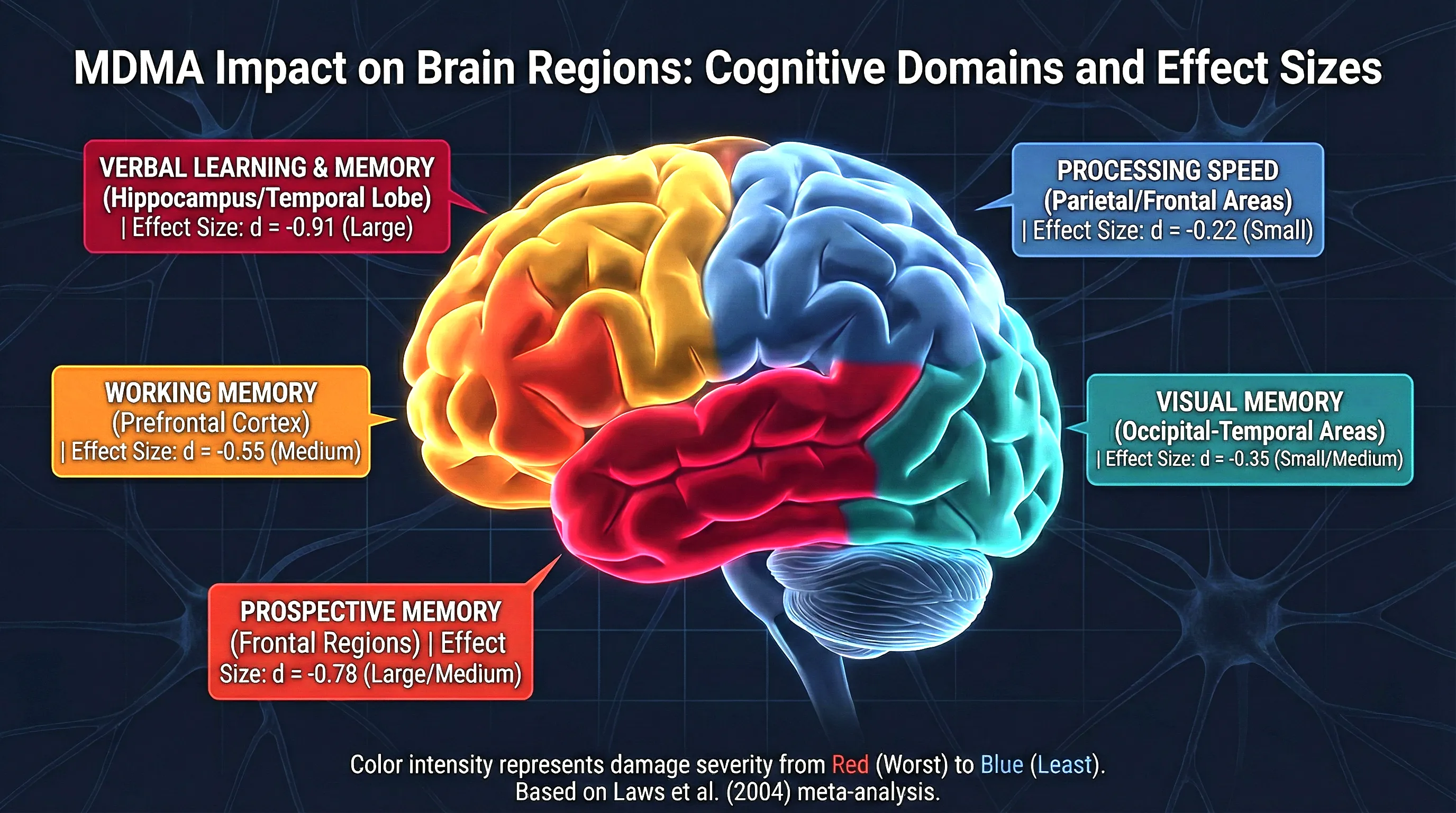
A landmark 2007 meta-analysis by Laws and Kokkalis broke down the memory effects by type:[2]
- Long-term memory: d = -0.87 (large effect)
- Short-term memory: d = -0.63 (medium effect)
- Verbal memory: d = -1.00 (large effect)
- Visual memory: d = -0.27 (small effect)
To put this in perspective, a Cohen’s d of 1.0 means MDMA users perform a full standard deviation below non-users on verbal memory tests. That’s not a subtle dip. That’s a measurable, meaningful decline in how well you can learn and recall new information.[3]
Which Brain Functions Take the Biggest Hit
The Ung 2025 review catalogued impairments across five cognitive domains:[1]
- Learning and memory — 8 of 14 studies found deficits. The strongest and most consistent finding.
- Executive function — 10 of 14 studies assessed this. Includes planning, problem-solving, and impulse control.
- Complex attention — 5 studies found issues with sustained focus and concentration.
- Language — 2 studies found verbal fluency problems.
- Perceptual motor function — 1 study flagged slower processing speed.
The pattern is clear. Memory takes the hardest hit. But the damage spreads across multiple cognitive systems. Your ability to plan, focus, find words, and process information all suffer.
It’s Not Just About Getting Older
Some people dismiss these findings by saying memory naturally declines with age. But the studies controlled for age. The deficits are above and beyond normal aging. These are young adults and middle-aged people scoring significantly worse than their peers who never used MDMA.
Why Quitting Doesn’t Fix the Damage
This is the finding that catches most people off guard. You’d expect that stopping MDMA use would let your brain heal. And to some extent, it does try.
But the recovery is incomplete. And in some brain regions, it doesn’t happen at all.
The Primate Evidence
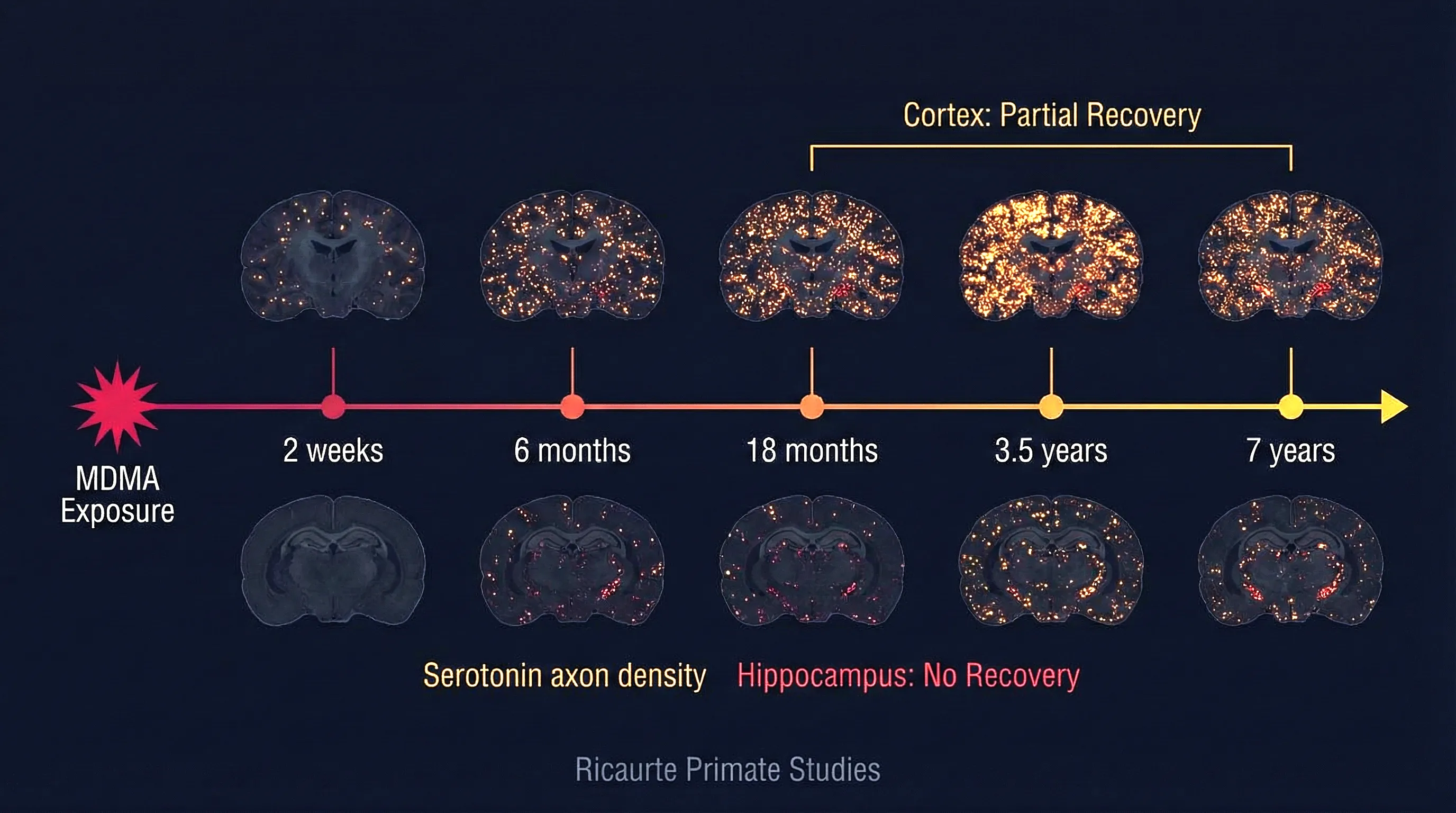
Neuroscientist George Ricaurte’s research at Johns Hopkins provides some of the most striking evidence. His team gave MDMA to squirrel monkeys and then examined their brains years later.
Key findings:
- Serotonin innervation patterns were still altered 7 years after a single course of MDMA exposure[4]
- Some brain regions showed partial recovery
- Other regions showed no recovery whatsoever
- The dose that caused lasting damage in monkeys (5 mg/kg) is close to what humans take recreationally (1.7 to 2.7 mg/kg)[5]
The Human Data Agrees
The Ung 2025 meta-analysis found that the difference in memory performance between current and former MDMA users was essentially zero (Hedges’ g = 0.03). This means abstinence. Whether for months or years. Didn’t meaningfully improve cognitive function.[1]
There are a few possible explanations:
- The serotonin neurons are permanently damaged. Even with partial regrowth, the wiring isn’t the same.
- The brain compensates but doesn’t fully repair. New pathways form, but they don’t work as efficiently as the originals.
- Critical windows have passed. The brain’s capacity for neuroplasticity may not be enough to overcome the structural damage from MDMA.
Dose Matters, But Not How You Think
Heavy users show the clearest deficits. But “heavy” doesn’t mean daily use. Research shows cumulative lifetime dose predicts cognitive impairment. Dozens of sessions over several years is enough.
The dose-response relationship also reveals a threshold effect. Heavy and former heavy users consistently perform worse on memory tasks than controls. Moderate users sometimes escape measurable damage. But the line between “moderate” and “heavy” isn’t as wide as most people assume.
Recommended read: How to Change a Memory by Steve Ramirez — A neuroscientist explores the cutting edge of memory science, from false memories to the possibility of editing traumatic ones.
What This Means If You’ve Used MDMA
If you’re reading this and you’ve used MDMA in the past, don’t panic. The research shows averages across populations. Individual outcomes vary based on genetics, total exposure, age of use, and overall brain health.
But it’s worth taking the findings seriously. Here’s what the science suggests you can do:
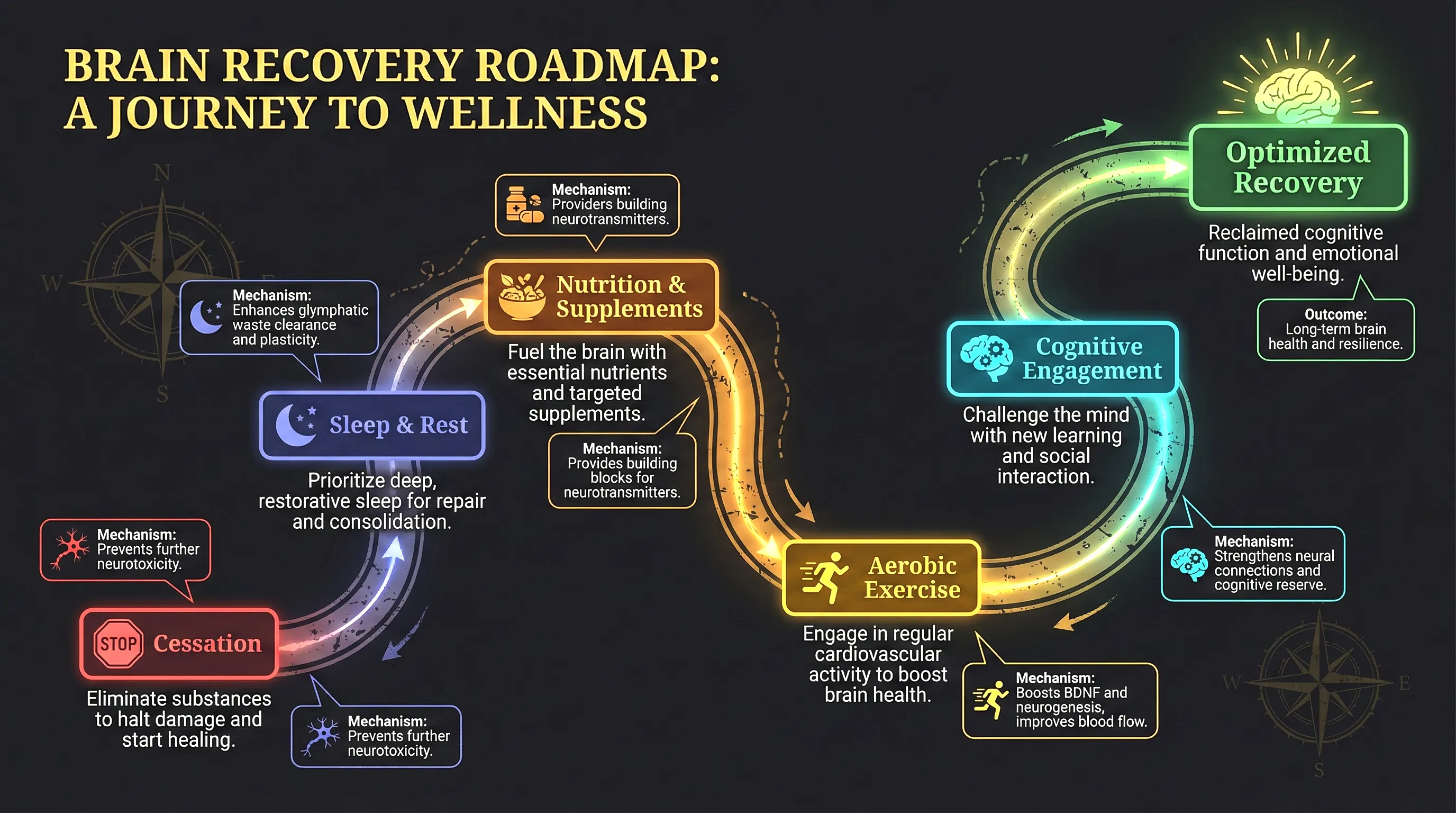
- Stop using. Even if quitting doesn’t reverse existing damage, continued use makes things worse. Every additional dose adds to the cumulative neurotoxic load.
- Protect your remaining serotonin system. Sleep, exercise, and nutrition all support serotonin production. Prioritize them.
- Train your memory actively. Cognitive exercise won’t undo structural damage, but it can strengthen compensatory pathways. Learning new skills, reading, and challenging your brain helps.
- Monitor your mental health. Serotonin depletion is linked to depression, anxiety, and sleep problems. If you notice these, talk to a professional.
- Be honest about your history. If you see a doctor or therapist, mention past MDMA use. It matters for treatment decisions.
The Bigger Picture
MDMA is often portrayed as a relatively “safe” party drug. It’s true that a single dose is unlikely to kill you the way fentanyl might. But safety isn’t just about surviving the night. It’s about what your brain looks like years later.
The 2025 Ung meta-analysis is the latest in a long line of studies showing the same thing. MDMA depletes the chemical system your brain depends on for learning, memory, mood, and focus. And that depletion appears to be long-lasting.
The high is temporary. The cognitive cost may not be.
Recommended read: The Shallows by Nicholas Carr — While focused on technology, this book brilliantly explains how environmental factors reshape your brain’s capacity for deep thinking and memory.
Sources
The Research That Rewrites What We Know
6. Recreational Ecstasy Use Is Linked to Lasting Memory Impairments (PsyPost, 2025)
The Memory Damage Is Measurable
2. Ecstasy (MDMA) and Memory Function: A Meta-Analytic Update (Human Psychopharmacology, 2007)
3. MDMA Use and Neurocognition: A Meta-Analytic Review (Psychopharmacology, 2007)