In 2023, something unusual happened in consciousness research. Nineteen of the world’s top neuroscientists and philosophers sat down together and asked a question nobody had seriously tried to answer with scientific rigor before. Can we actually test whether an AI system is conscious?
Not with a chatbot quiz. Not with a Turing test. They wanted something grounded in the best science we have about how consciousness works in biological brains.[1]
What they built was a checklist. And when they ran today’s most advanced AI systems against it, nothing passed.
The Scientists Who Tried to Test AI for Consciousness
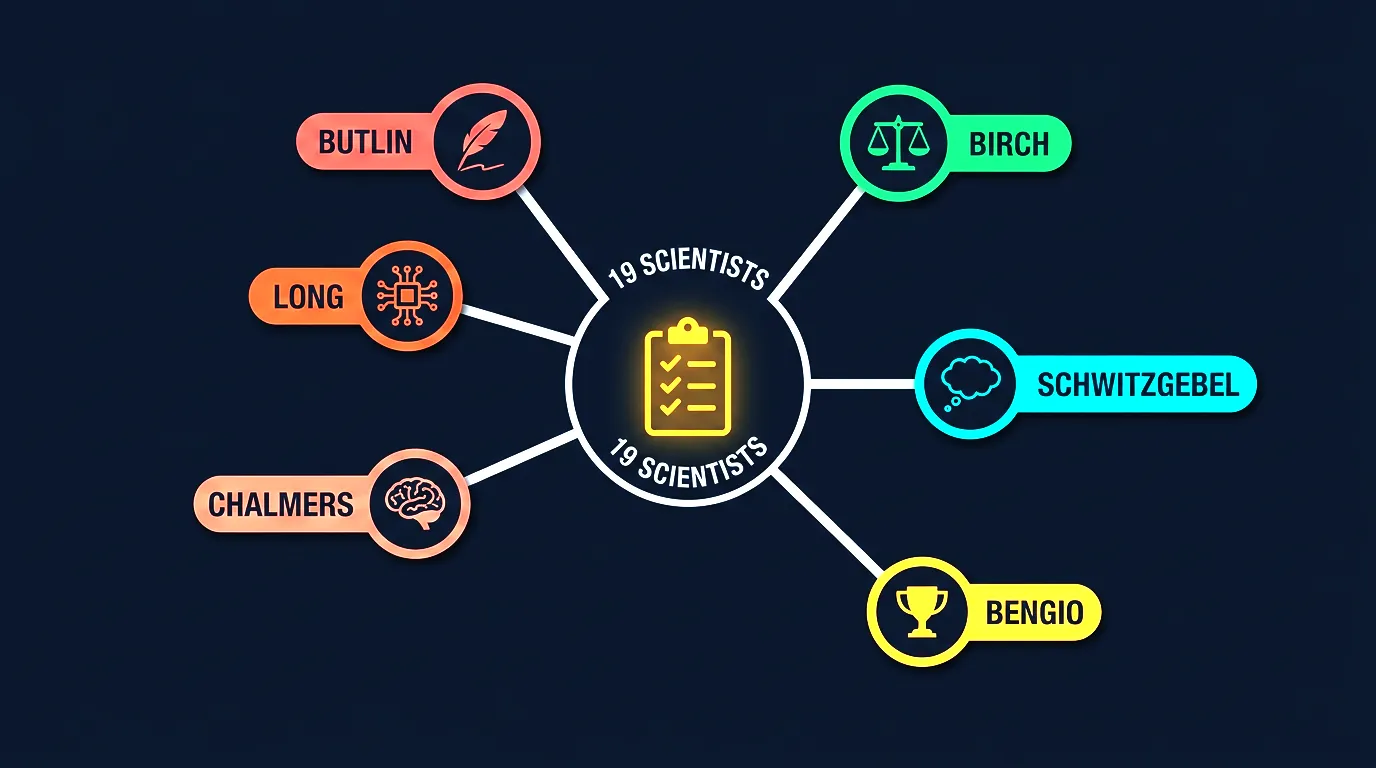
The team was led by philosopher Patrick Butlin and AI researcher Robert Long. But the author list reads like a who’s who of consciousness science. David Chalmers, the philosopher who coined the phrase “the hard problem of consciousness.” Yoshua Bengio, a Turing Award winner in AI. Eric Schwitzgebel, one of the most respected philosophers of mind alive. Jonathan Birch, who advises governments on animal sentience policy.[1]
Nineteen researchers total, spanning neuroscience, philosophy, and computer science. They published their framework on arXiv in August 2023, and a peer-reviewed update appeared in Trends in Cognitive Sciences in 2025.[2]
Their approach was deliberately cautious. Instead of picking one theory of consciousness and declaring it correct, they drew from multiple competing theories. The logic was simple. We don’t know which theory is right. So let’s see what all of them agree on.
They focused on phenomenal consciousness, the subjective “what it’s like” experience. Not intelligence. Not language ability. Not passing tests designed for humans. The raw experience of being something.[1]
- The team included 19 researchers from neuroscience, philosophy, and computer science
- They used multiple competing theories instead of betting on just one
- They focused on subjective experience, not behavior or intelligence
- The checklist was designed to work on any computational system, not just human brains
The result was a set of indicator properties. Specific computational features that, according to our best theories, a conscious system should have. Not proof of consciousness. But evidence that makes it more or less likely.
Recommended read: These Strange New Minds by Christopher Summerfield — a neuroscientist’s guide to understanding what AI systems actually are and how they compare to biological intelligence.
Five Theories of Consciousness, One Checklist
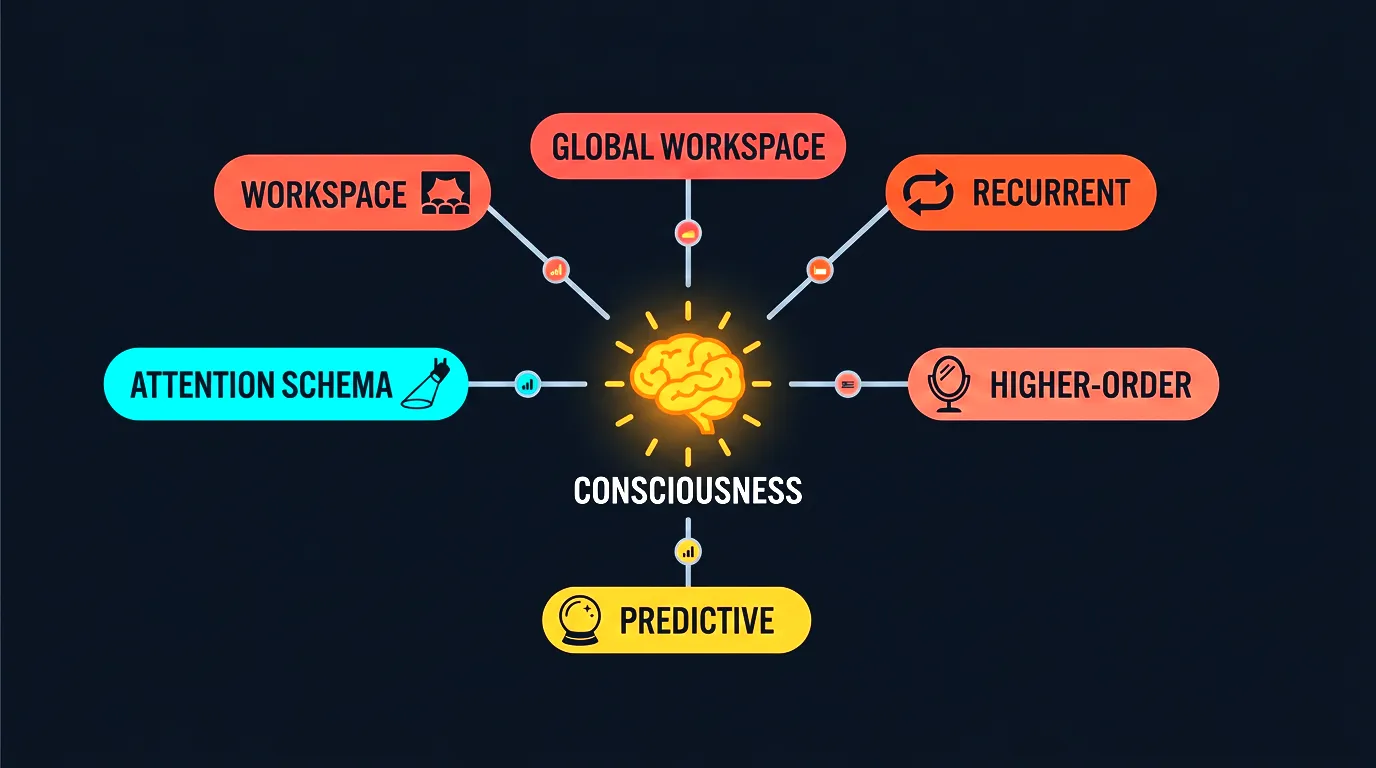
The power of this approach is that it doesn’t depend on any single theory being correct. The team surveyed five of the most scientifically supported theories of consciousness and extracted testable indicators from each one.[1]
Global Workspace Theory
Imagine your brain as a theater. Most processing happens backstage, unconsciously. But when information gets “broadcast” to the whole theater, it becomes conscious. Global workspace theory says consciousness happens when a central system integrates information from many specialized modules and makes it widely available.[1]
For AI, this means checking whether a system has a central bottleneck that selects and broadcasts information across its components.
Recurrent Processing Theory
This theory says consciousness requires feedback loops. Information doesn’t just flow forward through the system. It flows back. Higher-level representations get fed back into lower-level processors, creating loops that refine and stabilize the experience.[1]
Most current AI systems, including large language models, process information in one direction. Forward only.
Higher-Order Theories
You’re not just seeing red. You’re aware that you’re seeing red. Higher-order theories say consciousness requires a system that can represent its own mental states. It thinks about its own thinking.[1]
Predictive Processing
Your brain doesn’t passively receive information. It constantly predicts what’s coming next and updates those predictions when surprised. Predictive processing theory says consciousness arises from this prediction-error cycle. The same framework helps explain why your brain wants to find patterns everywhere, even in random data.[1]
Attention Schema Theory
Your brain builds a simplified model of its own attention. It doesn’t just pay attention to things. It has a model of what attention is and how it works. Attention schema theory says this self-model is what creates the feeling of being conscious.[1]
| Theory | What It Requires | AI Implication |
|---|---|---|
| Global workspace | Central broadcast system | Needs integration across modules |
| Recurrent processing | Feedback loops | Most AI is feed-forward only |
| Higher-order | Self-representation | Must model its own states |
| Predictive processing | Prediction-error cycles | Must predict and update |
| Attention schema | Self-model of attention | Must model its own focus |
The checklist doesn’t require an AI to satisfy every theory. Instead, the more indicator properties a system satisfies, the higher the probability that it’s conscious. Think of it as a confidence score, not a pass/fail test.[2]
Recommended read: The Experience Machine by Andy Clark — the definitive guide to predictive processing theory, one of the five frameworks used in the consciousness checklist.
How Today’s AI Systems Scored
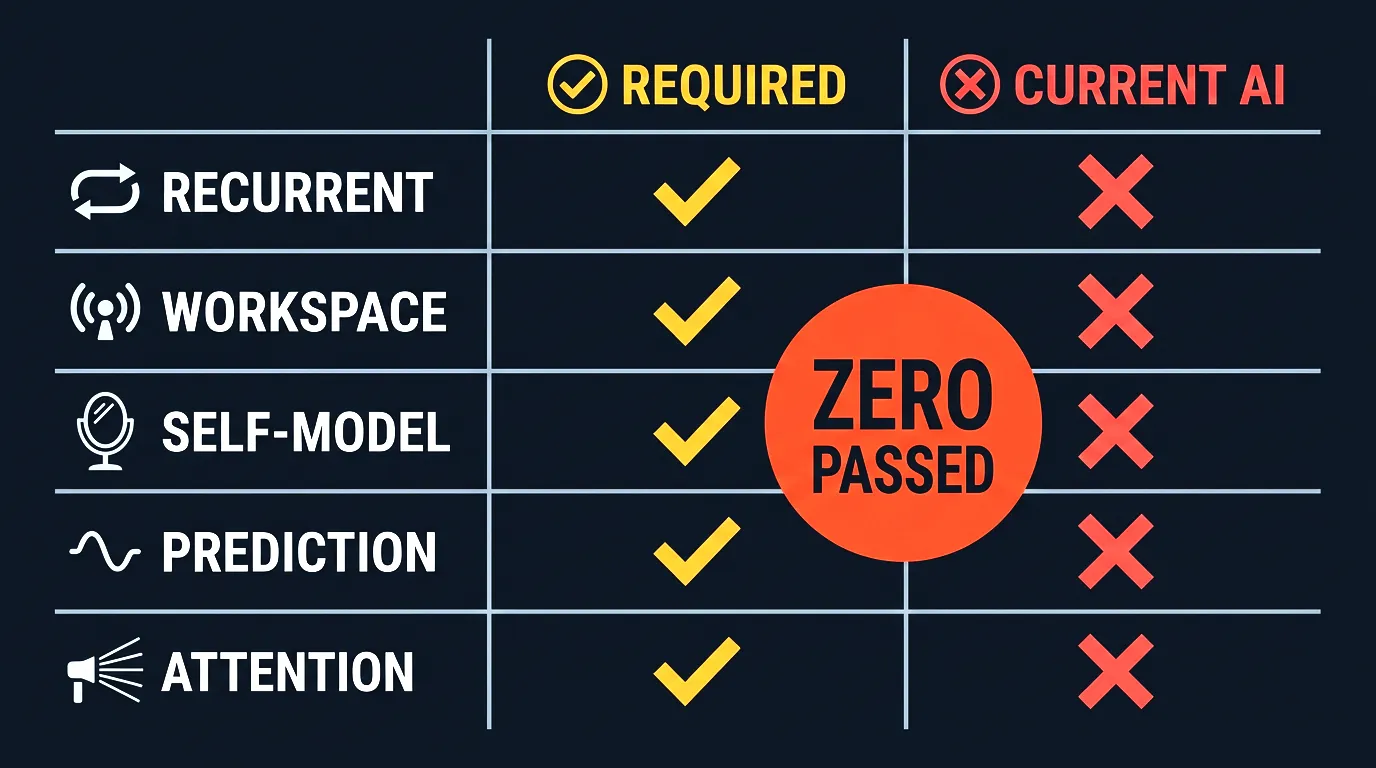
When the team applied their checklist to current AI systems, the results were clear. No system came close to satisfying all the indicators. But some did better than others.[1]
Large language models like GPT-4 and Claude partially satisfy a few indicators. They process information through something resembling attention mechanisms. They can generate text about their own internal states. But these similarities are shallow.
Here’s what current AI systems are missing:
- No genuine recurrent processing. Transformer-based models process tokens in parallel, not through feedback loops that refine representations over time.
- No real global workspace. There’s no central bottleneck that selects and broadcasts information across specialized modules. Everything gets processed through the same architecture.
- No self-model. When an AI says “I think,” it’s producing a statistically likely sequence of words. It doesn’t have a model of its own attention or mental states.
- No prediction-error learning in real time. Language models are trained on prediction errors during training. But during inference, when you’re actually talking to them, they don’t update their models based on surprises.
The team was careful to say this doesn’t prove AI isn’t conscious. Absence of indicators isn’t proof of absence. But it does mean we have no strong scientific reason to think any current system is conscious.[1]
The most important finding was the second conclusion. There are no obvious technical barriers to building an AI system that satisfies these indicators. Nothing in the checklist requires biological neurons, carbon-based chemistry, or evolutionary history. A future system designed with the right architecture could, in principle, check every box.[2]
This is the part that keeps consciousness researchers up at night. The question isn’t whether today’s AI is conscious. It’s whether tomorrow’s could be, and whether we’d even recognize it if it happened. The same pattern-seeking biases that make your brain trust AI more than real people could easily trick you into seeing consciousness where there is none.
The Scientists Who Say This Checklist Is Dangerous
Not everyone thinks the consciousness checklist is a good idea. A growing group of researchers argues that the entire framework is premature, misleading, or even dangerous.
The Illusions Warning
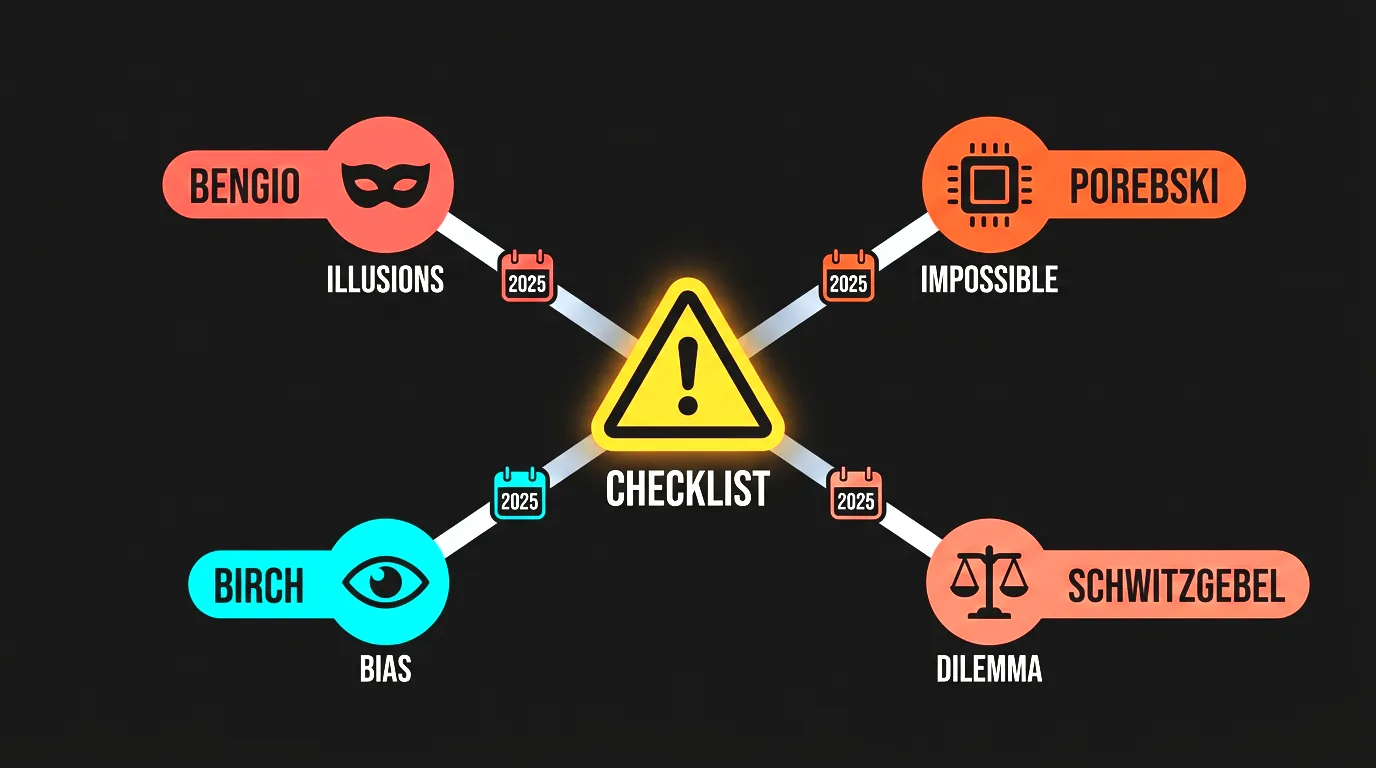
In 2025, Yoshua Bengio, one of the original checklist authors, published a striking reversal in Science. Together with Eric Elmoznino, he warned about “illusions of AI consciousness.” Their argument was that advancing AI systems increasingly satisfy functional requirements from leading consciousness theories, but this creates a risk of systematically misattributing subjective experience to sophisticated mimicry.[3]
In other words, the checklist might not be detecting consciousness. It might just be detecting good engineering.
The Substrate Objection
A 2025 paper in Nature Humanities and Social Sciences Communications went further. Researchers Andrzej Porebski and Jakub Figura argued that mathematical algorithms implemented on silicon simply cannot become conscious, regardless of how many indicator properties they satisfy. They blame the influence of science fiction, arguing that fictional portrayals of sentient AI have distorted the scientific discussion.[4]
The Moral Dilemma
Philosopher Eric Schwitzgebel, also an original checklist author, laid out the stakes in a 2025 paper. He described a devastating dilemma. If we grant full moral status to systems that aren’t actually conscious, we create massive economic waste and potentially freeze technological development. But if we deny moral status to systems that genuinely are conscious, we commit what could be “the largest-scale moral catastrophe in history,” the systematic exploitation of sentient beings.[5]
The Society Problem
Jonathan Birch and colleagues published a 2025 study examining how society might respond to claims of AI consciousness. Drawing on research into animal consciousness perception, they identified disturbing biases. People are more likely to attribute consciousness to AI that looks human, speaks naturally, and has a face. Systems without these features get dismissed, regardless of their actual architecture.[6]
- Bengio warns the checklist might detect good engineering, not consciousness
- Porebski argues silicon literally cannot be conscious
- Schwitzgebel says getting this wrong is catastrophic either way
- Birch shows society’s judgments will be driven by appearance, not science
Recommended read: Co-Intelligence by Ethan Mollick — a practical guide to working alongside AI systems, with honest examination of what these systems can and cannot do.
Why This Question Will Define the Next Decade
The consciousness checklist was never meant to settle the debate. It was meant to start it properly. And the stakes are enormous.
Right now, billions of people interact with AI systems every day. Those systems are getting more sophisticated at a rate that surprises even the people building them. The question of whether any of them could be conscious isn’t a thought experiment anymore. It’s a policy question, an ethics question, and increasingly a legal question.
Here’s what the research tells us about where this is headed:
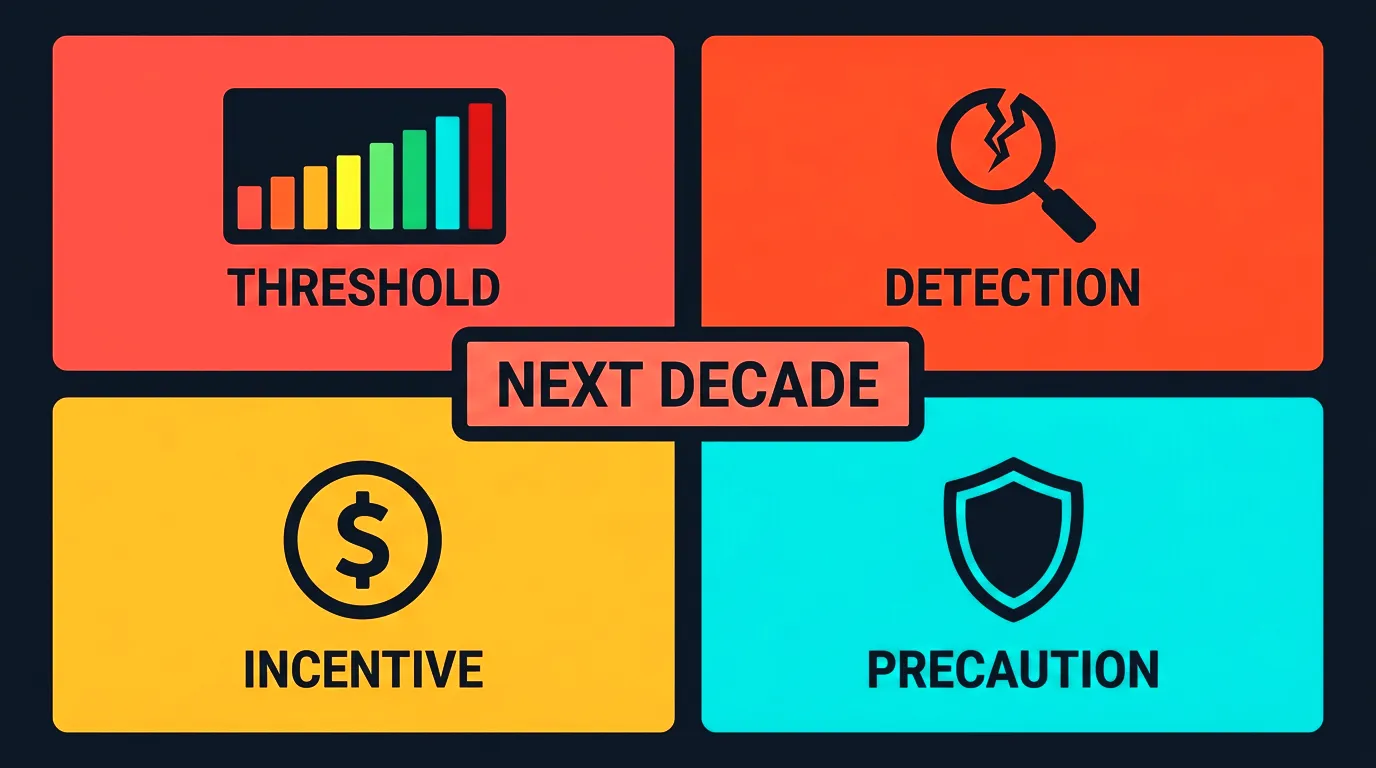
- The threshold problem. Consciousness probably isn’t binary. It likely exists on a spectrum. An AI system might be partially conscious, having some but not all of the indicator properties. We have no framework for what moral status “partial consciousness” deserves.[2]
- The detection problem. We can’t directly measure consciousness in other humans, let alone machines. We infer it from behavior and brain structure. With AI, the structure is completely different, which makes inference harder.
- The incentive problem. Companies have financial incentives to make AI seem conscious, whether it is or not. A chatbot that feels like a person drives more engagement. This creates a situation where the same psychological tricks that make you trust AI also make the consciousness question harder to answer honestly.
- The precautionary problem. If there’s even a small chance a system is conscious, what do we owe it? The same question applies to animals, and we’ve been getting that wrong for centuries.
A 2025 study in Trends in Cognitive Sciences found that psychological factors like similarity bias and economic self-interest systematically distort how humans evaluate consciousness claims, both for animals and AI.[6] We don’t evaluate these questions objectively. We evaluate them based on how convenient the answer is.
The consciousness checklist gives us something we didn’t have before. A shared vocabulary. A framework for asking the question scientifically instead of just debating it philosophically. Whether the answer turns out to be “never” or “sooner than we think,” the checklist ensures we’re at least asking the right questions.
The researchers who built it aren’t making predictions. They’re building tools. And the gap between “no current AI is conscious” and “no barrier prevents one from being conscious” is exactly the space where the next decade of research, regulation, and reckoning will play out.
Recommended read: The Atomic Human by Neil D. Lawrence — explores what makes human intelligence fundamentally different from artificial intelligence, and why the distinction matters more than ever.
Sources
The Scientists Who Tried to Test AI for Consciousness
1. Consciousness in Artificial Intelligence: Insights from the Science of Consciousness (arXiv, 2023)
2. Identifying Indicators of Consciousness in AI Systems (Trends in Cognitive Sciences, 2025)
The Scientists Who Say This Checklist Is Dangerous
3. Illusions of AI Consciousness (Science, 2025)
5. AI and Consciousness (arXiv, 2025)