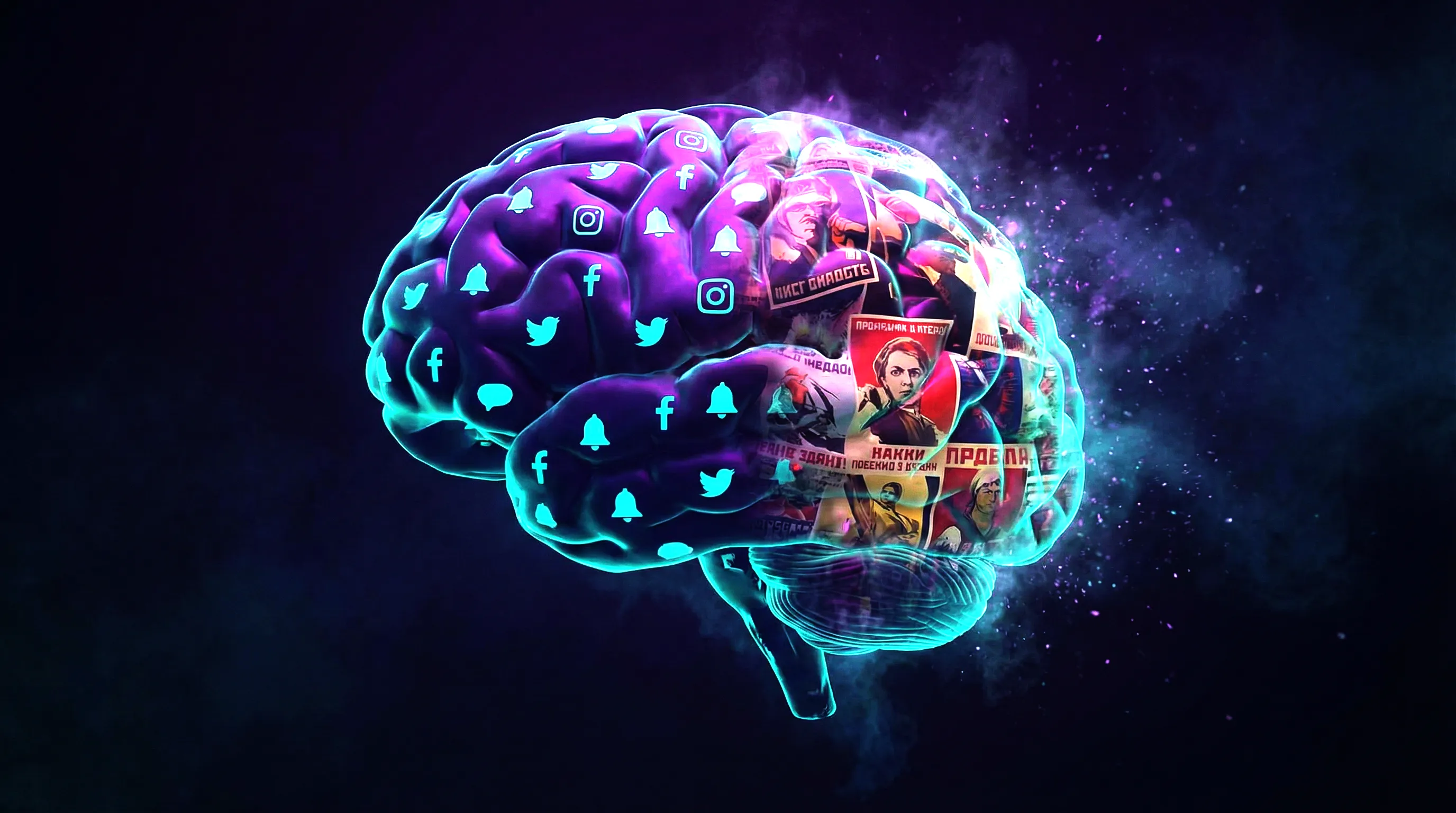
You’ve probably scrolled past propaganda today. You just didn’t know it.
That political meme your uncle shared? It may have started in a bot farm. The outrage-bait headline you almost clicked? An algorithm chose it specifically because it would make you angry. The “expert” opinion that confirmed exactly what you already believed? Someone designed it to feel that way.
Propaganda isn’t just government posters from the 1940s. It’s alive and thriving in your pocket. And the scariest part isn’t that it exists. It’s that social media has made it more effective than anything a dictator could have dreamed up.
Your Feed Is Engineered for Influence, Not Truth
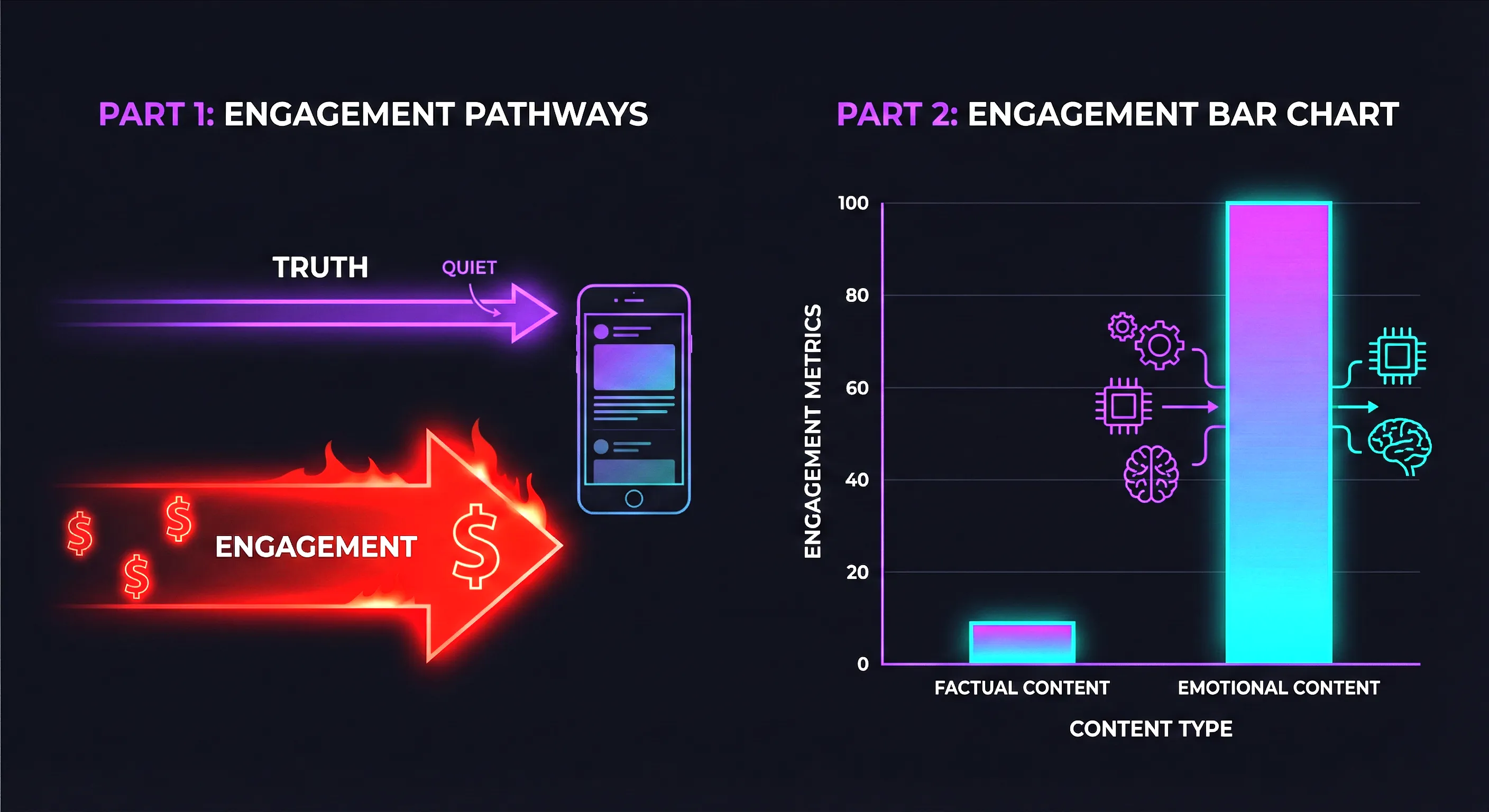
Here’s something most people don’t think about. Social media companies don’t make money by showing you accurate information. They make money by keeping you on the platform as long as possible.
That means every algorithm, every recommendation, every “suggested for you” post is optimized for one thing. Engagement. Not truth. Not balance. Not your well-being.
As researcher Lee McIntyre explains, “automated algorithms at virtually all the social media companies seem primed to spread false information and incendiary rhetoric because they are formulated to maximize engagement, clicks, and time spent on the site.”[1] The platforms aren’t built to inform you. They’re built to hook you.
The scale is staggering. As of April 2025, an estimated 5.31 billion social media accounts were in use worldwide, representing nearly 65% of the global population.[2] That level of digital saturation offers a fertile environment for disinformation to propagate rapidly, especially as generative AI systems enable low-cost, scalable content production and targeting.
This creates the perfect environment for propaganda to thrive:
- Emotional content keeps you scrolling longer than factual content
- Outrage and fear generate more clicks than nuance
- Algorithms learn what triggers you and serve you more of it
- Content that confirms your existing beliefs feels satisfying, so you stay longer
The result? Your feed becomes a funnel. It starts broad and slowly narrows until you’re seeing a very specific slice of reality. One that feels like the whole picture but isn’t even close.
“Rather than promote truth, they are engineered for profit.” - Lee McIntyre
Big tech platforms know this is happening. But as McIntyre points out, “there has so far been little incentive for them to do it” when it comes to fixing the problem.[1] Because the problem is also what makes your attention so valuable to advertisers.
Recommended read: The Chaos Machine by Max Fisher. A deep dive into how social media algorithms radicalize people and destabilize democracies worldwide.
The Old Tricks That Work Better Than Ever Online
The propaganda techniques flooding your feed aren’t new. Most of them were identified in the 1930s by a researcher named Clyde Miller. What’s changed is the delivery system. Social media turns these old tricks into precision weapons.
The Illusory Truth Effect
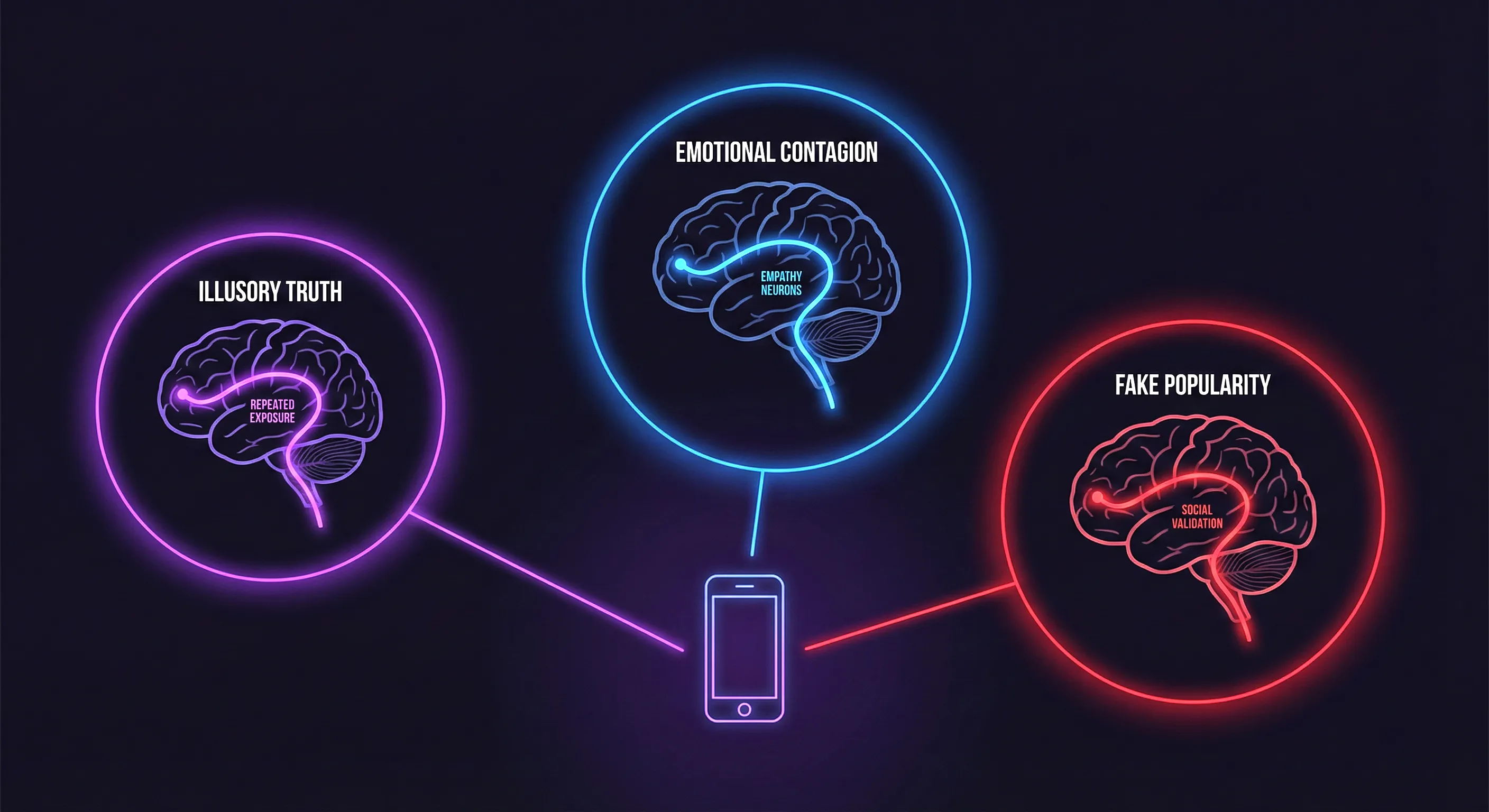
This is one of the most powerful tools in the propagandist’s kit. The illusory truth effect means that the more you hear something, the more likely you are to believe it. Even if it’s completely false.
Research by Vellani and colleagues confirmed that this effect directly leads to the spread of misinformation on social media.[3] Here’s the scary part. It works even when you already know the subject well. Your brain still registers familiar claims as more credible.
Social media supercharges this effect because algorithms show you the same types of content over and over. A lie you see ten times starts feeling like common knowledge.
Emotional Contagion
In 2014, Facebook ran a secret experiment on roughly 690,000 users.[4] They changed what people saw in their feeds. Some users saw more positive posts. Others saw more negative ones. The result? People’s own emotions shifted to match what they were shown.
“They could watch entire populations of people on Facebook shift their emotions and their behaviors without their knowledge.” - Tobias Rose-Stockwell
The study also found something crucial.[4] When there was less emotional content, people stopped posting. So the platform has every reason to keep the emotional temperature high.
Bot Networks and Manufactured Consensus
Propagandists use bot networks to make content look more popular than it really is. Political bots are automated social media accounts, often built to look and act like real people, designed to manipulate public opinion.[5] As security researcher Lukasz Olejnik describes, when 1,000 fake accounts share a post, real people start thinking “there must be something to this.” They share it too. And suddenly manufactured popularity becomes real popularity.
This is called astroturfing, manufacturing the perception of grassroots support. During the February 2025 German elections, thousands of bots promoting a political party were identified on X.[6] Many had been created specifically in January 2025 for this purpose, spamming election-related content until automated moderation caught them.[5] Bot farms have moved into the center of information warfare, using automated accounts to influence elections and weaken trust in institutions.
| Propaganda Technique | How It Worked in the 1930s | How It Works on Social Media |
|---|---|---|
| Illusory truth | Repeat slogans on radio and in newspapers | Algorithms repeat content you engage with |
| Emotional manipulation | Stirring speeches and dramatic imagery | Emotion-optimized content in your feed |
| Fake popularity | Staged rallies and planted audiences | Bot networks and artificial engagement |
| Micro-targeting | Leaflets aimed at specific neighborhoods | AI-powered psychological profiling |
| Appeal to authority | Celebrity endorsements in print | Influencer partnerships and paid promotion |
Deepfakes Changed the Game
The year 2025 marked a turning point. AI-generated content moved from novelty to weapon. And the propaganda landscape will never be the same.
The Scale of the Problem
Around half a million deepfake videos were shared on social media in 2023. Projections show up to 8 million by 2025. Over 6% of fraud incidents now involve deepfakes.[7] This is no longer a theoretical threat. It’s a daily reality.
Within the first week of 2026, experts warned of a new conundrum. What’s fake often looks real. And what’s real often looks fake. Rapid deepfake rollouts around major news events stir confusion and suspicion about legitimate news coverage.
Radicalization, Not Persuasion
Here’s the most important finding from recent research. Deepfakes rarely change people’s minds outright. Instead, they radicalize existing views. This is especially dangerous for teenagers whose algorithms are already pushing them toward extremism.
If you already distrust a politician, a deepfake showing them saying something outrageous confirms what you already believe. If you already support someone, a deepfake attacking them strengthens your loyalty. The propaganda doesn’t need to convince you of something new. It just needs to push you further in the direction you’re already leaning.
This is the same mechanism behind why people refuse to change their political beliefs. Deepfakes exploit the confirmation bias that’s already running in your head.
State-Sponsored Operations
AI-driven disinformation campaigns now leverage sophisticated techniques including deepfake propaganda, bot-driven astroturfing, algorithmic amplification, and large-scale sentiment manipulation.[8] Operations attributed to China have spread disinformation on Western social media platforms using AI models to generate posts in both English and Chinese across TikTok, X, Facebook, and Reddit.[8]
The goal isn’t always to promote a specific narrative. Often it’s simply to destroy trust. When nobody can tell what’s real anymore, democracy itself becomes harder to sustain.
The Trust Collapse
While political deepfakes and synthetic media don’t always mislead directly, they create uncertainty that erodes trust in all media. UNESCO has identified this as a “crisis of knowing.”[9] When seeing is no longer believing, the foundation of shared reality cracks. And propaganda thrives in the cracks.
Recommended read: Foolproof by Sander van der Linden. Explains how misinformation infects your mind and offers science-backed strategies to build psychological immunity.
Why Your Brain Is the Perfect Target
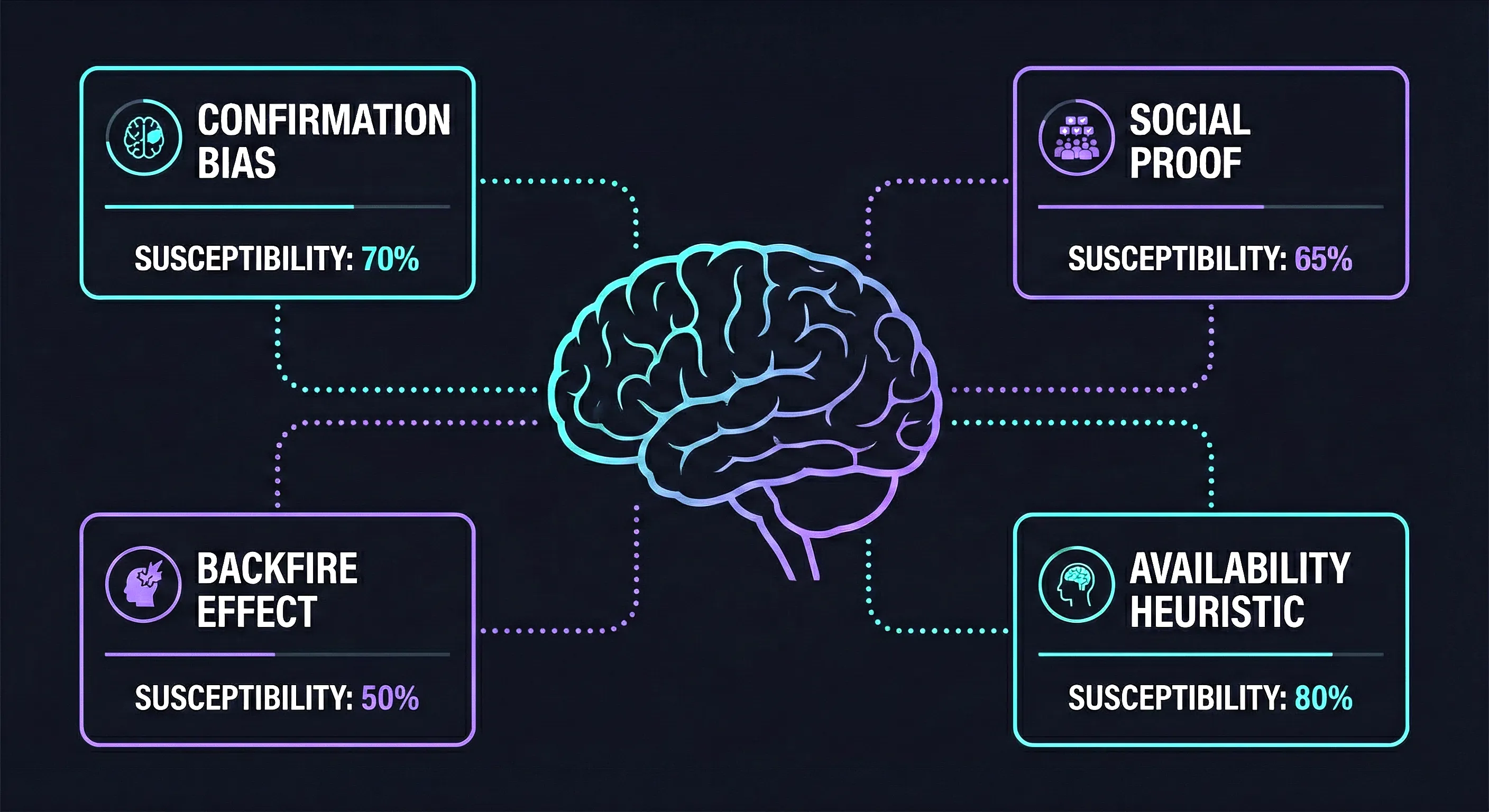
Propaganda works on social media because it exploits the same mental shortcuts your brain uses every day. These aren’t flaws. They’re features that helped your ancestors survive. But they make you vulnerable online.
You Trust What Feels Familiar
Your brain uses a simple rule. If something feels familiar, it’s probably true. Psychologists call this the availability heuristic. In a world where you encountered the same information from multiple real sources, this was a useful shortcut.
On social media, it backfires. The same false claim can appear in your feed dozens of times from different accounts. Your brain reads that repetition as evidence. Even when smart, educated people encounter this, they fall for it.
You Follow the Crowd Without Thinking
Humans are social creatures. When you see thousands of people sharing or liking something, your brain assumes it must be important or true. This is the pull of conformity and crowd behavior that psychologists have studied for decades.
Propagandists know this. That’s exactly why they use bots and coordinated networks to create the illusion of mass agreement. Once enough real people join in, the propaganda sustains itself.
You’re Wired for Outrage
Content that triggers anger or moral outrage gets shared more than any other type of content. Your amygdala, the brain’s threat detection center, lights up when you see something that violates your values. And social media platforms know this.
As Rose-Stockwell documents, Facebook’s own internal research showed that “heightened emotional content was directly associated with increased time on the platform.” They aren’t just allowing outrage. They’re incentivizing it.
Here’s what makes you most vulnerable:
- Confirmation bias. You engage more with content that matches what you already believe
- Social proof. You trust content that appears popular
- The backfire effect. Corrections sometimes make you believe the original lie even more
- Information overload. When overwhelmed, you default to quick emotional judgments instead of careful analysis
How to Protect Yourself From Social Media Propaganda
You can’t completely avoid propaganda on social media. But you can make yourself a much harder target. The key is building what researchers call psychological inoculation. Think of it like a vaccine for your mind.
-
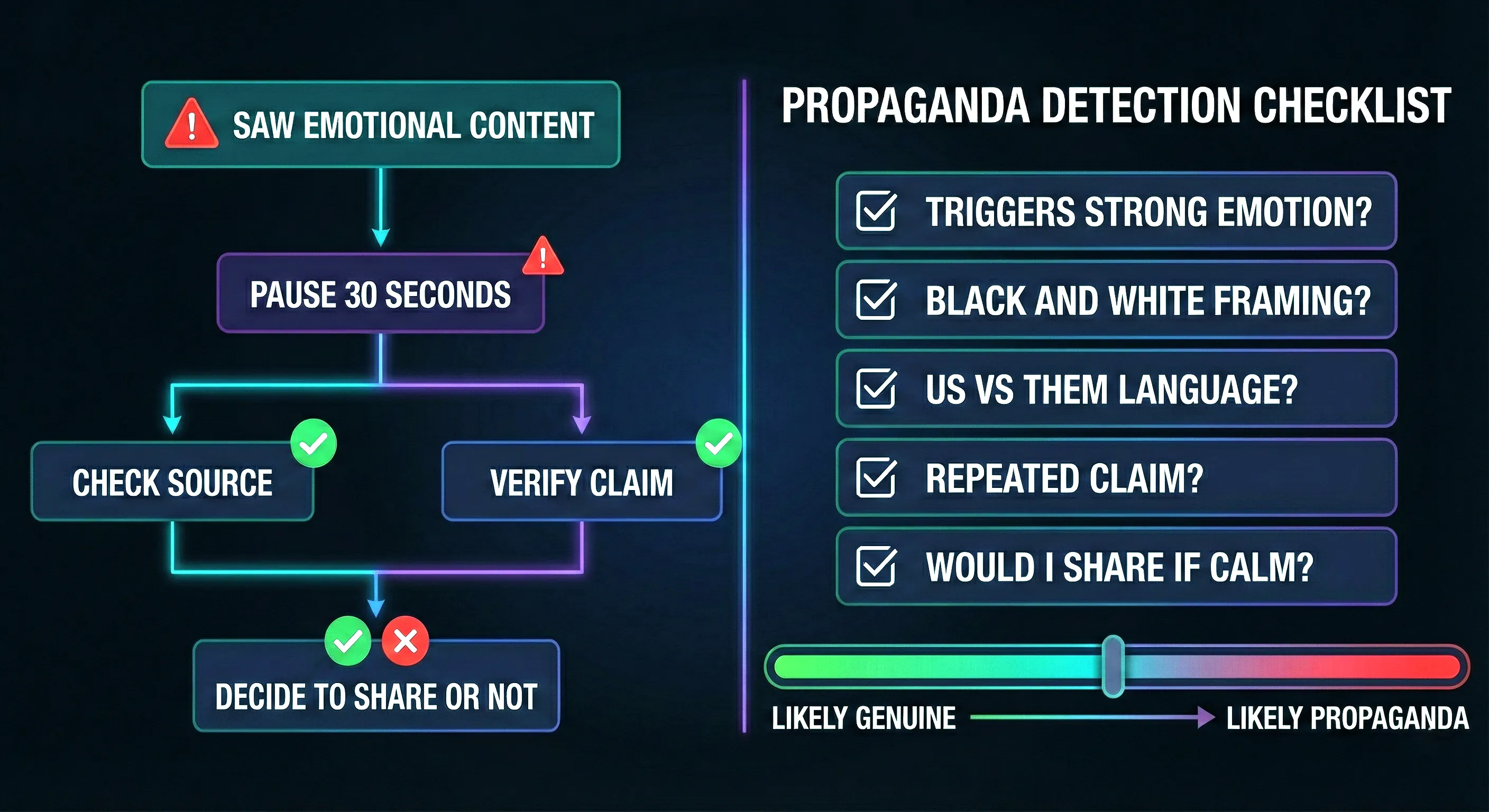
Slow down before sharing. The most effective propaganda relies on quick, emotional reactions. If something makes you furious or thrilled, pause. That emotional spike is exactly what the content was designed to trigger. Wait at least 30 seconds before engaging.
-
Check the source, not just the headline. Look at who posted the content. Is it a real person? When was the account created? Does it post at unusual hours or in suspicious patterns? Bot accounts often have generic profile photos and repetitive posting patterns. After the 2025 German election bot campaign, platform moderation caught the accounts quickly, but only after they’d already spread their messages.
-
Seek out opposing views on purpose. Algorithms create filter bubbles by showing you more of what you already agree with. Break the cycle by deliberately following sources that challenge your perspective. This doesn’t mean following extremists. It means reading thoughtful people who disagree with you.
-
Learn the techniques. Research by Roozenbeek and van der Linden showed that “psychological inoculation improves resilience against misinformation on social media.”[10] Simply knowing how propaganda works makes you less susceptible to it. You’re doing this right now by reading this post.
-
Be skeptical of video evidence. In 2025 and 2026, seeing is no longer believing. If a video seems designed to provoke outrage, verify it through multiple credible sources before reacting. Deepfakes are getting better, but they still struggle with natural hand movements, consistent lighting, and spontaneous reactions.
Here’s a quick self-check you can use:
- Does this content make me feel angry, scared, or morally superior?
- Is it presenting a complex issue as black-and-white?
- Does it use “us vs. them” language?
- Am I seeing this claim for the first time, or has it been repeated many times?
- Would I share this if I weren’t emotional right now?
If you answered “yes” to three or more of these questions, you’re likely looking at propaganda. Step back. Verify. Then decide what to do.
Every time you open a social media app, you’re stepping onto a battlefield. The weapons are algorithms, emotional triggers, and AI-generated content designed to shape what you think and believe. Your attention is the most valuable thing you own. Don’t let someone else spend it for you.
Recommended read: Outrage Machine by Tobias Rose-Stockwell. Shows how tech platforms amplify discontent and what we can do to fight back.
Sources
Your Feed Is Engineered for Influence, Not Truth
1. Post-Truth (MIT Press, 2018)
2. Global Social Media Statistics (DataReportal, 2025)
The Old Tricks That Work Better Than Ever Online
3. The Illusory Truth Effect Leads to the Spread of Misinformation (Cognition, 2023)
4. Experimental Evidence of Massive-Scale Emotional Contagion Through Social Networks (PNAS, 2014)
5. Social Media Bots Tried to Influence the U.S. Election. Germany May Be Next (Science, 2025)
Deepfakes Changed the Game
7. Deepfake Statistics 2025: The Data Behind the AI Fraud Wave (Deepstrike, 2025)
9. Deepfakes and the Crisis of Knowing (UNESCO, 2025)