You promised yourself ten minutes. Just a quick check on the latest headlines. That was two hours ago.
Your thumb keeps scrolling. Missile strikes. Civilian casualties. A shaking camera pointed at rubble. You feel sick, but you cannot look away. Your heart pounds. Your jaw is clenched. And some part of your brain whispers that stopping would be irresponsible. That you owe it to the people on screen to keep watching.
You don’t. But your brain doesn’t know that. To your amygdala, the threat is real, the danger is present, and looking away could get you killed. That ancient wiring is why you are still scrolling at 2 a.m. with tears in your eyes.
Your Amygdala Thinks the War Is Happening to You
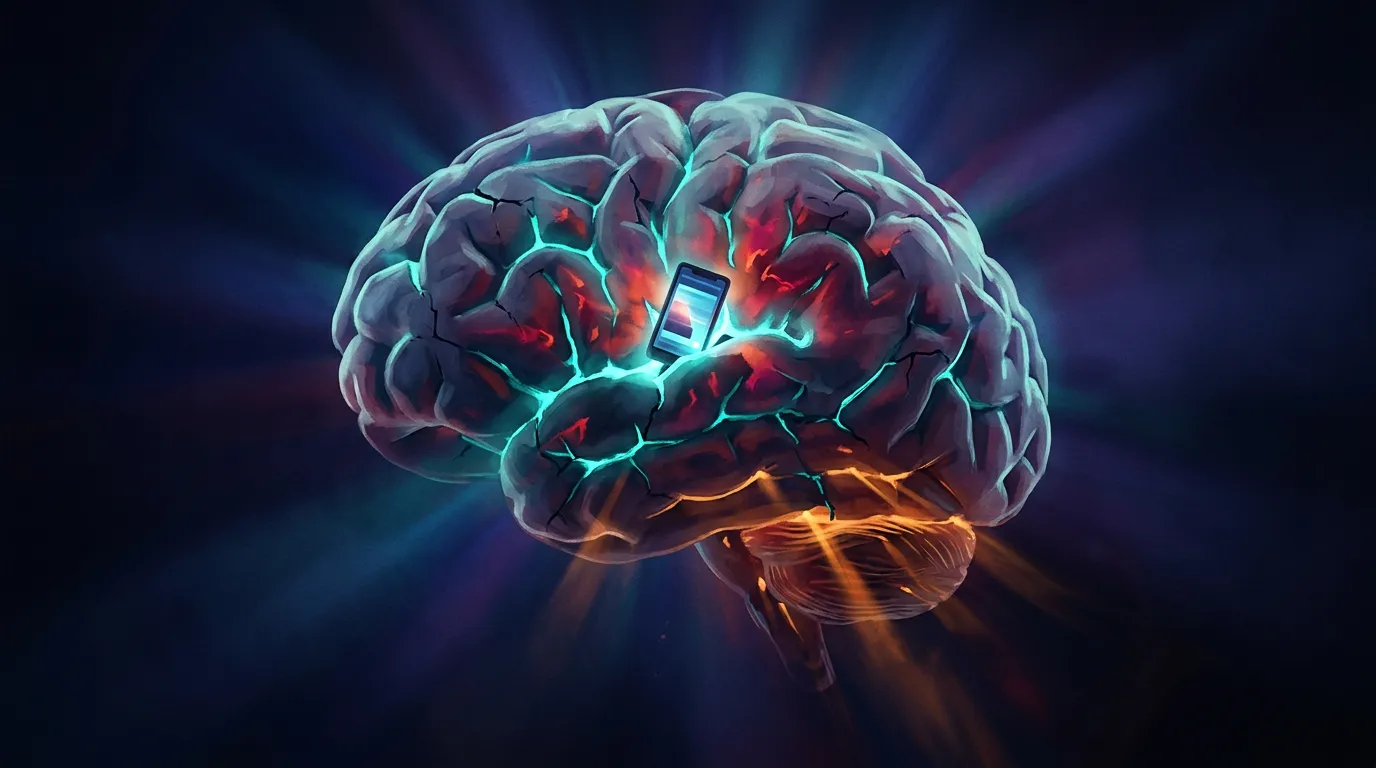
Your brain has a built-in alarm system called the amygdala. It evolved millions of years ago to detect threats. A rustling bush. A predator’s shadow. The scream of a tribal member in danger. When the amygdala detects something threatening, it triggers your fight-or-flight response in milliseconds. Faster than conscious thought.[1]
Here is the problem. Your amygdala cannot tell the difference between a real threat and a video of one on your phone. When you watch footage of a missile strike, your brain responds as if the explosion is happening outside your window. Cortisol floods your bloodstream. Adrenaline spikes. Your heart rate climbs.
The Negativity Bias Makes It Worse
This response is amplified by something psychologists call the negativity bias. Your brain gives roughly twice as much weight to negative information as positive information. The amygdala uses about two-thirds of its neurons specifically to detect negativity and stores that information into long-term memory faster than anything positive.[2]
From an evolutionary standpoint, this made perfect sense. Missing a real threat meant death. A false alarm just meant wasted energy. So your brain evolved to err on the side of caution. It overestimates danger and underestimates safety. Every time.
That is why one brutal war clip can erase the calming effect of twenty cat videos. Your brain is built to prioritize the threat.
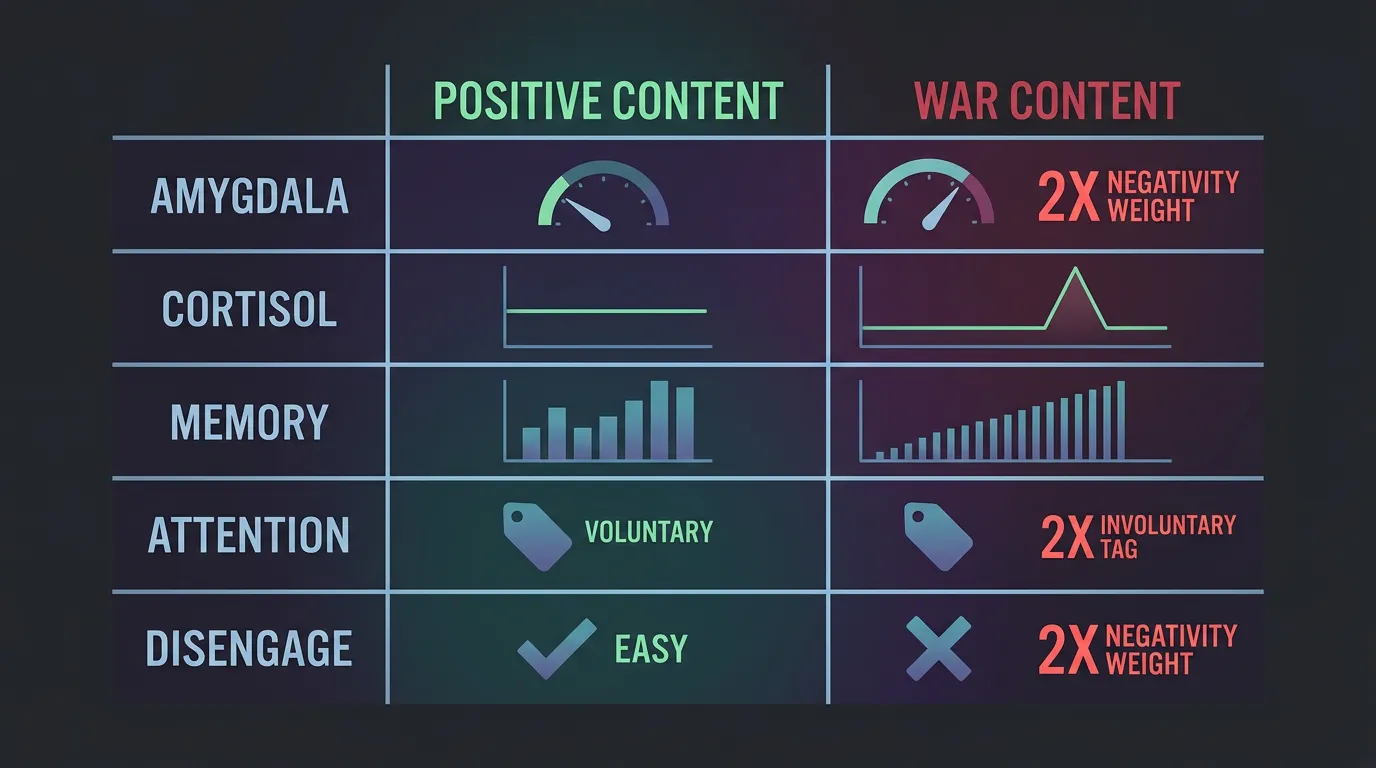
| Response | Positive Content | War/Threat Content |
|---|---|---|
| Amygdala activation | Slow, moderate | Instant, intense |
| Cortisol release | Minimal | Significant spike |
| Memory encoding | Standard | Rapid, long-term |
| Attention capture | Voluntary | Involuntary |
| Time to disengage | Easy | Extremely difficult |
Recommended read: The Sirens’ Call by Chris Hayes. A powerful exploration of how attention became the world’s most endangered resource and why your brain is losing the battle.
The Algorithm Is Designed to Exploit Your Fear
Your brain’s threat-detection system did not evolve for social media. But social media evolved for it.
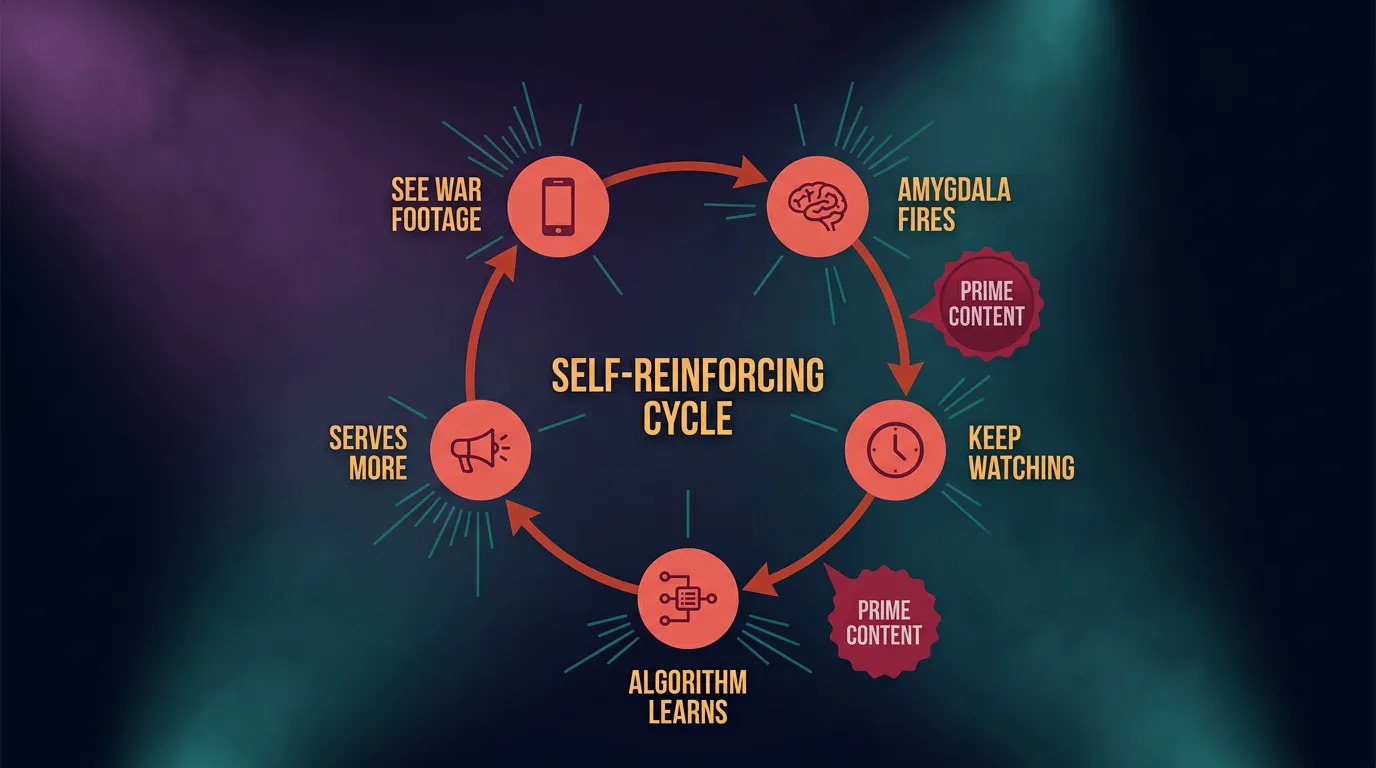
Platforms like TikTok, X, and Instagram use algorithms that track one metric above all others: engagement. And nothing drives engagement like fear, outrage, and moral disgust. A 2025 study in the Journal of Media Psychology found that negativity biases in individuals interact with content algorithms to create a feedback loop. The algorithm learns that threatening content keeps you scrolling, so it serves you more of it.[3]
Researchers at Northwestern University discovered that algorithms specifically amplify what they call PRIME information. That stands for Prestigious, Ingroup, Moral, and Emotional. War footage hits every single one of those categories. The research showed that algorithms oversaturate feeds with emotionally charged content regardless of whether it is accurate or representative.[4]
How the Feedback Loop Works
- You see war footage. Your amygdala fires. Cortisol surges.
- You keep watching. The algorithm registers this as high engagement.
- The algorithm serves more. Your feed fills with increasingly graphic content.
- Your baseline shifts. Your brain adapts to the stress and needs more intense content to trigger the same response.
- You cannot stop. The cycle self-reinforces.
This is what Tobias Rose-Stockwell, author of Outrage Machine, calls the fundamental design flaw of attention-based platforms. The algorithm does not want to traumatize you. It does not have feelings. But trauma keeps you engaged. So the algorithm feeds you more of it.
A 2026 scoping review led by Sharpe and colleagues analyzed seventeen empirical studies on doomscrolling and confirmed consistent associations with anxiety, depression, stress, and reduced resilience. The theoretical explanations centered on rumination, emotional exhaustion, and intolerance of uncertainty.[5]
Watching War on a Screen Can Give You Real Trauma
Here is the part most people do not expect. You do not have to be anywhere near a war zone to develop trauma symptoms from watching one.
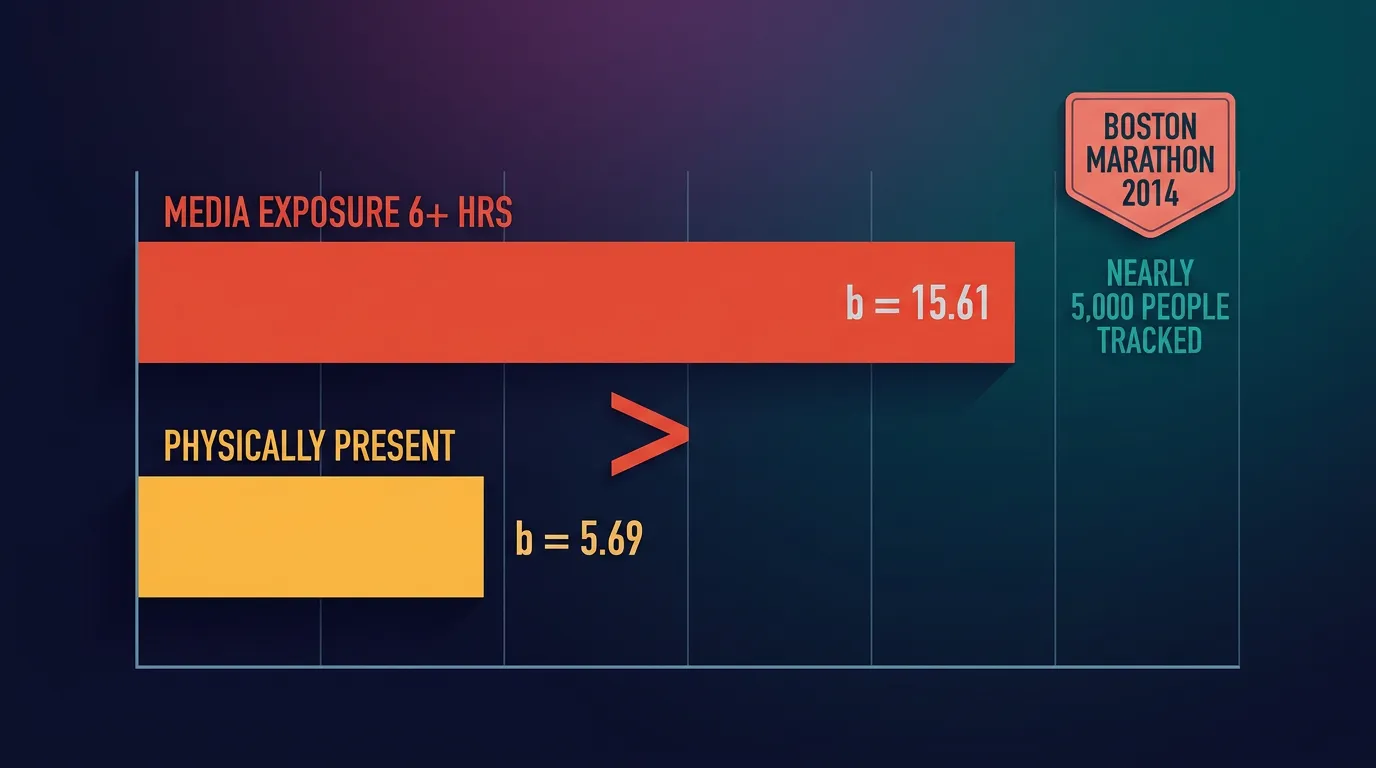
The landmark 2014 study by Holman, Garfin, and Silver at UC Irvine tracked nearly 5,000 people after the Boston Marathon bombings. Their finding shocked the research community. People who consumed six or more hours of bombing-related media coverage per day developed more acute stress symptoms than people who were physically present at the bombing. Media exposure was associated with higher acute stress (b = 15.61) than direct exposure (b = 5.69).[6]
This is not a metaphor. This is measurable, clinical-grade stress.
Vicarious Traumatization Is Real
Psychologists call this vicarious traumatization. It happens when repeated exposure to other people’s trauma changes your own psychological functioning. Originally studied in therapists and first responders, the concept now applies to anyone who spends hours consuming graphic content online.
A 2024 study published in JMIR Mental Health examined the impact of war-related media across 11 countries. It found that continuous media coverage and graphic imagery heightened anxiety and helplessness even in populations far from the conflict zone. Prolonged uncertainty about the war’s resolution contributed significantly to the mental health burden.[7]
Researchers at Boston University have raised alarms about a surge in vicarious trauma linked specifically to news and social media consumption. In a study conducted before the pandemic, religious leaders across the US reported secondary traumatic stress at rates higher than military personnel.[8]
Key symptoms of media-induced vicarious traumatization include:
- Intrusive thoughts about images you have seen online
- Difficulty sleeping or nightmares about war footage
- Emotional numbness or feeling detached from people around you
- Hypervigilance and scanning for new threats
- Guilt about looking away or not doing enough
- Physical symptoms like headaches, nausea, or chest tightness
A 2024 study on doomscrolling and mental well-being found that mindfulness and secondary traumatic stress fully mediated the relationship between doomscrolling and reduced mental well-being. In other words, doomscrolling does not just make you feel bad. It changes how your brain processes stress.[9]
Recommended read: Extremely Online by Taylor Lorenz. The untold story of how internet culture reshaped human attention and emotional experience.
The Paradox of Feeling Informed While Being Traumatized
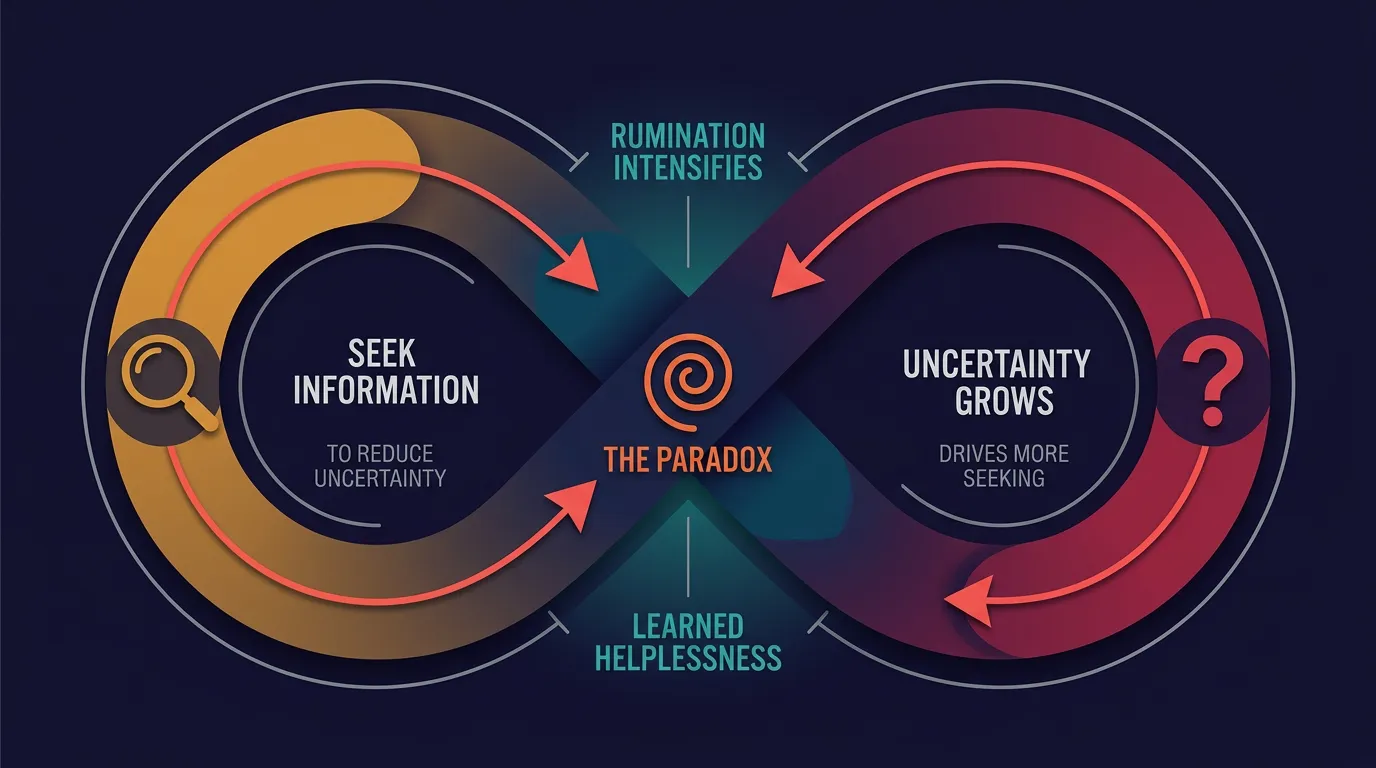
There is a cruel trick your brain plays on you during a doomscrolling session. It tells you that consuming more information will make you safer. That staying glued to the feed is a form of preparation. That looking away would be naive or selfish.
This is your brain confusing information-seeking with threat-monitoring. In the wild, gathering information about a nearby predator genuinely helped you survive. But scrolling through your twentieth graphic war video at midnight does not prepare you for anything. It just keeps your stress response locked in the on position.
The Information Illusion
Research on doomscrolling and uncertainty reveals a painful paradox. The more war coverage you consume, the less certain you feel. A 2025 study published in JMIR Mental Health found that media-induced uncertainty was the primary driver of psychological distress. Not the content itself, but the feeling that no amount of information could resolve the ambiguity.[10]
| What You Think | What Actually Happens |
|---|---|
| ”I’m staying informed” | Your stress hormones stay elevated for hours |
| ”I’ll feel better once I understand the situation” | Each new update deepens uncertainty |
| ”I owe it to the victims to watch” | Vicarious trauma reduces your capacity to help |
| ”Just five more minutes” | Two hours pass without awareness |
| ”I need to know what’s happening” | Repeated exposure creates learned helplessness |
A study linking intolerance of uncertainty, doomscrolling, and rumination found that people who struggled most with ambiguity were the most compulsive doomscrollers. And that doomscrolling intensified their rumination, creating a spiral where seeking information to reduce uncertainty actually increased it.[11]
Recommended read: Shift by Ethan Kross. A science-backed guide to managing your emotional responses before they manage you.
How to Break the Doomscrolling Cycle
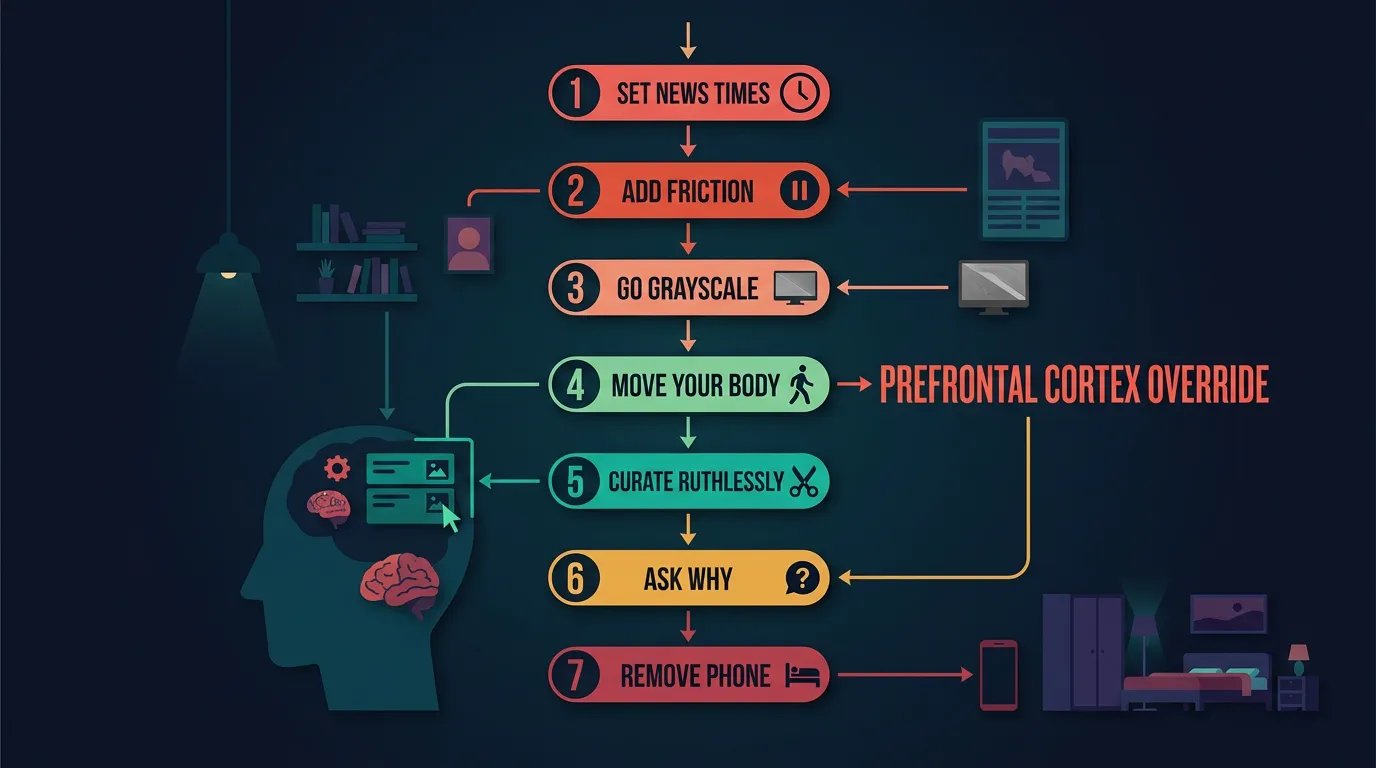
Breaking the cycle does not mean ignoring the world. It means consuming information intentionally instead of compulsively. Here are evidence-based strategies that work.
-
Set a news schedule. Check the news twice a day at fixed times. Morning and evening. Use a timer. When the timer goes off, you stop. This replaces reactive scrolling with intentional consumption.
-
Use friction tools. Apps like OneSec, Freedom, and Opal add a pause before you open social media. That brief interruption breaks the automatic habit loop and gives your prefrontal cortex time to override the amygdala.
-
Switch to grayscale. Turning your phone display to black and white reduces the dopamine hit from colorful, emotionally charged thumbnails. Studies show this lowers compulsive usage significantly.
-
Replace the behavior. Your brain needs a substitute. When you feel the urge to scroll, do something physical instead. A walk, pushups, or even holding ice cubes. The physical sensation interrupts the stress cycle.
-
Curate ruthlessly. Unfollow accounts that post graphic content without context or solutions. Follow journalists who provide analysis, not just footage. Your feed is not neutral. You can reshape it.
-
Practice the STOP technique. When you catch yourself doomscrolling, pause and ask: Am I scrolling out of curiosity or compulsion? If the answer is compulsion, close the app. This builds metacognitive awareness.
-
Move your phone. Keep your phone out of your bedroom. The single most effective intervention against nighttime doomscrolling is physical distance between you and the device.
When to Seek Professional Help
If you experience intrusive thoughts, nightmares, emotional numbness, or persistent anxiety related to war footage you have seen online, you may be experiencing vicarious traumatization. This is a real clinical condition and it responds well to evidence-based treatments like EMDR and cognitive processing therapy. Talk to a mental health professional.
A 2025 meditation study found that mindfulness-based interventions specifically reduced doomscrolling behavior and improved psychological resilience in young adults.[12]
Recommended read: Dopamine Nation by Anna Lembke. A Stanford psychiatrist explains the pleasure-pain balance and why digital compulsions respond to the same strategies as any other addictive behavior.
Sources
Your Amygdala Thinks the War Is Happening to You
1. The Neuroscience of Doomscrolling: How It Rewires Your Brain (Therapy Group DC, 2025)
The Algorithm Is Designed to Exploit Your Fear
4. Social media algorithms exploit how we learn from our peers (Northwestern University, 2023)
Watching War on a Screen Can Give You Real Trauma
6. Media’s role in broadcasting acute stress following the Boston Marathon bombings (PNAS, 2014)
The Paradox of Feeling Informed While Being Traumatized
How to Break the Doomscrolling Cycle
12. Breaking the Doomscrolling Cycle: Meditation as a Remedy for Anxiety in the Digital Age (SSRN, 2025)