You know that person who always has wild ideas? The one who sees connections nobody else notices, who can turn a blank page into something surprising?
You’ve probably wondered why they seem to think differently. Maybe you’ve even wondered if there’s something wrong with you for not being that way.
Here’s the thing. Creativity isn’t magic. It’s not a gift handed to a lucky few at birth. Neuroscience is finally showing us exactly why some brains generate more original ideas than others. And the answers are stranger than you’d expect.
Your Brain’s Creative Wiring Is Different Than You Think
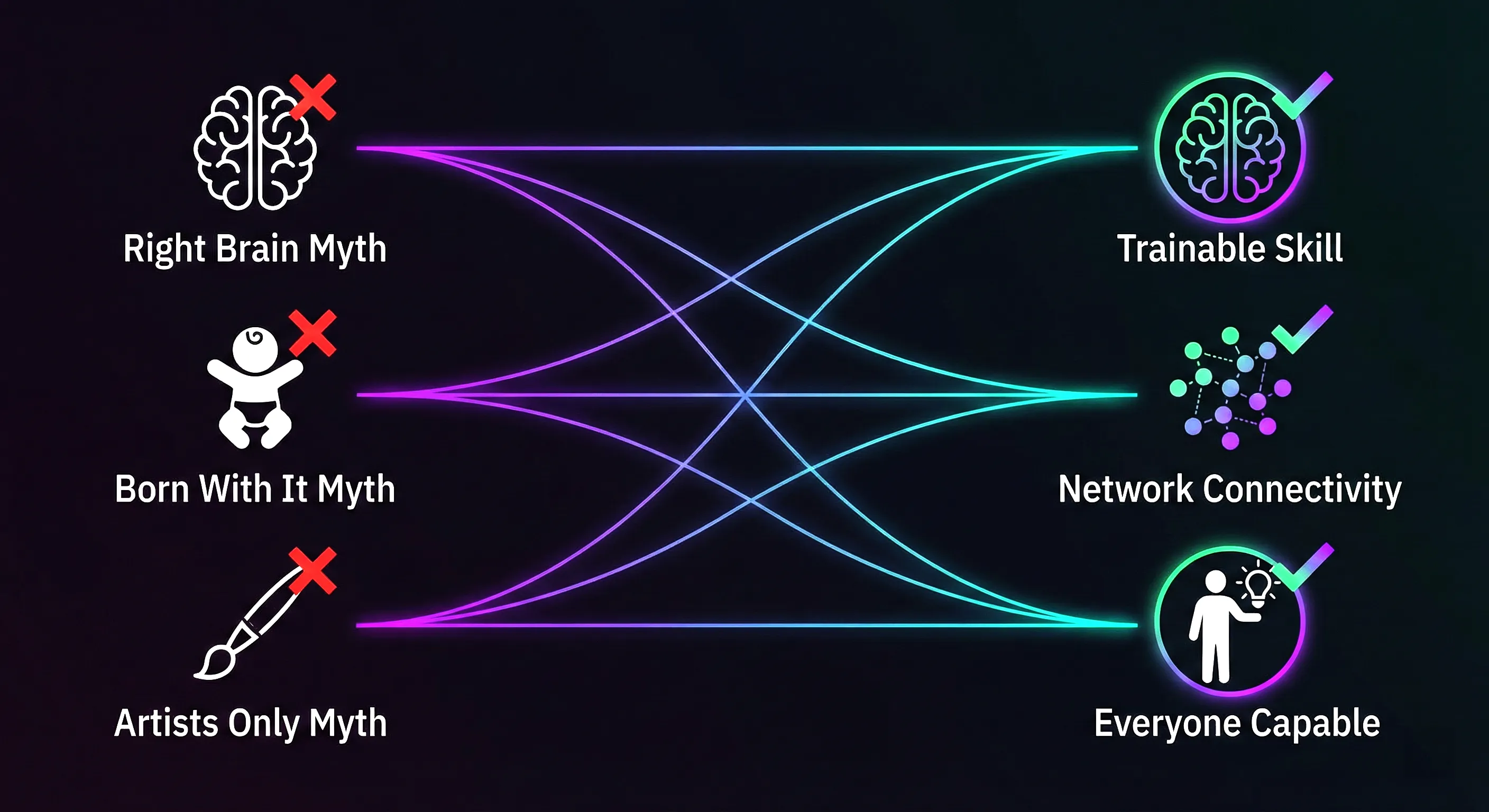
For decades, people believed creativity lived in the “right brain.” That’s a myth. Brain imaging studies have demolished it completely.
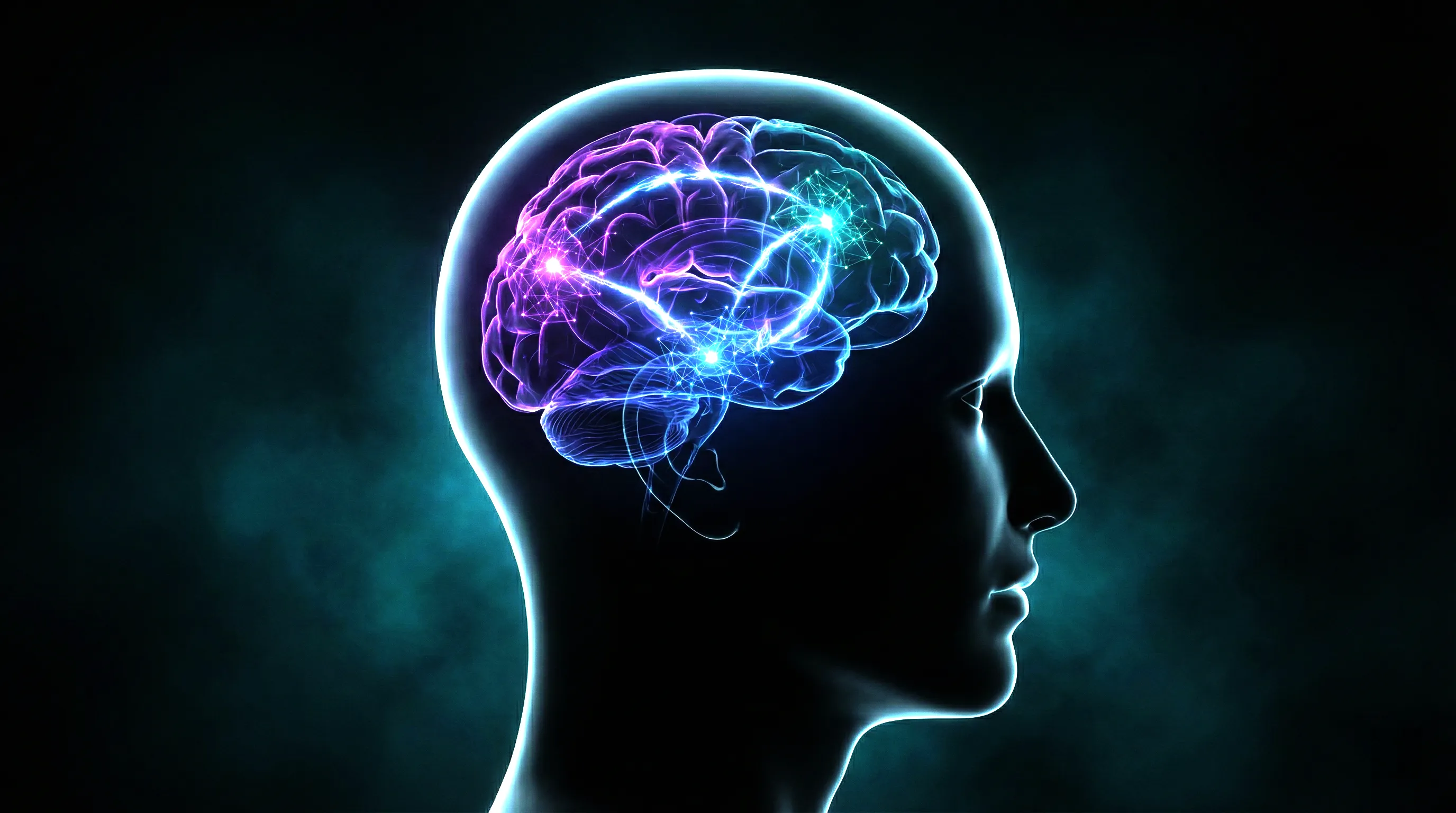
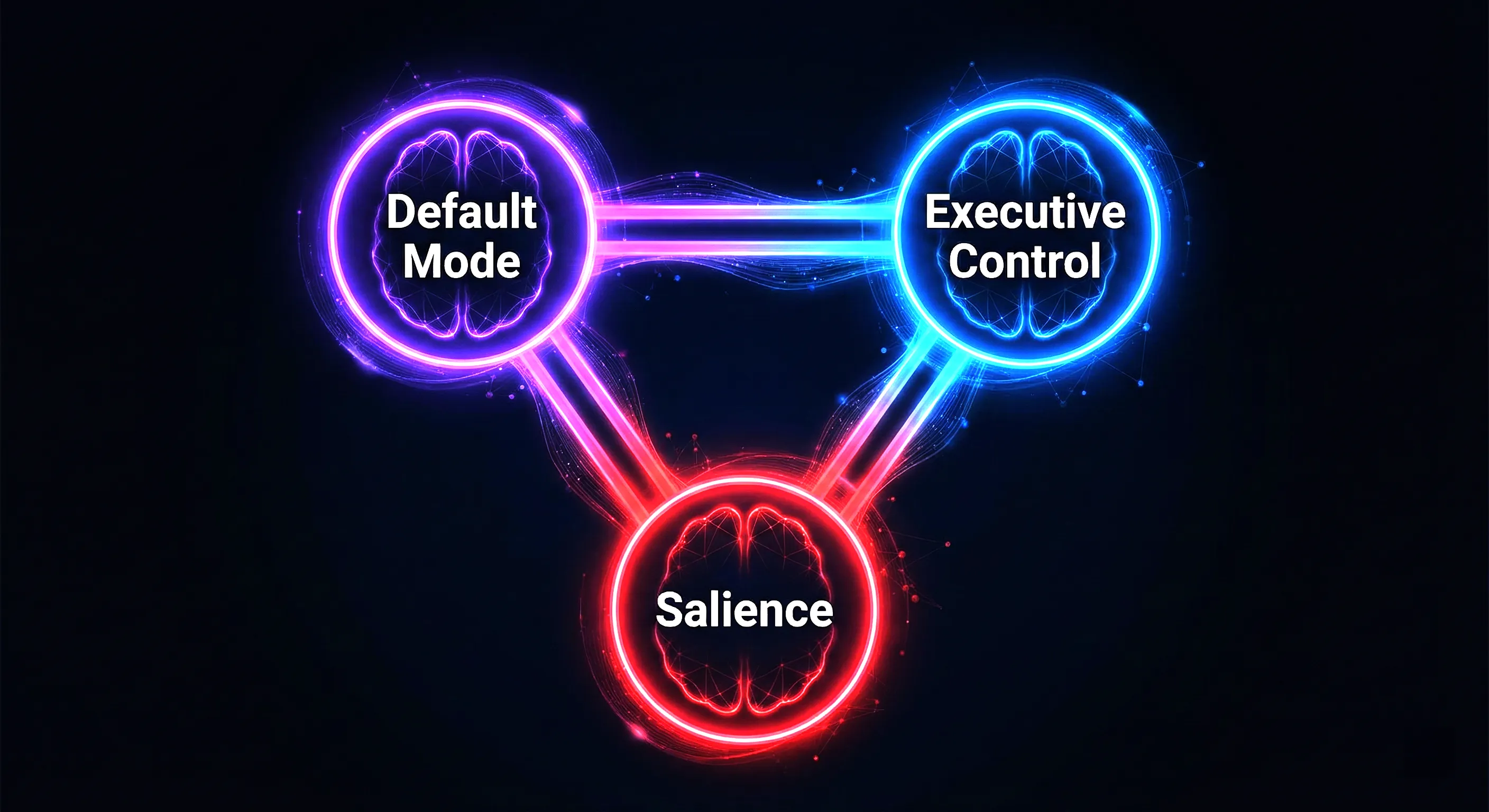
Creativity doesn’t come from one side of your brain. It comes from how well different brain networks talk to each other. A landmark study published in Proceedings of the National Academy of Sciences found that creative ability can be predicted by the strength of connections between three specific networks.[1]
- The default mode network. This fires up when you’re daydreaming, mind wandering, or thinking about hypothetical scenarios.
- The executive control network. This kicks in when you need to focus, evaluate ideas, and make decisions.
- The salience network. This acts as a switch operator, deciding when to toggle between the other two.
Most people use these networks separately. Creative people use them simultaneously. Their brains can brainstorm freely and evaluate critically at the same time. It’s like having a conversation where you’re both the wild dreamer and the sharp editor in the same breath.
“Creative people are better able to co-activate brain networks that in most people don’t typically work together.” — Roger Beaty, Penn State University
A 2025 international brain-imaging study across 13 countries took this further. Researchers examined over 1,400 participants and found that people who regularly engaged in creative activities like dancing, making music, or creating visual art had brains that looked biologically younger.[2] The effect got stronger with more years of creative experience. Even short-term creative training produced measurable improvements in brain aging markers.
Your creative wiring isn’t fixed. It reshapes itself the more you use it.
The Boredom Advantage, Why Doing Nothing Sparks Ideas
Here’s a counterintuitive finding. Creative people are better at doing nothing.
A 2025 study from the University of Arizona found that highly creative individuals actually enjoy sitting alone in a room with their thoughts.[3] They don’t get restless or anxious. Instead, they let one idea lead to another, building chains of associations that less creative people simply don’t experience.
During the COVID-19 pandemic, researchers noticed the same pattern. Creative people reported less boredom during lockdowns because they stayed engaged with their own thoughts.
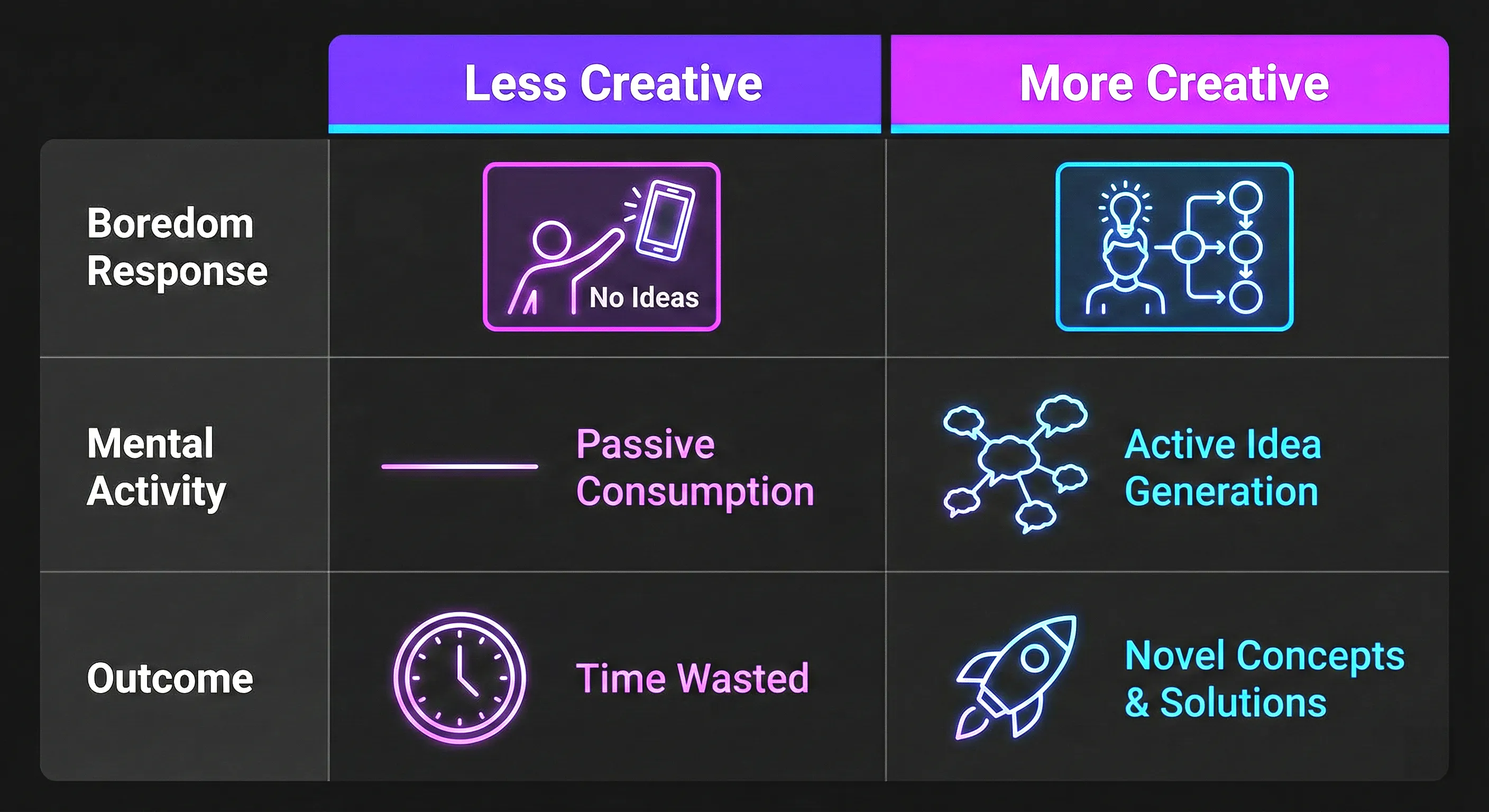
This connects to what neuroscientists call the default mode network. When you’re bored, this network lights up. It starts pulling together random memories, future scenarios, and half-formed ideas. For most people, this just feels uncomfortable. For creative people, it’s where the magic happens.
| Boredom Response | Less Creative | More Creative |
|---|---|---|
| Sitting alone with thoughts | Feels anxious, reaches for phone | Enjoys it, lets ideas flow |
| Unstructured time | Seeks external stimulation | Generates internal connections |
| Mind wandering | Random, unfocused | Deliberate, associative |
| Pandemic lockdown experience | Higher boredom | Lower boredom, more engagement |
Research presented at the 2025 ECNP congress in Amsterdam added another layer. Scientists found that ADHD is linked to higher levels of creativity.[4] The connecting factor? Deliberate mind wandering. People with ADHD who intentionally let their thoughts roam scored higher on creativity measures than neurotypical participants.
“Mind wandering, particularly deliberate mind wandering where people allow their thoughts to wander on purpose, was associated with greater creativity in people with ADHD.” — 2025 ECNP Research Presentation
This doesn’t mean you need ADHD to be creative. But it does mean that the urge to let your mind drift, something schools and workplaces actively punish, might be one of your brain’s most valuable creative tools. If you’ve ever noticed how your brain’s reward system shapes your habits, you’ll see a similar pattern here. The things we’re told to suppress often serve a deeper purpose.
Recommended read: Stolen Focus by Johann Hari — a deep dive into why our ability to pay attention is collapsing and how reclaiming boredom might be the key to creative thinking.
The Constraints Paradox, Why Limits Make You More Creative
This one trips everyone up. You’d think total freedom would produce the most creative work. Give someone unlimited time, unlimited resources, and zero rules. That should be the recipe for genius, right?
Wrong. Research consistently shows the opposite.
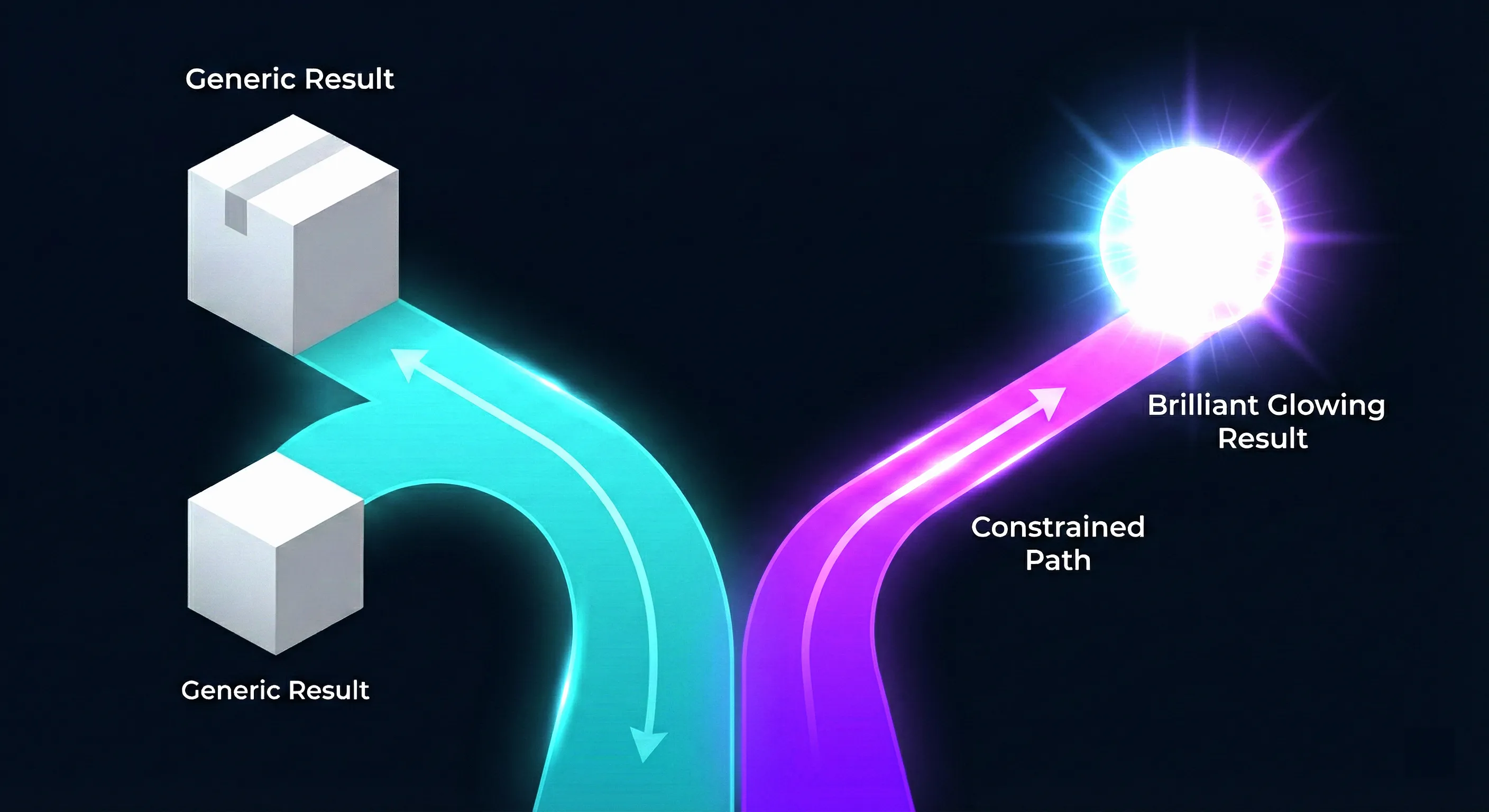
Psychologists Christine Moreau and Darren Dahl ran a study where participants created art under two conditions. One group had specific constraints. The other had complete freedom. Independent judges rated the constraint-driven work 37% higher for originality.[5]
Why? Constraints force your brain to search harder. When you can’t take the obvious path, you’re pushed into low-probability, unusual territory. Your executive control network has to work overtime, and that intense cognitive effort produces more novel combinations.
- Dr. Seuss wrote Green Eggs and Ham after a bet that he couldn’t write a book using only 50 different words. It became one of the best-selling children’s books in history.
- Twitter’s 140-character limit spawned entirely new forms of communication, humor, and storytelling.
- Haiku poets have produced centuries of profound art within a rigid 5-7-5 syllable structure.
A 2024 study in Organization Studies found that different types of constraints interact to produce different creative outcomes.[6] Problem constraints and resource constraints work through completely different mechanisms. Sometimes constraining the problem but freeing up resources works best. Sometimes it’s the reverse. The key insight is that some form of limitation almost always outperforms total freedom.
This connects to something psychologists call functional fixedness. When you have unlimited options, your brain defaults to the most familiar solutions. It takes the lazy path. Constraints break that pattern and force genuine originality. It’s the same reason cognitive biases quietly sabotage your everyday decisions. Your brain prefers shortcuts until something forces it off the beaten path.
Recommended read: A Whack on the Side of the Head by Roger von Oech — a classic guide to breaking through mental blocks using creative constraints and provocations.
Five Science-Backed Ways to Train Your Creative Brain
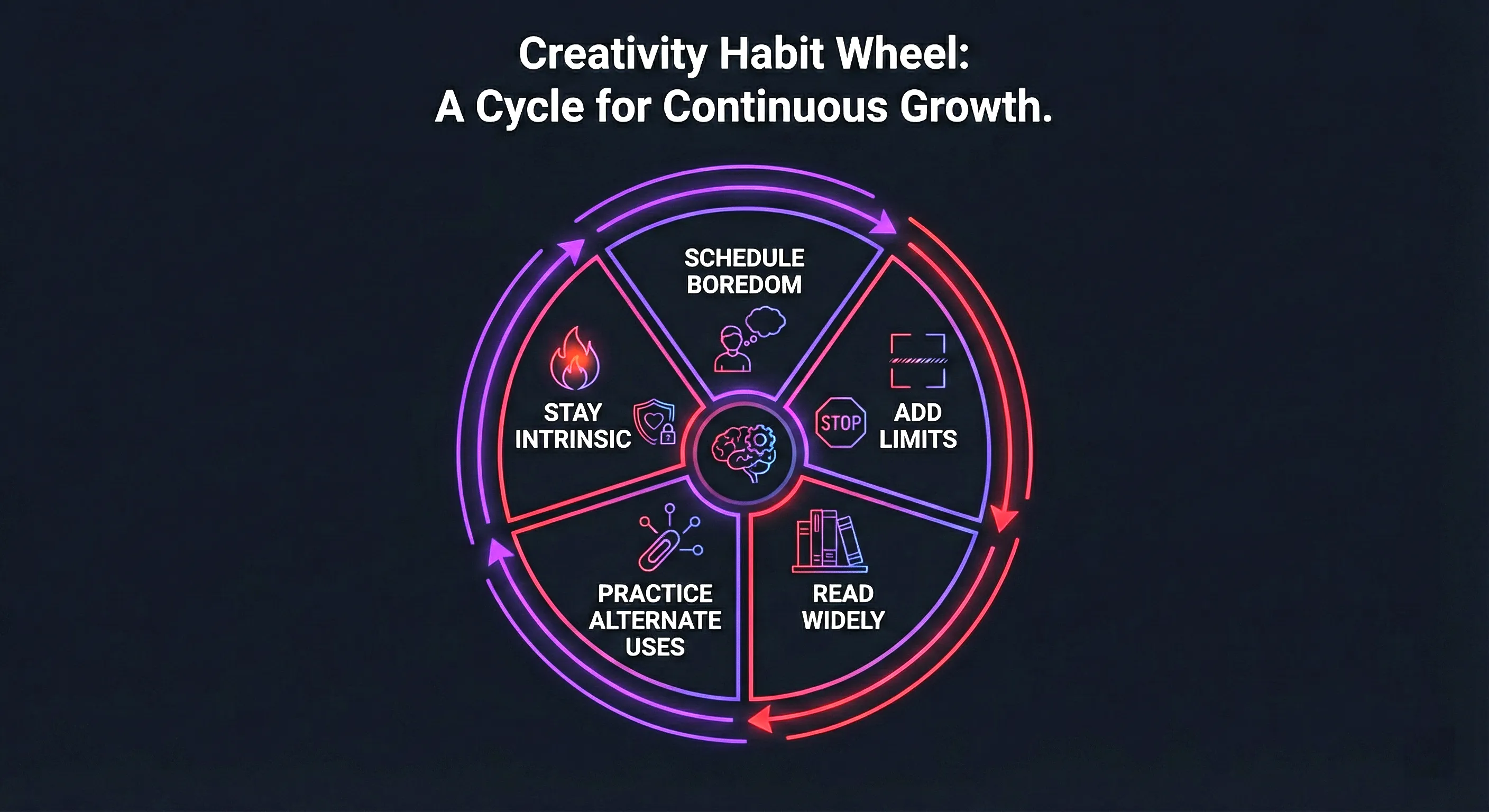
Creativity isn’t a fixed trait. It’s more like a muscle. Here’s what the research says actually works.
-
Schedule unstructured time. Block 20-30 minutes daily with no phone, no tasks, no input. Let your default mode network do its thing. The University of Arizona study found this is what separates creative thinkers from everyone else.
-
Add constraints on purpose. Give yourself artificial limits. Write with only 100 words. Solve a problem using only materials in your kitchen. Design something in 15 minutes instead of an hour. Research shows constraints force originality.
-
Diversify your inputs. Creative people connect distant ideas. You can’t do that if all your inputs come from the same domain. Read outside your field. Talk to people who think differently. A 2026 study found that multicultural attitudes and openness to experience directly predicted divergent thinking scores.
-
Practice divergent thinking exercises. The classic: list as many uses for a brick as you can in two minutes. Do this regularly. Research on upper alpha brain waves shows that divergent thinking practice literally changes your neural patterns over time.
-
Protect your intrinsic motivation. Teresa Amabile’s decades of research at Harvard Business School identified the single biggest creativity killer. External evaluation.[7] When people feel watched, judged, or rewarded for performance, their creative output drops sharply. Work on creative projects for the joy of it, not the outcome.
What About the “Creative Personality”?
Mihaly Csikszentmihalyi spent 30 years studying the world’s most creative people.[8] He found they share a paradoxical trait. They hold contradictions comfortably. They’re both playful and disciplined. Introverted and extroverted. Humble and proud. They can switch between these modes fluidly.
This isn’t a personality type you’re born with. It’s a flexibility you develop. The more you expose yourself to different experiences and ways of thinking, the more comfortable you become holding opposing ideas at the same time. And that, Csikszentmihalyi argued, is the foundation of all creative work.
“If I had to express in one word what makes their personalities different from others, it’s complexity. They show tendencies of thought and action that in most people are segregated.” — Mihaly Csikszentmihalyi
Recommended read: Creativity: Flow and the Psychology of Discovery and Invention by Mihaly Csikszentmihalyi — the definitive study of what makes creative people tick, based on interviews with 91 exceptional creators.
Creativity Isn’t What You Were Told
The old story about creativity was simple. Some people have it, most don’t. The right brain does it, the left brain doesn’t. Artists are creative, accountants aren’t.
None of that is true.
Creativity is a measurable, trainable cognitive process. It depends on how your brain networks communicate, how comfortable you are with boredom and ambiguity, and whether your environment supports or suppresses intrinsic motivation. The 2025 brain aging study proved that creative engagement literally keeps your brain younger.[2] The constraints research showed that limitations fuel originality.[5] [6] The ADHD research revealed that mind wandering, the thing we’ve been taught to suppress, is a creative superpower.[4]
You don’t need to be born different. You need to think differently about how you use the brain you already have. If you’re curious about how your personality shapes the way you approach problems like this, the science of personality change offers some surprising answers.
The most creative thing you can do today? Close this tab, sit with your thoughts for 20 minutes, and see what happens.
Recommended read: Originals by Adam Grant — explores how nonconformists move the world, with research-backed strategies for championing original ideas.
Sources
Your Brain’s Creative Wiring Is Different Than You Think
1. Robust Prediction of Individual Creative Ability from Brain Functional Connectivity (PNAS, 2018)
2. Creative Experiences and Brain Clocks (Nature Communications, 2025)
The Boredom Advantage, Why Doing Nothing Sparks Ideas
4. ADHD and Creativity: Mind Wandering as a Mediating Factor (ECNP Congress, 2025)
The Constraints Paradox, Why Limits Make You More Creative
Five Science-Backed Ways to Train Your Creative Brain
7. Componential Theory of Creativity (Harvard Business School, 2012)