
Your parents told you to stop sleeping in. Your alarm clock is set for 7 AM even on Saturdays. And every productivity guru on the internet says you should wake up at 5 AM, seven days a week.
They’re all wrong. Science just proved it.
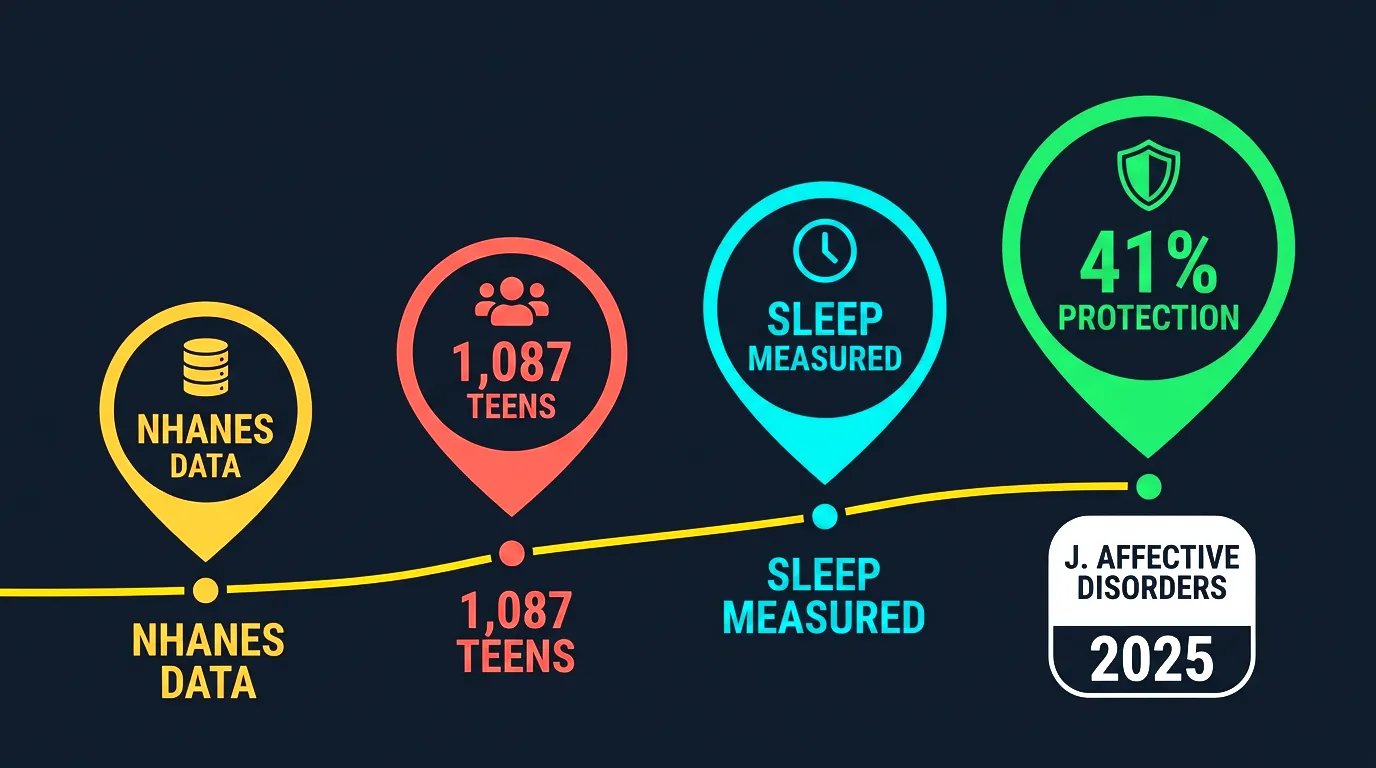
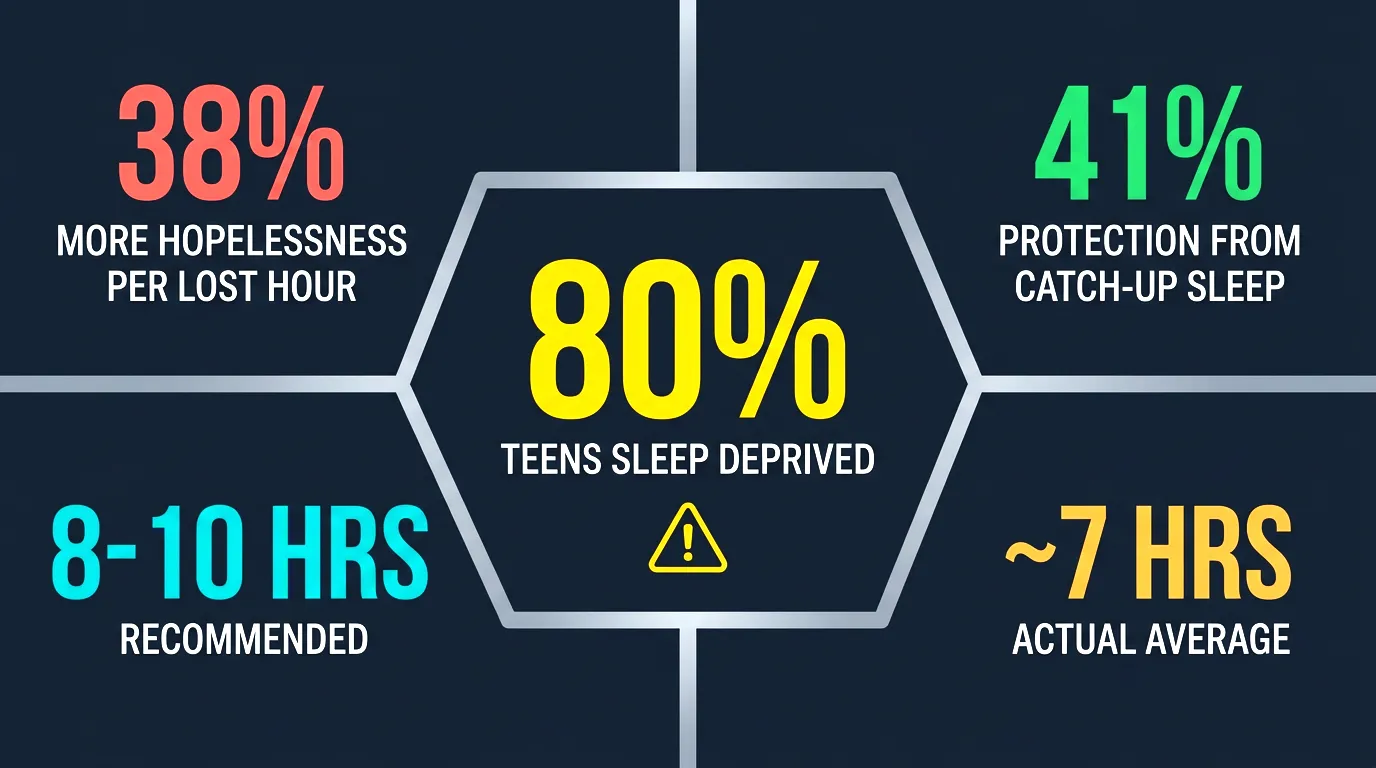
A 2025 study in the Journal of Affective Disorders found that young people who caught up on sleep over the weekend had a 41% lower risk of depression.[1] That’s not a small effect. That’s roughly the same protection you’d get from regular exercise. And all you have to do is sleep.
What the Research Actually Found
Researchers Jason Carbone and Melynda Casement analyzed data from 1,087 Americans aged 16 to 24.[1] The data came from NHANES, the National Health and Nutrition Examination Survey, collected between 2021 and 2023. NHANES is one of the most reliable health datasets in the country.
The researchers compared two groups. People who slept more on weekends than weekdays. And people who didn’t. Then they checked who reported feeling “sad or depressed” on a daily basis.
The results were striking.
- Young adults with weekend catch-up sleep had 41% lower odds of daily depressive symptoms
- The protective effect held up even after controlling for age, sex, race, income, and overall sleep duration
- The effect was strongest in people aged 16 to 24, the age group most vulnerable to depression
“Weekend catch-up sleep was associated with significantly lower odds of daily depressive symptoms in late adolescence and young adulthood.” — Carbone & Casement, Journal of Affective Disorders, 2025
This isn’t the only study pointing in this direction. A separate 2025 meta-analysis in the same journal pooled data from multiple studies and found that weekend catch-up sleep is linked to a 20% lower risk of depression across all age groups.[2]
Why This Matters Right Now
The timing of this research couldn’t be more important. Nearly 80% of American teenagers aren’t getting the recommended 8 to 10 hours of sleep per night.[3] Seven out of ten high schoolers fall short on school nights. And each hour of lost sleep increases the risk of feeling hopeless by 38%.[4]
Recommended read: The Anxious Generation by Jonathan Haidt — The definitive look at why teen mental health is collapsing and what screens have to do with it.
We’re in the middle of a teen mental health crisis. And one of the simplest interventions might be letting kids sleep in on Saturday.
| Finding | Study | Year |
|---|---|---|
| 41% lower depression risk with weekend catch-up sleep | Journal of Affective Disorders | 2025 |
| 20% lower depression risk across all ages | Meta-analysis, Journal of Affective Disorders | 2025 |
| 80% of teens don’t get enough sleep | Fortune Well / CDC | 2025 |
| 38% increase in hopelessness per lost hour | High school survey, 28,000 students | 2024 |
The Sweet Spot, Two Hours and Not a Minute More
Sleeping in helps. But there’s a catch. You can overdo it.
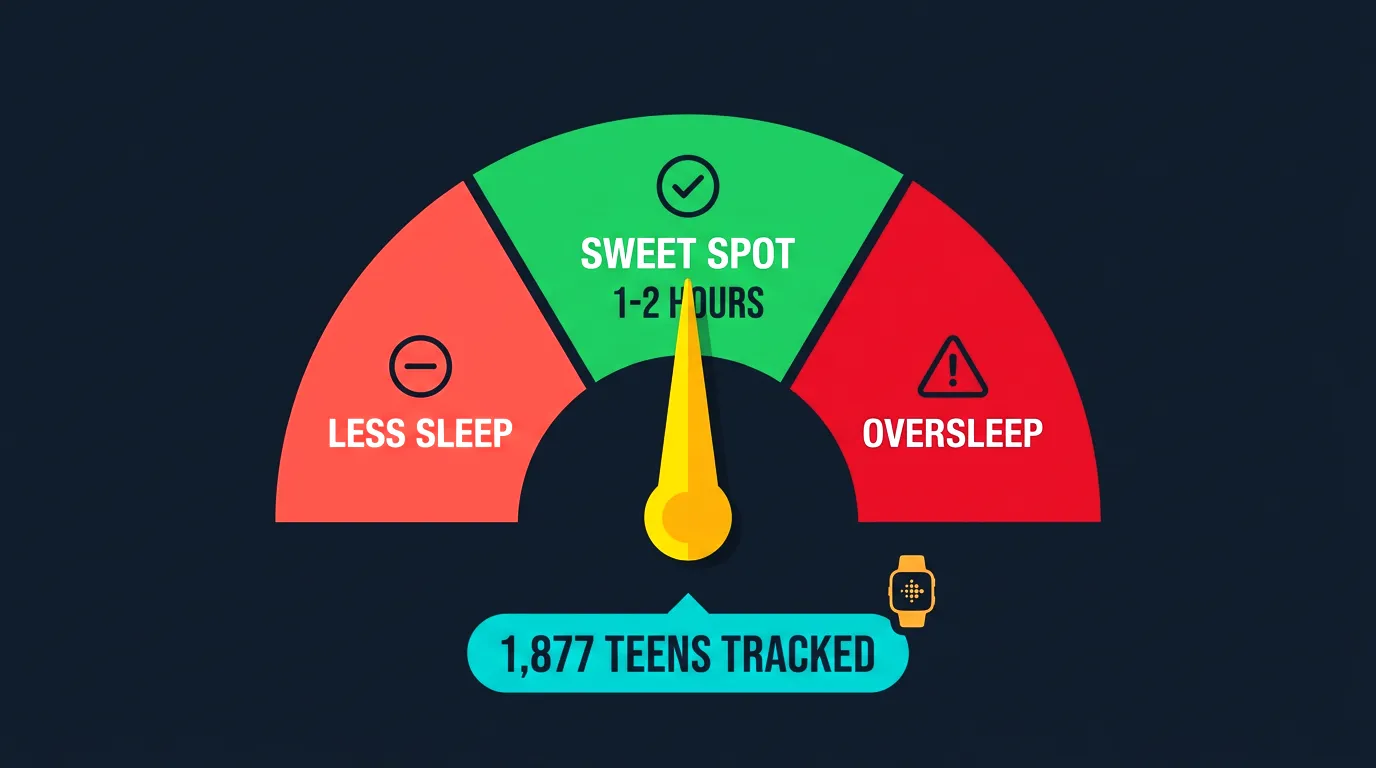
A separate study presented at SLEEP 2025 in Seattle found the exact sweet spot for weekend catch-up sleep.[5] Sojeong Kim, a doctoral candidate at the University of Oregon, analyzed data from 1,877 teens in the Adolescent Brain Cognitive Development Study. Unlike most sleep studies that rely on self-reports, this one used Fitbit data to track actual sleep.
Here’s what she found.
- Teens who slept up to 2 extra hours on weekends had fewer anxiety symptoms
- Teens who slept less on weekends than weekdays had more anxiety
- Teens who slept more than 2 extra hours on weekends also had more internalizing symptoms
“Both sleeping less on weekends than weekdays and sleeping substantially more on weekends were associated with higher anxiety symptoms.” — Sojeong Kim, University of Oregon
So the sweet spot is real. About 1 to 2 extra hours of weekend sleep gives you the mental health benefits. Go past that, and you start losing them.
Why Too Much Backfires
When you sleep 4 or 5 extra hours on a weekend, you’re not recovering. You’re disrupting your circadian rhythm. Your body’s internal clock gets confused. It thinks you’ve changed time zones. That’s why you feel groggy on Monday morning after sleeping until noon on Sunday.
This pattern is called social jet lag. It’s the gap between your body’s natural sleep schedule and the schedule society forces on you. Research shows that large swings in sleep timing from weekday to weekend are linked to worse mood, more inflammation, and higher cortisol levels.
The goal isn’t to binge-sleep on weekends. It’s to recover just enough to offset the damage from your weekday sleep debt.
Why Sleep Deprivation Wrecks Your Mood
To understand why weekend sleep helps, you need to understand what happens to your brain when you don’t sleep enough. The damage is fast and brutal.
Your Amygdala Goes Haywire
The amygdala is the brain’s alarm system. It processes fear, anger, and sadness. When you’re well-rested, your prefrontal cortex keeps the amygdala in check. Think of it as a wise parent calming down an anxious child.
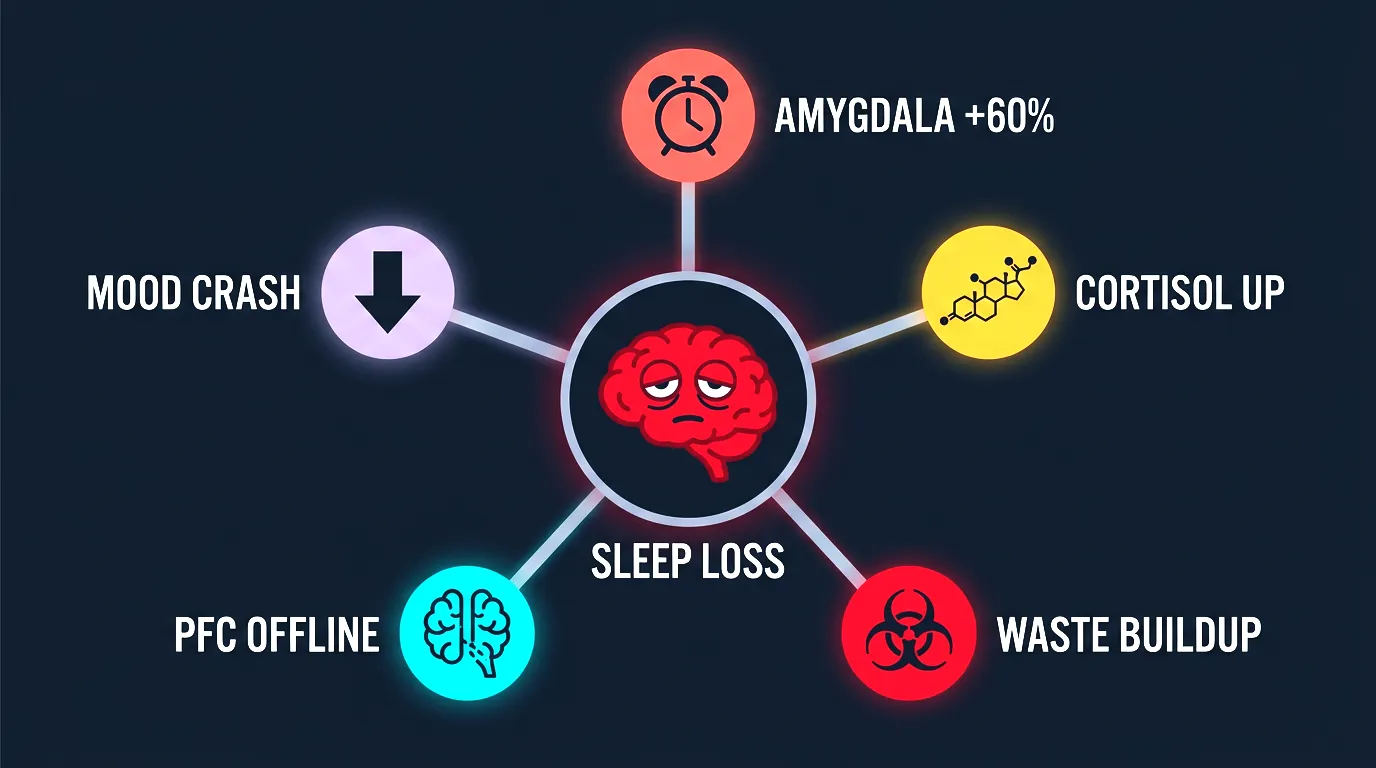
When you’re sleep-deprived, that connection breaks. Brain imaging studies show a 60% increase in amygdala reactivity after just one night of lost sleep.[6] Your emotional alarm system is screaming, and the part of your brain that’s supposed to calm it down has gone offline.
- Sleep deprivation weakens the connection between the prefrontal cortex and amygdala
- Emotional reactions become stronger and harder to control
- Risk-taking behavior and impulsive decisions increase
- Negative experiences feel more intense while positive ones feel duller
Recommended read: The Balanced Brain by Camilla Nord — A neuroscientist explains how your brain creates mood and what goes wrong when the system breaks down.
Your Brain’s Cleaning System Shuts Down
Your brain has its own waste removal system called the glymphatic system. During deep sleep, this system expands by up to 60%, flushing out toxic proteins and metabolic waste. It’s like a dishwasher that only runs while you’re sleeping.
A 2025 study in Nature’s Translational Psychiatry found a direct link between glymphatic dysfunction and depression.[7] Depressed patients showed compromised waste clearance in the brain, along with disrupted cortisol regulation. When you skip sleep, the waste builds up. The waste affects your mood. And the cycle spirals.
Cortisol Stays Elevated
Cortisol is your stress hormone. Normally, it peaks in the morning and drops at night. Sleep deprivation flips this pattern. Evening cortisol levels stay elevated, which makes it harder to fall asleep, which raises cortisol even more.
This is why you can’t control your emotions when you’re running on four hours of sleep. It’s not a willpower problem. It’s a brain chemistry problem.
How to Catch Up the Right Way
Now you know that weekend catch-up sleep works, but only within limits. Here’s how to do it without wrecking your Monday.
The 90-Minute Rule
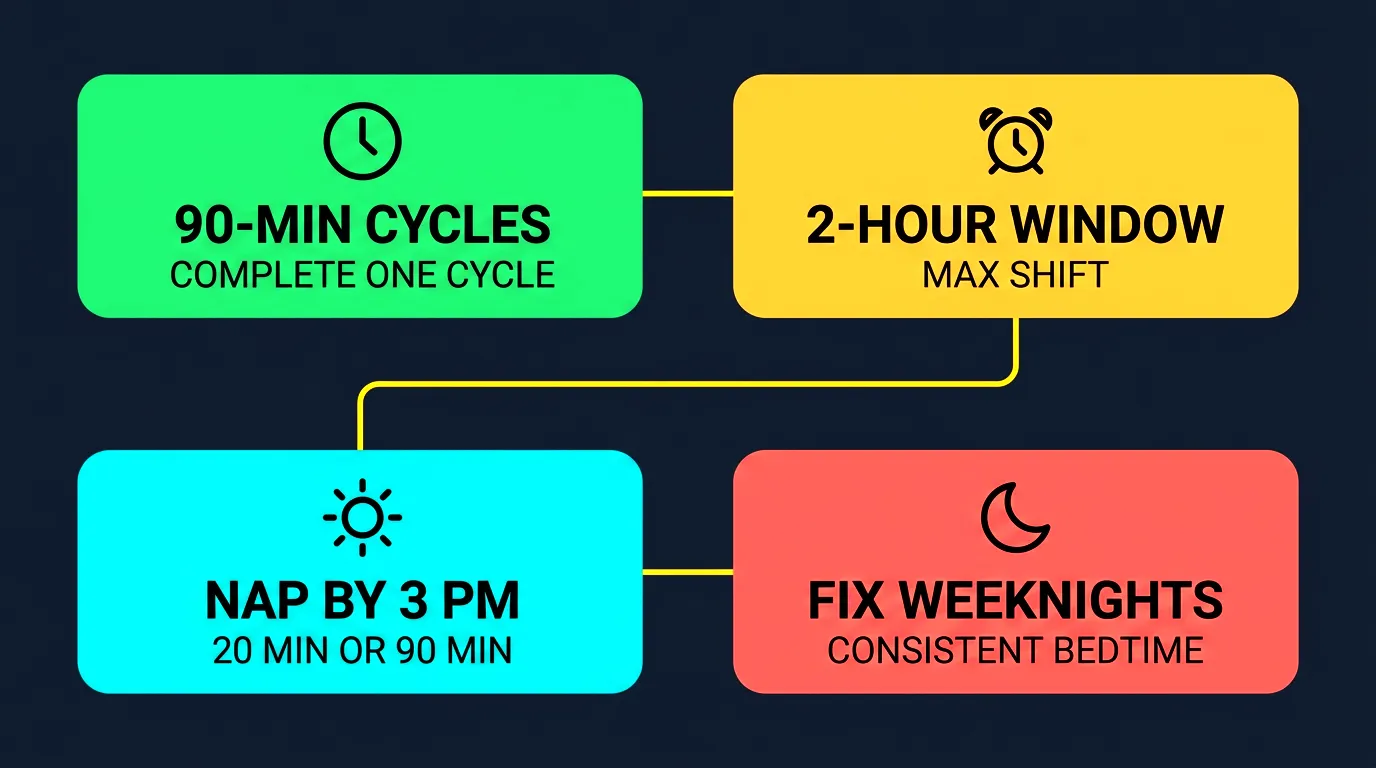
Your sleep moves in 90-minute cycles. Each cycle takes you through light sleep, deep sleep, and REM sleep. Waking up in the middle of a cycle is what makes you feel groggy. So aim to add sleep in 90-minute blocks.
- One extra cycle: sleep 90 minutes later than usual
- Best option: go to bed at your normal time and wake up 90 minutes later
- Worst option: staying up 3 hours later and sleeping 5 hours later
Keep Your Wake-Up Window Tight
Don’t shift your wake time by more than 2 hours on weekends. If you normally wake at 6:30 AM, don’t sleep past 8:30 AM. This keeps your circadian rhythm stable while still giving you recovery time.
Nap Smart if You Need More
If you’re still tired after sleeping in, a short afternoon nap can help without disrupting your nighttime sleep.
- Keep naps under 20 minutes for an energy boost
- Or go for a full 90-minute nap to complete one sleep cycle
- Nap before 3 PM to avoid affecting nighttime sleep
- Never nap to replace nighttime sleep regularly
Fix the Source, Not Just the Symptom
Weekend catch-up sleep is a bandage. It helps, but the real fix is getting enough sleep during the week. Here’s where to start.
- Set a consistent bedtime that allows for 7 to 9 hours of sleep
- Cut screen time at least 30 minutes before bed, blue light from apps suppresses melatonin
- Keep your bedroom cool, dark, and quiet
- Avoid caffeine after 2 PM
Recommended read: Atomic Habits by James Clear — The best guide for building a bulletproof sleep routine that actually sticks.
Building a real sleep routine is like building any other habit. It takes consistent cues, rewards, and a system that makes the right choice automatic.
| Strategy | Why It Works | Best For |
|---|---|---|
| Sleep 90 min extra on weekends | Completes one full sleep cycle | Mild weekly sleep debt |
| Keep wake time within 2 hours | Protects circadian rhythm | Everyone |
| 20-minute power nap | Boosts alertness without grogginess | Afternoon energy crash |
| 90-minute nap | Full cycle recovery | Major sleep debt |
| Consistent weeknight bedtime | Prevents sleep debt from forming | Long-term health |
Sleep Is the Most Underrated Mental Health Tool
We spend billions on therapy, medication, and wellness apps. And those things matter. But the single most impactful thing most people could do for their mental health costs nothing and requires zero effort.
Just sleep more.
The Data Is Overwhelming
A longitudinal study of nearly 3,000 Americans aged 11 to 17 found that sleeping less than 6 hours per night substantially increased the risk of anxiety and depression one year later.[8] A study of close to 5,000 teens found that those with depression symptoms got 3.5 fewer hours of sleep than the control group.[8]
Sleep isn’t just correlated with better mental health. It’s causal. When you fix sleep, mood improves. When you destroy sleep, mood collapses. The relationship runs in both directions, creating either a virtuous cycle or a vicious one.
Recommended read: Rewire by Nicole Vignola — A neuroscientist’s toolkit for changing your brain through daily habits, starting with sleep.
What This Means for Parents and Schools
The American Academy of Sleep Medicine recommends 8 to 10 hours of sleep for teens aged 13 to 18.[9] Yet the average high schooler gets about 7 hours on school nights. School start times, homework loads, and screen addiction are all working against teenage brains.
This research gives parents and policymakers a simple message. If you can’t fix the system overnight, at least let kids sleep in on the weekend. It’s not laziness. It’s medicine.
- Delaying school start times to 8:30 AM or later could increase sleep by 30 to 45 minutes
- Weekend catch-up sleep can serve as a safety net for chronically sleep-deprived teens
- Consistent sleep education should be part of school health curricula
- Parents should treat weekend sleep as recovery, not laziness
The science is clear. Your brain needs sleep to regulate your emotions, clear out waste, and maintain the connections that keep you mentally healthy. Weekend catch-up sleep isn’t perfect. But for millions of young people running on empty five days a week, it might be the difference between coping and breaking down.
So this weekend, set the alarm a little later. Your brain will thank you.
Sources
What the Research Actually Found
3. America’s teen sleep crisis: 80% aren’t getting enough (Fortune Well, 2025)
4. The simplest way teens can protect their mental health (ScienceDaily, 2026)
The Sweet Spot, Two Hours and Not a Minute More
5. Study identifies the ‘sweet spot’ for catch-up sleep by teens on weekends (SLEEP 2025)
Why Sleep Deprivation Wrecks Your Mood
6. The human emotional brain without sleep: A prefrontal amygdala disconnect (Current Biology, 2007)
Sleep Is the Most Underrated Mental Health Tool
9. Teen Sleep Duration Health Advisory (American Academy of Sleep Medicine)
Additional References
10. Sleep-in science: How 2 extra weekend hours can calm teen anxiety (ScienceDaily, 2025)
11. Where the brain pays sleep debt (Science, 2025)
12. Norepinephrine-mediated slow vasomotion drives glymphatic clearance during sleep (Cell, 2024)