In 1978, researchers tracked down twenty-two major lottery winners and asked them a simple question. How happy are you?[1]
The winners had collected between $50,000 and $1,000,000. You’d expect them to be thrilled with life. They weren’t. They were no happier than a control group who hadn’t won anything. And here’s the kicker. They reported getting less pleasure from everyday activities like eating breakfast, talking to friends, and hearing a joke than the people who never won.[1]
Winning the lottery didn’t just fail to make them happier. It made ordinary life feel worse.
The Hedonic Treadmill, Your Brain’s Built-In Happiness Killer
Evolutionary psychologist Donald Campbell coined the term hedonic treadmill in the 1970s to describe something unsettling about human nature.[2] No matter how much better your life gets, your brain adjusts. The thrill fades. And you end up right back where you started.
Here’s how psychologist Barry Schwartz describes it in The Paradox of Choice:
Your first desktop computer had 8K of memory and loaded programs by cassette tape. You loved it. Years later, you dumped a computer with thousands of times that speed because it felt “too clunky.” What you do with computers hasn’t changed much. What you expect from them has.
That’s hedonic adaptation in action.
- You get cable TV and feel ecstatic about all the options. A year later, you complain there’s nothing on
- You move into a bigger house. Within months, it just feels like “home”
- You get a raise. The initial thrill lasts a few weeks, then your new salary is just your salary
- You buy a luxury car. Researchers at the University of Michigan found no relationship between a car’s value and how much joy the owner felt while driving it on any given day
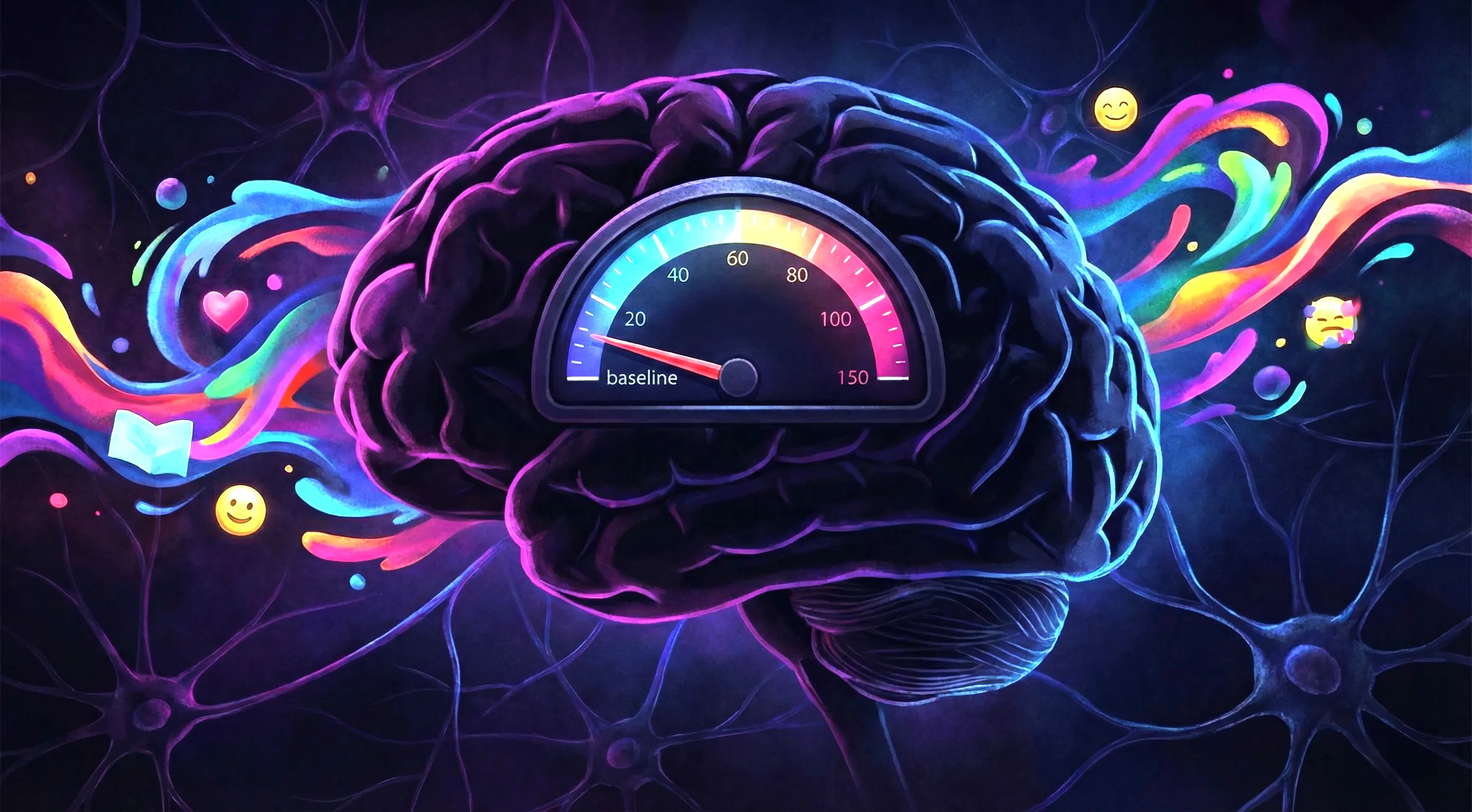
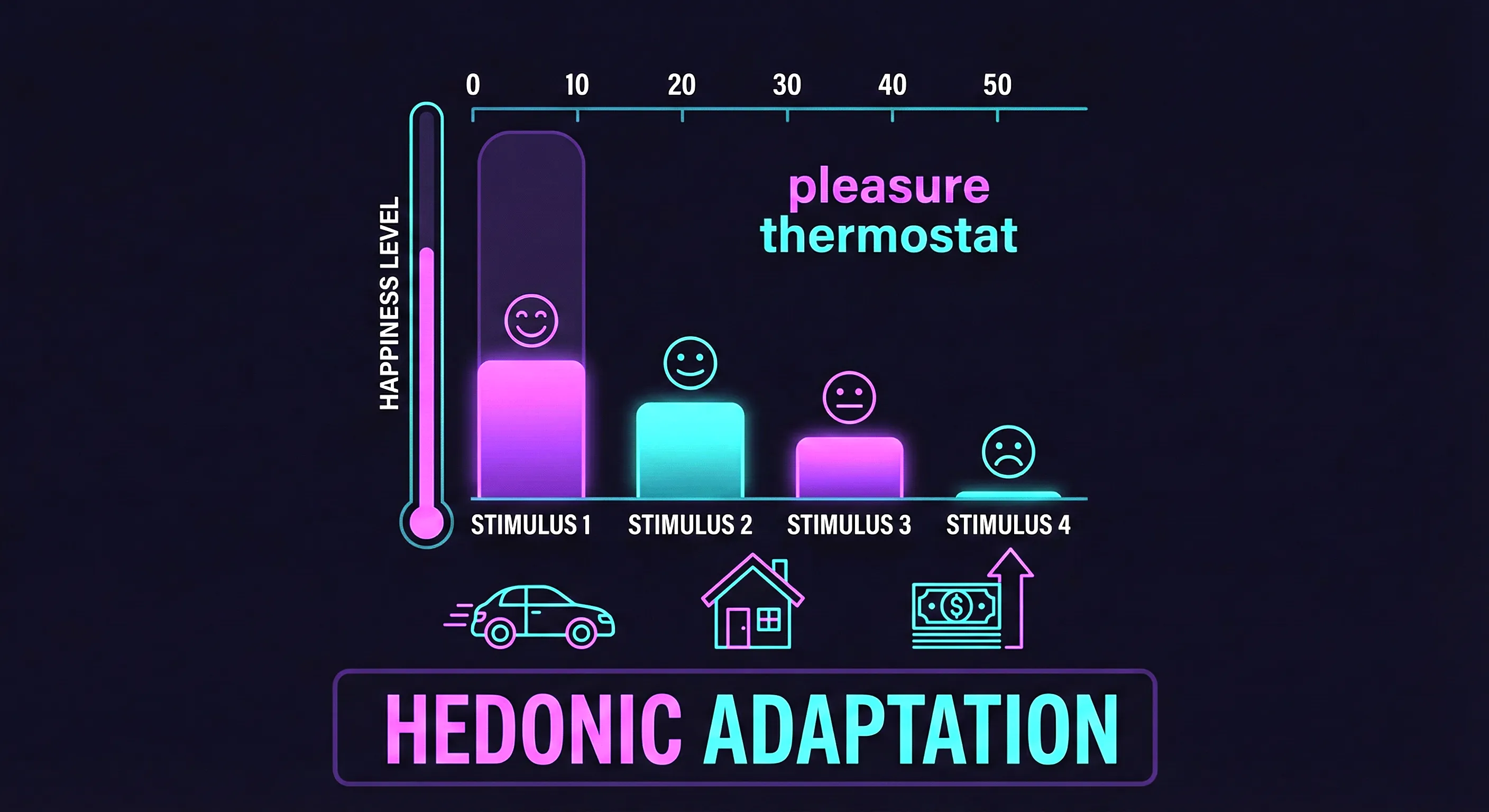
The process works like a pleasure thermostat. An experience that boosts your happiness by 20 degrees at first will boost it by 15 the next time, then 10, then not at all. Eventually, you’re standing in the air conditioning and you can’t even feel it anymore.
“The direct pursuit of happiness is a recipe for an unhappy life.” - Donald Campbell
Recommended read: The Paradox of Choice by Barry Schwartz. Explains how adaptation and the overwhelming number of choices in modern life conspire to make us less satisfied, not more.
Why Your Brain Is Designed to Get Bored
Here’s the uncomfortable truth. Your brain isn’t broken. It’s doing exactly what evolution built it to do.
Psychologist Timothy Wilson compares happiness to blood pressure. Your blood pressure rises when you stand up and drops when you sit down. There’s no single ideal level. The system is designed to respond to changes, not to stay fixed.
Emotions work the same way. Imagine the last time you felt euphoric. Your wedding day. A child’s birth. Landing your dream job. Your heart raced, your blood pressure spiked, you felt on top of the world. Now imagine feeling that way for a week.
Sounds exhausting, right? Wilson argues that prolonged euphoria would actually be dangerous. If your body stayed that revved up, you’d risk a heart attack. And if you were stuck in a permanent state of bliss, you’d miss important danger signals.
The Experiment That Proves It
Researchers at Haifa University showed volunteers adorable photos of puppies and babies, sixteen times each. They measured facial muscle activity and asked people how they felt.
- At first, their faces lit up. Smile muscles activated. They reported feeling pleasure
- By the sixteenth viewing, their smile muscles barely moved. They reported less and less pleasure
- But they still rated the photos as “wonderful”
They knew the puppies were cute. They just couldn’t feel it anymore. It’s the same reason your favorite song stops giving you chills after you’ve heard it a hundred times.
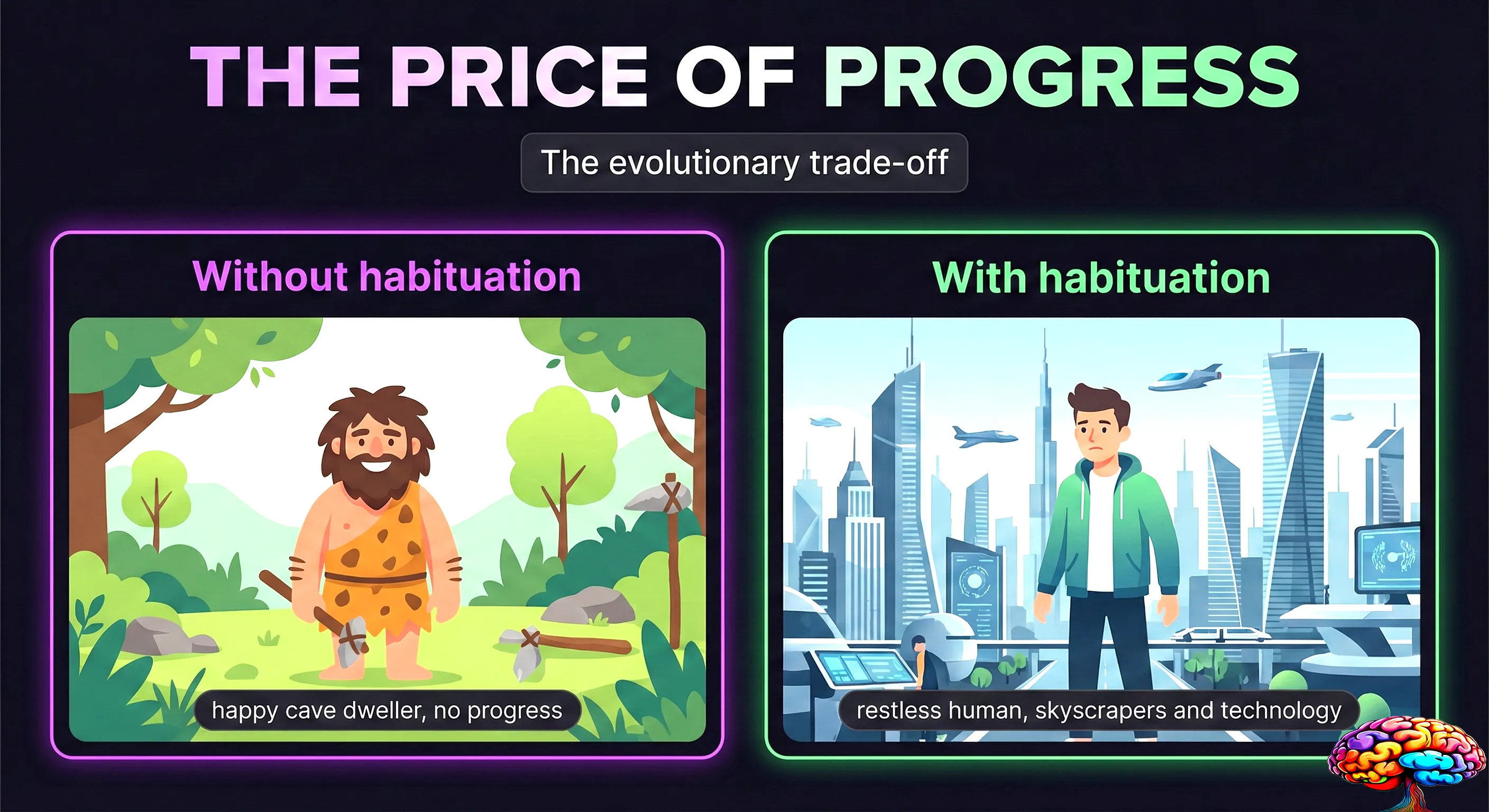
Tali Sharot, co-author of Look Again, explains why this happens. Habituation drives progress. If you never got bored with your entry-level job, you’d have no motivation to grow. Without the restlessness of adaptation, we might still be living in caves.
When Normal Adaptation Becomes Clinical
There’s a critical line between normal hedonic adaptation and something far more serious. Anhedonia is the clinical inability to feel pleasure, and it represents a breakdown in the brain’s reward system, not just a dimming of it.
A 2025 review published in Psychiatry and Clinical Neurosciences Reports mapped the neuroscience behind this breakdown.[3] Researchers identified dopaminergic, glutamatergic, and serotonergic alterations in reward pathways that can push normal adaptation into clinical numbness. Pro-dopaminergic pharmacological interventions have shown the most promise for treating anhedonia in depression, according to a 2025 living systematic review and network meta-analysis.[8] To experience hedonic pleasure, multiple processes must work together: arousal (detecting potentially rewarding stimuli), appraisal (identifying which stimuli are hedonically relevant), and expression of the emotional response.[3]
When any of these steps breaks down, you don’t just feel bored. You feel nothing.
| What Habituates Fast | What Habituates Slowly |
|---|---|
| New possessions (cars, phones, clothes) | Experiences (vacations, concerts, courses) |
| Income increases and promotions | Social connection and relationships |
| Physical comfort (bigger house, nicer office) | Acts of giving and helping others |
| Routine pleasures repeated daily | Novel, intermittent pleasures |
The Focusing Illusion, Why You Think the Next Thing Will Fix Everything
There’s a famous line from Nobel Prize winner Daniel Kahneman that captures this perfectly:
“Nothing in life matters quite as much as you think it does while you are thinking about it.”
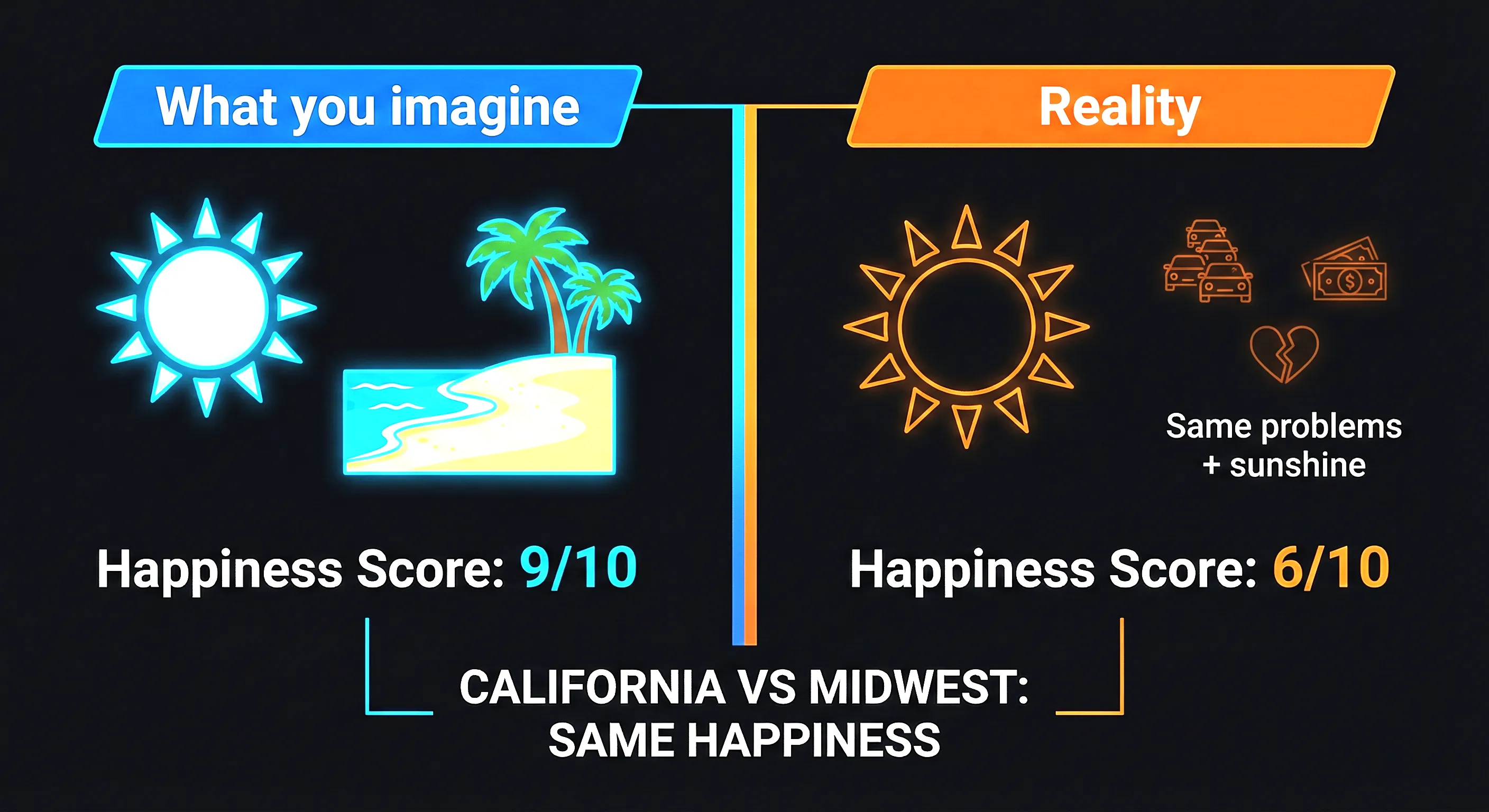
This is called the focusing illusion. When you imagine how happy you’d be living in California, you think about sunshine and beaches. You forget about traffic, wildfires, and the same relationship problems that follow you everywhere.
Researchers David Schkade and Kahneman tested this directly. They asked Midwestern students how happy Californians must be. The Midwesterners were sure California students were happier. They weren’t. Self-reported happiness was virtually identical in both locations.[4]
You’re Terrible at Predicting What Will Make You Happy
Psychologist Daniel Gilbert calls this affective forecasting, and we’re spectacularly bad at it.[5]
- College professors predicted they’d be devastated if denied tenure. Professors who were actually denied tenure? Just as happy as those who got it, after a few years
- People predicted that moving to a better climate would boost their happiness significantly. It didn’t
- People thought a 15% raise would feel wonderful. Within weeks, it felt normal
Gilbert found that people would even choose a job paying $30,000, $40,000, then $50,000 over a job paying $60,000, $50,000, then $40,000. Even though the second job pays more total money.[6] Why? Because your brain cares about the direction of change, not the absolute amount. A pay cut feels terrible even when you’re making more money than most people.
Your brain is essentially a change-detector, not a happiness-detector. It notices when things get better or worse. It barely registers when things stay the same. This is why that promotion felt amazing for a week and invisible for the next fifty-one. It’s the same reason rewards often destroy the very motivation they’re supposed to create. The same pattern shapes how cognitive biases quietly sabotage your everyday decisions without you noticing.
Recommended read: Stumbling on Happiness by Daniel Gilbert. A witty, research-packed exploration of why we’re so bad at predicting what will make us happy, and what we can do about it.
How to Outsmart Your Happiness Thermostat
The hedonic treadmill sounds depressing. But researchers have found specific strategies that slow it down or break the cycle entirely.
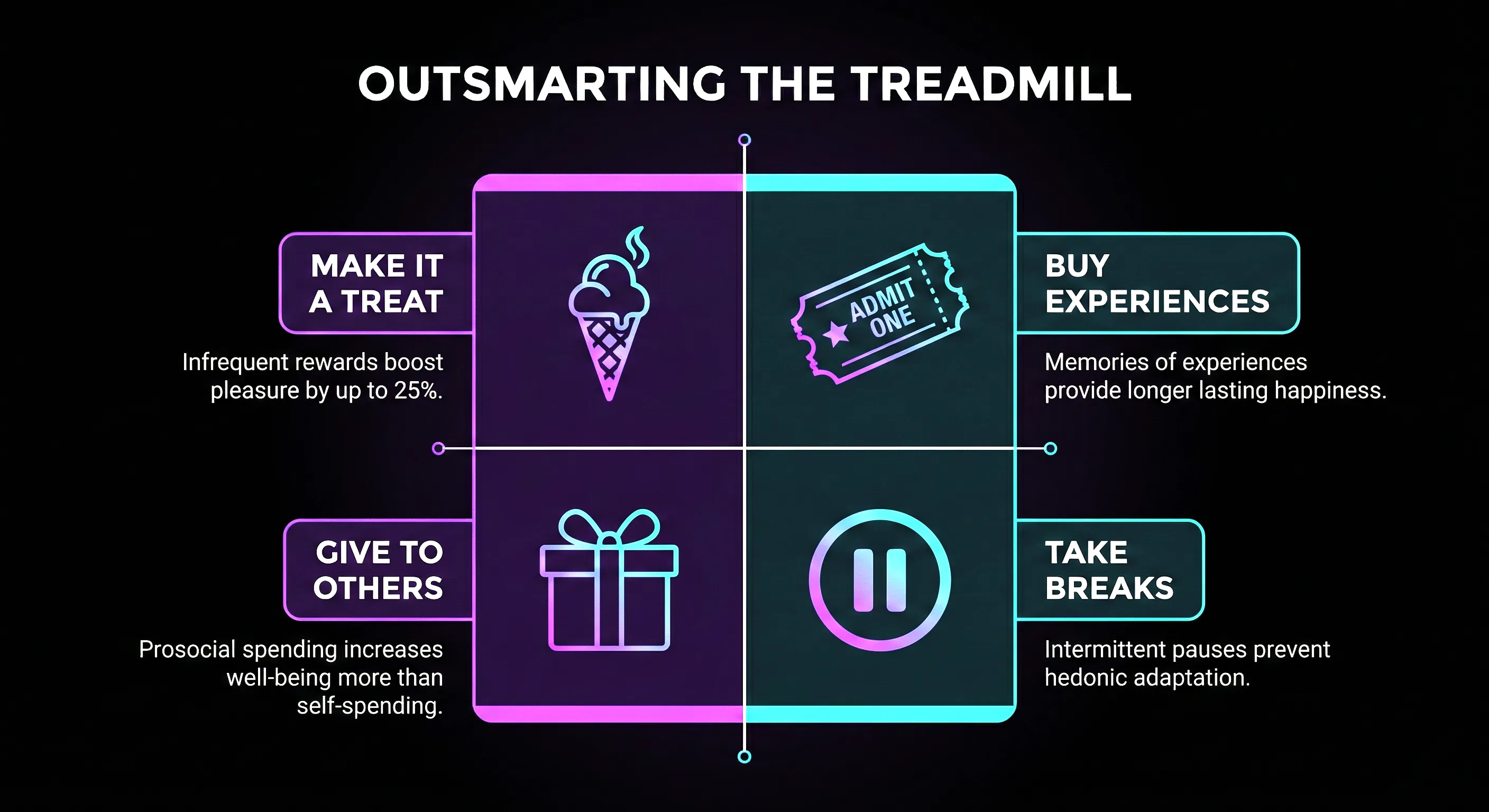
1. Make It a Treat
Comedian Sarah Silverman has a philosophy about fart jokes that turns out to be brilliant life advice. She insists her writers use them sparingly on her show. Why? “If they are a genuine treat and a surprise, they are the surest way to send me into tear-soaked convulsions of laughter.”
Economist Tibor Scitovsky said the same thing more formally. Pleasure results from incomplete and intermittent satisfaction of desires.
Researchers proved this with macaroni and cheese:
- Group 1 ate mac and cheese every day for a week. By day five, they were sick of it
- Group 2 ate mac and cheese once a week for five weeks. They loved it every single time
The daily group habituated. The weekly group never did. The lesson is simple. Space out your pleasures.
2. Buy Experiences, Not Things
Studies consistently show that experiences produce more lasting happiness than possessions. Tali Sharot explains why.
- You habituate to possessions quickly because they sit unchanged in your environment
- Satisfaction with material goods drops sharply over time
- Satisfaction with experiences often increases over time as memories become rosier
- People regret not buying experiences more than not buying things
At the moment of purchase, a new sofa and a Broadway show might feel equally exciting. But months later, the sofa is just furniture. The show is a story you tell at dinner parties.
3. Give Instead of Get
In a study where people received $5 a day for five days, joy from spending on themselves dropped by a full point on a seven-point scale. Joy from spending on others? It dropped by only half a point.
The happiness of giving habituates roughly half as fast as the happiness of getting. The same habits research shows that actions requiring intentional effort tend to stick better than passive pleasures.
4. Introduce Breaks and Variety
Researchers found something counterintuitive about massages. People enjoyed three thirty-minute massages more than a single ninety-minute massage, even though the total time was identical. The breaks allowed the pleasure to “reset.”
This is dishabituation. Stepping away from something good lets your brain rediscover it. Sharot describes getting COVID and being exiled to her basement. When she returned upstairs, home life felt like it had been “sprinkled with pixie dust.”
You don’t need a basement quarantine. You just need breaks.
Recommended read: Look Again by Tali Sharot and Cass Sunstein. The definitive guide to why we stop noticing the good things in our lives and the science of how to “dishabituate” and appreciate them again.
What Actually Keeps Happiness Alive
Psychologist Robert Emmons breaks down the sources of happiness into three categories:[7]
| Source | % of Happiness | Can You Change It? |
|---|---|---|
| Genetic set point | 50% | No. You’re born with a baseline range |
| Life circumstances (income, location, job) | 10% | Barely matters. You adapt to changes fast |
| Intentional activities (what you choose to do) | 40% | Yes. This is where the leverage is |
That 40% is everything. It means nearly half your happiness depends not on what happens to you, but on what you deliberately do.[7]
The research consistently points to the same activities that resist habituation, and a 2025 study in the Journal of Happiness Studies found that combining eudaimonic and hedonic interventions produces greater life satisfaction gains than either approach alone.[9]
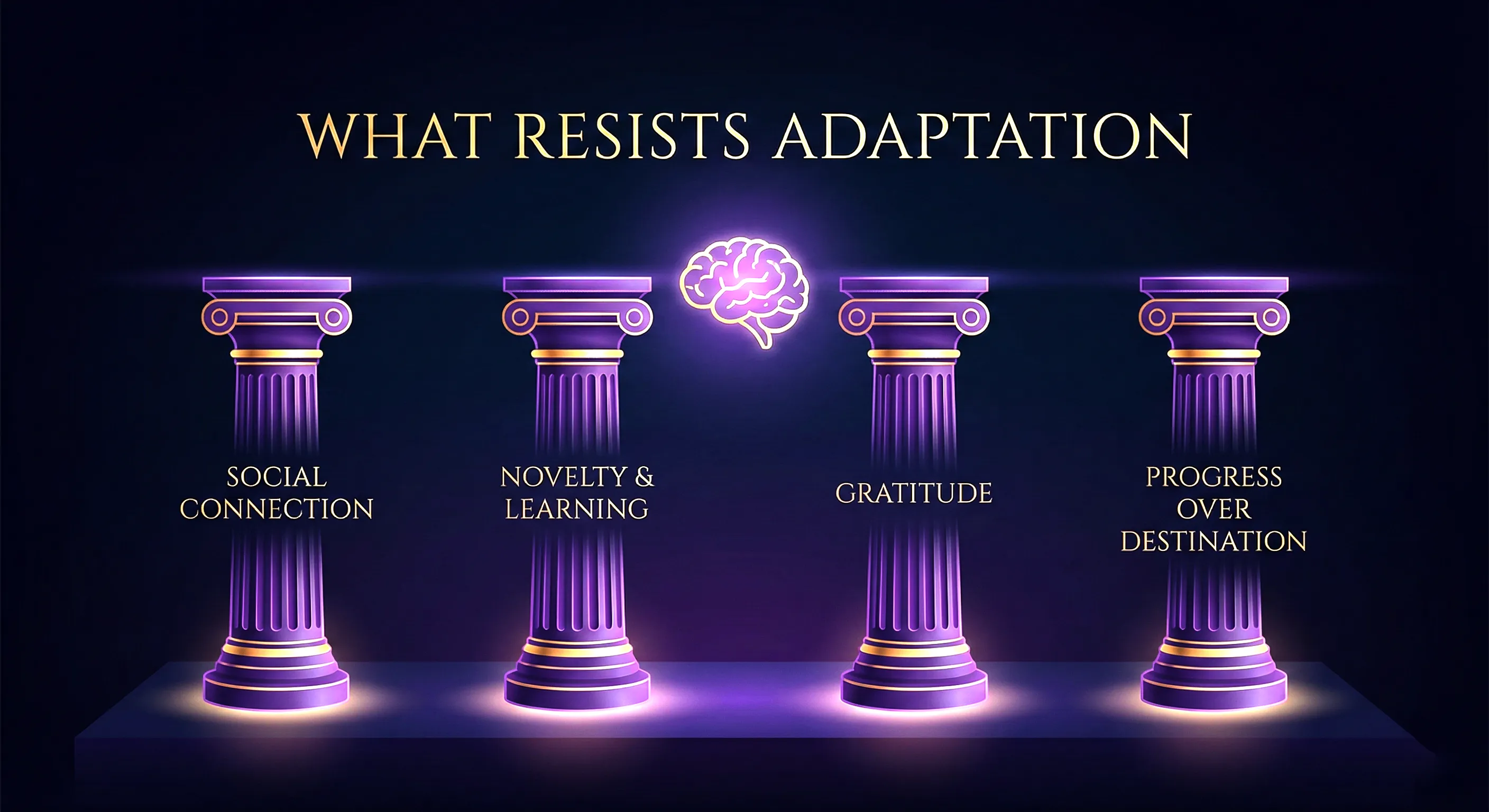
- Social connection. Psychologist Steven Pinker found that the factors most correlated with happiness aren’t wealth, looks, or status. They’re spouses, friends, religion, and challenging, meaningful work
- Novelty and learning. Happiness follows a U-curve across life. It dips in midlife when things feel stable and predictable, then rises again when change returns. Post-retirement happiness spikes partly because people have to restructure their entire lives
- Gratitude practice. Emmons found that intentionally noticing good things works like the imagination exercise. Laurie Santos, “Yale’s happiness professor,” suggests visualizing your life without the things you have. The horror of imagining loss makes the reality feel precious again
- Progress over destination. Sharot’s research shows that joy often comes from perceiving yourself as moving forward, not from arriving. The journey literally feels better than the destination
The dopamine system that apps hijack plays a role here too. When you chase quick dopamine hits from scrolling, you speed up your hedonic treadmill. When you invest in slower, deeper sources of satisfaction, you slow it down.
Here’s the paradox that every happiness researcher eventually lands on. The people who chase happiness directly never catch it. The people who chase meaning, connection, and growth find that happiness tags along for the ride.
Nine-year-old Livia, Tali Sharot’s daughter, understood this intuitively. When her mom asked if she’d want to live in a gorgeous clifftop mansion, she said no. “If you are that rich, you get ice cream and toys all the time and so you don’t appreciate it because you get it every day. It stops being a treat.”
A nine-year-old outsmarted the hedonic treadmill. You can too.
Recommended read: Dopamine Nation by Anna Lembke. Explores the pleasure-pain balance in your brain and why relentless pleasure-seeking leads to numbness, with practical strategies for resetting your reward system.
Sources
The Hedonic Treadmill, Your Brain’s Built-In Happiness Killer
2. Hedonic Relativism and Planning the Good Society (Adaptation-Level Theory, 1971)
Why Your Brain Is Designed to Get Bored
3. Anhedonia: Current and Future Treatments (Psychiatry and Clinical Neurosciences Reports, 2025)
The Focusing Illusion, Why You Think the Next Thing Will Fix Everything
5. Affective Forecasting (Advances in Experimental Social Psychology, 2003)
6. Why Don’t We Learn from Poor Choices? (Journal of Consumer Psychology, 2011)
What Actually Keeps Happiness Alive
7. Pursuing Happiness: The Architecture of Sustainable Change (Review of General Psychology, 2005)