

A mother hands her 14-month-old a tablet to keep him quiet during dinner. The screen lights up with bright colors and bouncing shapes. The toddler goes silent. It works every time.
But something is happening inside that tiny skull that nobody can see. The brain networks responsible for vision and thinking are locking into place years ahead of schedule. And that premature wiring will still be causing problems more than a decade later.
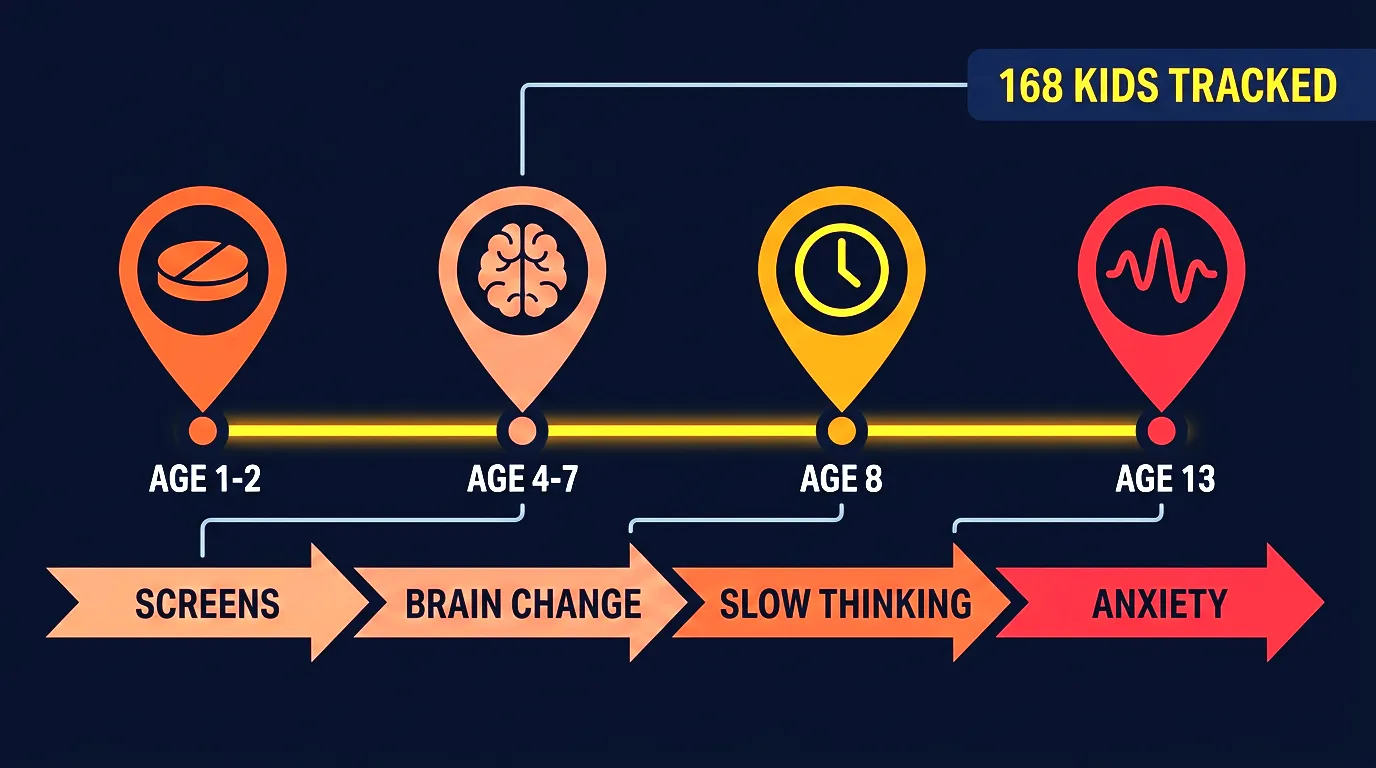
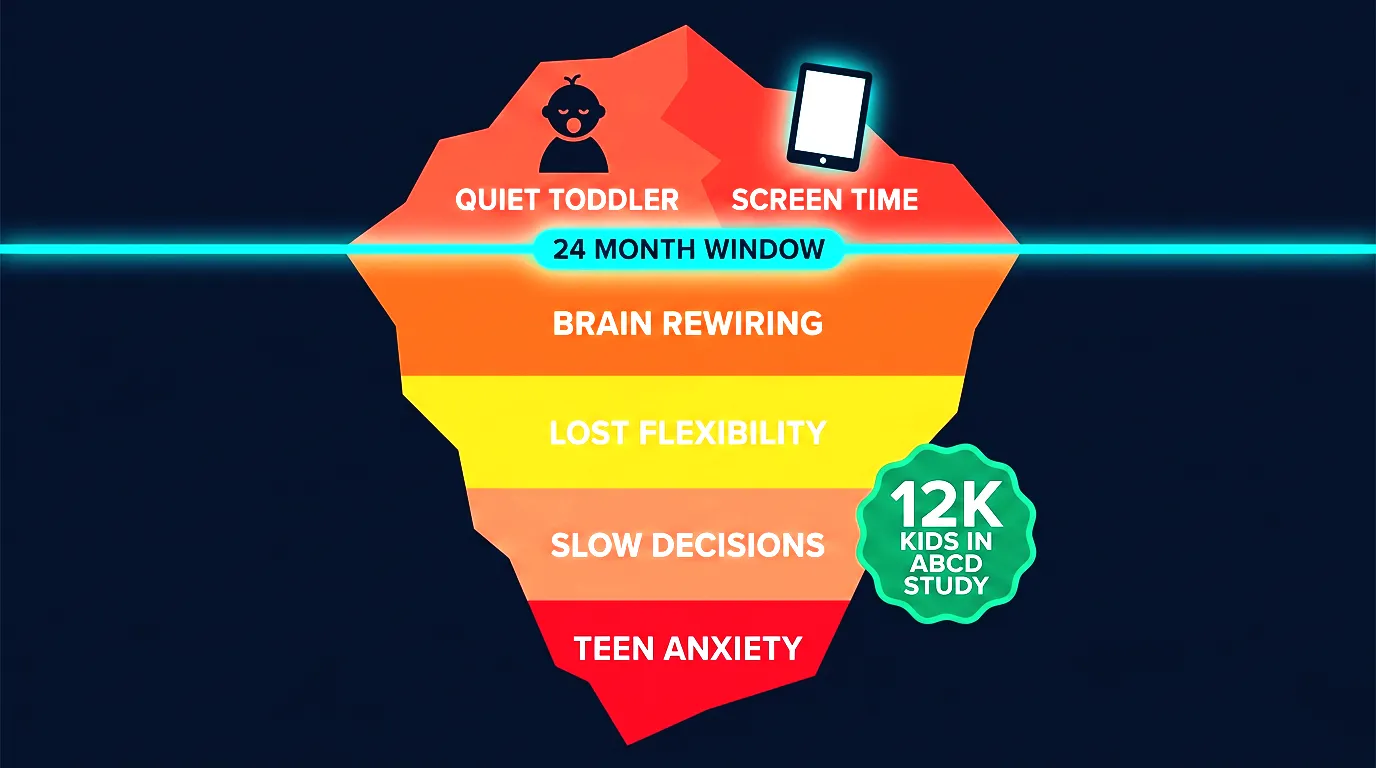
A landmark 2025 study published in eBioMedicine followed 168 children from infancy to age 13.[1] What the researchers found was alarming. Kids who got heavy screen time before their second birthday showed measurable brain changes that led to slower thinking at age 8 and higher anxiety at age 13. Screen time at ages 3 and 4 didn’t produce the same effects. The damage window was specific and narrow.
Your child’s brain before age 2 is uniquely vulnerable. And millions of parents are handing over screens without knowing it.
The Study That Changed Everything
The research came from Singapore’s GUSTO cohort, led by Dr. Huang Pei and Asst. Prof. Tan Ai Peng at the A*STAR Institute for Human Development and Potential and the National University of Singapore.[1] Their team tracked children from birth, collecting screen time data at ages 1, 2, 3, and 4.
Then they did something most studies never do. They took brain scans at three separate time points. Ages 4.5, 6, and 7.5. They tested decision-making at age 8.5 using the Cambridge Gambling Task. And they measured anxiety symptoms at age 13 with the Multidimensional Anxiety Scale.
The results revealed a clear chain reaction:
- Early screen exposure (ages 1 to 2) caused accelerated maturation of visual-cognitive brain networks
- Premature specialization reduced the brain’s flexibility for complex thinking tasks
- Slower decision-making at age 8.5 followed directly from those structural changes
- Higher anxiety at age 13 was the downstream behavioral outcome
Here’s what makes this study different from the usual “screens are bad” headlines. It mapped the entire biological pathway. Not just a correlation. A chain of cause and effect stretching over a decade.
“Children with high infant screen exposure demonstrated accelerated maturation of brain networks responsible for visual processing and cognitive control.” — Dr. Huang Pei, A*STAR IHDP[1]
The critical finding was timing. Screen exposure at ages 3 and 4 showed no similar brain changes. Only the first two years of life created this vulnerability.
What Premature Brain Specialization Actually Means
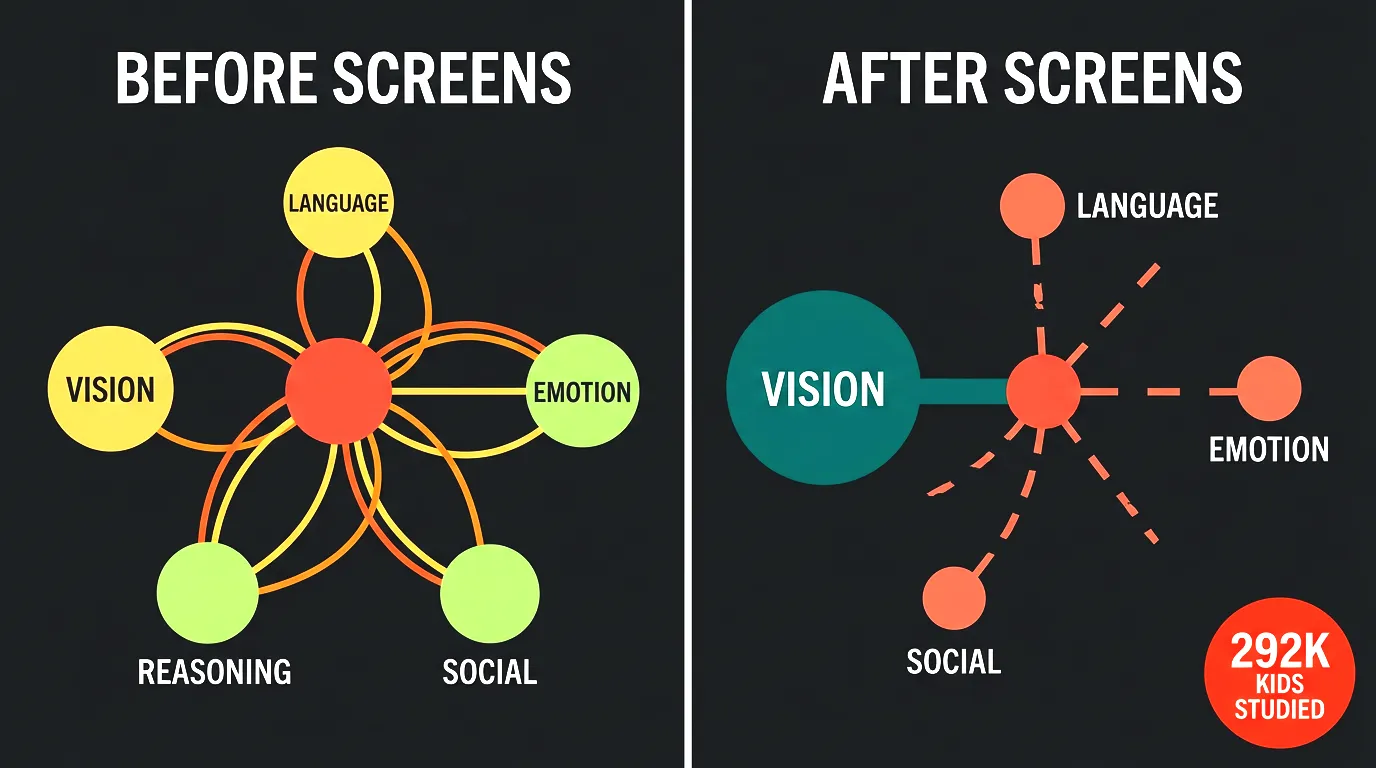
During normal development, your child’s brain networks gradually become more specialized over time. Think of it like a tree growing slowly, building strong roots before branching out. Visual processing networks, cognitive control networks, and emotional regulation networks all mature at their own pace. They build efficient connections between each other as they develop.
Screens throw a wrench into that timeline.
The intense sensory stimulation from screens. The rapid color changes, the movement, the sound. All of it forces the visual-cognitive networks to specialize faster than nature intended.[1] The networks lock into place before they’ve built the cross-connections needed for flexible thinking.
What the Brain Scans Showed
A separate 2019 study from Cincinnati Children’s Hospital used MRI to scan the brains of preschoolers aged 3 to 5.[2] Children who exceeded 1 hour of daily screen time showed lower white matter integrity. White matter is the highway system connecting different brain regions for language, literacy, and cognition.
| Brain Area Affected | What It Does | What Screens Change |
|---|---|---|
| White matter tracts | Connect brain regions for language and reading | Lower structural integrity |
| Visual processing networks | Process what your child sees | Premature specialization |
| Cognitive control networks | Help with planning and decision-making | Lock in too early, reduce flexibility |
| Cortical thickness | Supports reasoning and empathy | Thinner in high-screen children |
Kids with higher screen use also had thinner cortex in areas involved with social cognition, reasoning, and empathy.[2] At an age when these areas should be getting thicker, they were doing the opposite.
Recommended read: The Anxious Generation by Jonathan Haidt — A deep dive into how the digital rewiring of childhood is fueling a mental health epidemic in young people.
The 2025 APA meta-analysis of 117 studies covering 292,000 children confirmed a “vicious circle” pattern.[3] Screen time causes emotional and behavioral problems. Those problems then drive kids to use even more screens. It’s a feedback loop that starts in the crib.
The Numbers Nobody Talks About
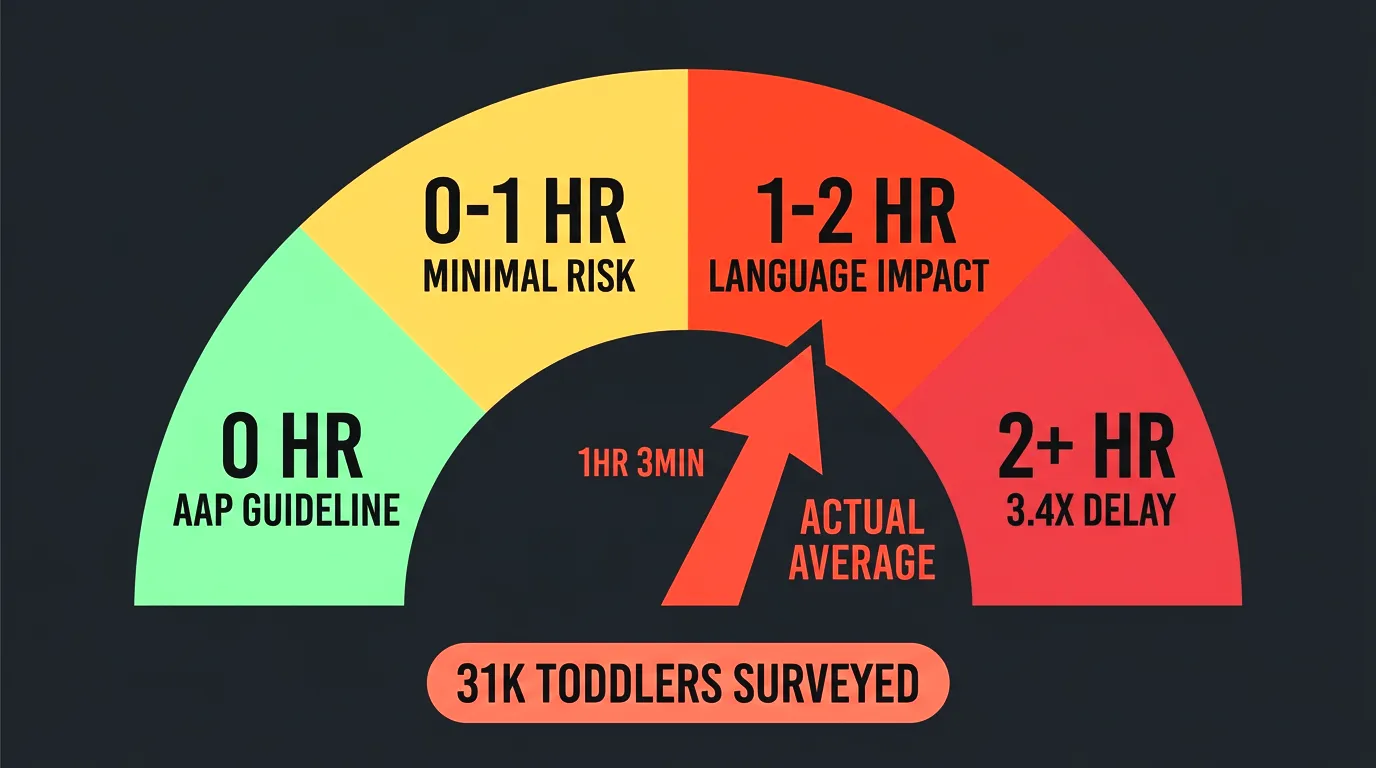
The guidelines are clear. The American Academy of Pediatrics says children under 18 months should have zero screen time, except for video chatting.[4] For ages 18 to 24 months, only high-quality educational content watched with a caregiver is acceptable.
Reality looks nothing like those guidelines.
According to 2024 data, infants aged 0 to 2 average 1 hour and 3 minutes of screen time per day.[5] Nearly half. 49%. of children under 2 already interact with smartphones regularly. By ages 2 to 4, that number jumps to 2 hours and 8 minutes daily.
The Language Connection
The brain damage goes beyond anxiety. A 2024 study from Denmark’s TRACES project surveyed over 31,000 toddlers and found that mobile device screen time was associated with poorer language development.[6]
Another study found toddlers with more than 2 hours of screen time had 3.4 times higher odds of language delay.[7] And children who started watching before 12 months and exceeded 2 hours daily were six times more likely to have language delays.
Here’s the breakdown:
- 0 to 1 hours daily: Minimal measurable effects on language
- 1 to 2 hours daily: Below average language ability by age 4.5
- 2+ hours daily: 3.4x higher odds of language delay
- Started before 12 months + 2+ hours: 6x higher odds of language delay
A 2025 systematic review in the journal Children examined 46 studies and found consistent links between higher screen use and reduced physical activity, poorer sleep, attention difficulties, and challenges in emotional and social functioning.[8]
The research is not ambiguous. Early screen time doesn’t just steal attention. It hijacks your child’s dopamine system at the most vulnerable point in their development.
Recommended read: Irresistible by Adam Alter — Explains exactly how technology is designed to be addictive, and why children are especially vulnerable to its pull.
What Actually Protects Your Child’s Brain
The Singapore GUSTO team discovered something hopeful in a related 2024 study published in Psychological Medicine.[9] Parent-child reading at age 3 significantly weakened the link between infant screen time and altered brain development.
Children whose parents read to them frequently showed fewer brain network changes, even if they had been exposed to high screen time as infants. Shared reading appeared to provide exactly what passive screens don’t. Interactive engagement, language exposure, emotional connection, and back-and-forth communication.
Practical Steps Based on the Research
-
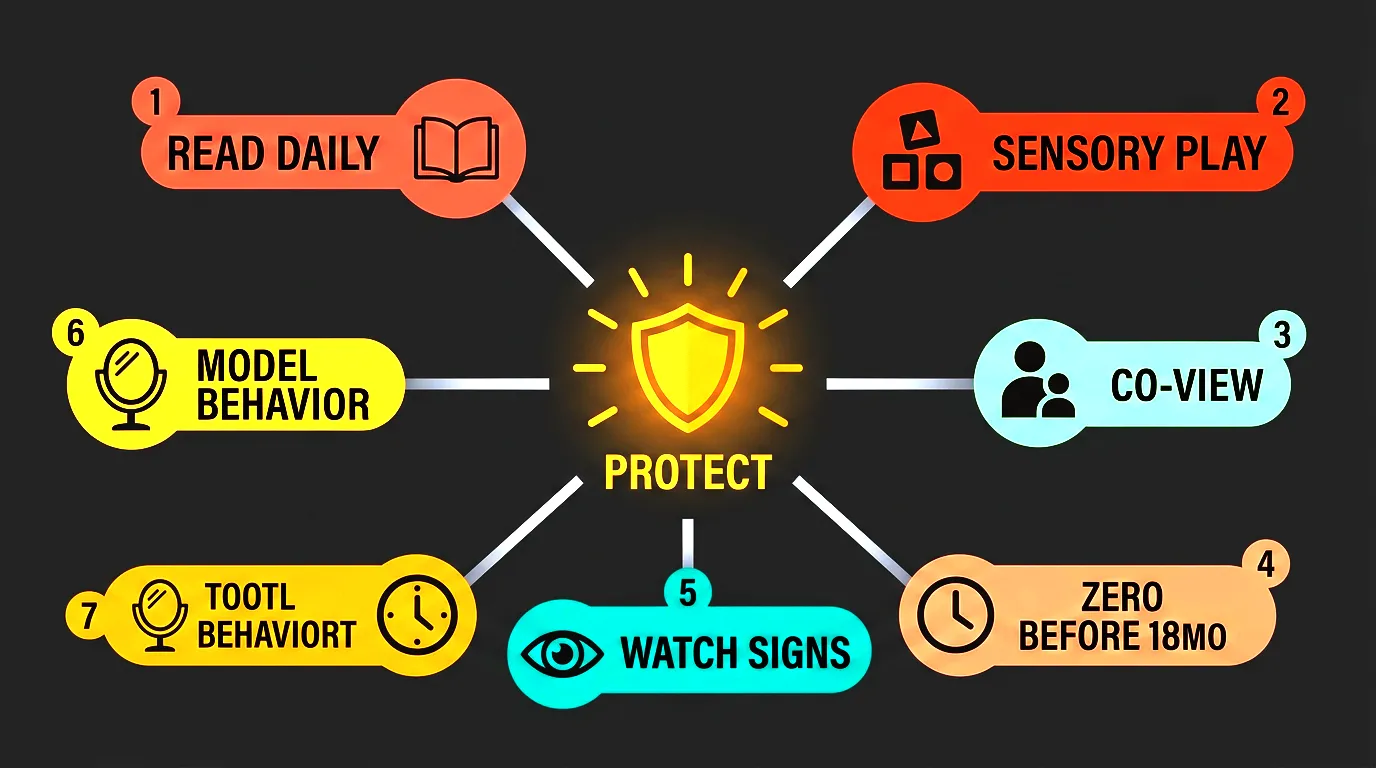
Zero screens before 18 months. The AAP guideline isn’t arbitrary. The GUSTO study confirms that this specific window matters most for brain wiring.[1]
-
Read together daily starting at birth. The protective effect of shared reading was strongest when it became a regular habit by age 3.[9] Even 15 minutes a day makes a measurable difference.
-
Replace screens with sensory play. Your toddler’s brain needs multi-sensory input. Blocks, sand, water, textures. These build the cross-connections that screens prevent.
-
If screens happen, co-view actively. For ages 18 to 24 months, sit with your child. Talk about what’s on screen. Point, ask questions, engage. The AAP now emphasizes quality and interaction over strict time limits.[4]
-
Watch for early warning signs. Language delays, difficulty with eye contact, trouble transitioning away from screens, and emotional regulation struggles can all signal excessive screen exposure.
-
Model screen behavior yourself. The 2025 APA study found that children with existing emotional problems were more likely to increase their screen use.[3] If your child sees you glued to a phone, they learn that screens are the default response to boredom or stress.
Recommended read: Stolen Focus by Johann Hari — Explores how our attention is being stolen by design, and what we can reclaim for ourselves and our children.
The data is clear. The first two years are not just important. They’re irreplaceable. What happens to your child’s brain during that window echoes forward into adolescence and beyond.
The Bigger Picture, and Why It Matters Now
We’re running a massive uncontrolled experiment on an entire generation of children. The average infant is getting over an hour of daily screen time before they can walk. Nearly half of toddlers are already swiping on smartphones.[5] And the research keeps showing the same thing. Earlier exposure means deeper damage.
The 2025 GUSTO study gave us the first complete biological map of how that damage works.[1] Screen stimulation forces the brain to specialize too early. That premature wiring reduces cognitive flexibility. Reduced flexibility means slower decision-making. And slower processing feeds anxiety as the child grows into adolescence.
Jonathan Haidt’s The Anxious Generation calls this the “great rewiring of childhood.” The GUSTO data proves that the rewiring starts far earlier than most parents realize. Not at age 10 when kids get their first phone. Not at age 6 when they start school. At age 1, when they first lock eyes with a glowing screen.
The ABCD Study, tracking nearly 12,000 children across 21 research sites in the United States, continues to find that higher total screen time is associated with worse mental health outcomes across the board.[10] Depressive symptoms. Conduct problems. Attention deficits. The pattern is consistent regardless of socioeconomic background.
Girls are generally more at risk of developing emotional problems with greater screen use, while boys are more likely to increase their screen time when already facing challenges.[3] Gaming carries higher risk than educational or recreational content.
The science isn’t telling parents to panic. It’s telling them to act. The window before age 2 is short. And what you do during those 24 months shapes how your child’s brain processes the world for the next decade of development.
Every hour of shared reading, every block tower built together, every moment of face-to-face interaction is building the neural architecture that screens would have replaced with something faster but far less flexible.
Your child’s brain is not broken. But it is being built right now. And the blueprints matter.
Sources
The Study That Changed Everything
1. Neurobehavioural links from infant screen time to anxiety (eBioMedicine, 2025)
What Premature Brain Specialization Actually Means
3. Electronic Screen Use and Children’s Socioemotional Problems (Psychological Bulletin, 2025)
The Numbers Nobody Talks About
4. Screen Time Guidelines (American Academy of Pediatrics, 2025)
5. Screen Time Statistics Shaping Parenting in 2025 (Lurie Children’s Hospital, 2025)
8. Impact of Screen Time on Development of Children (Children, 2025)