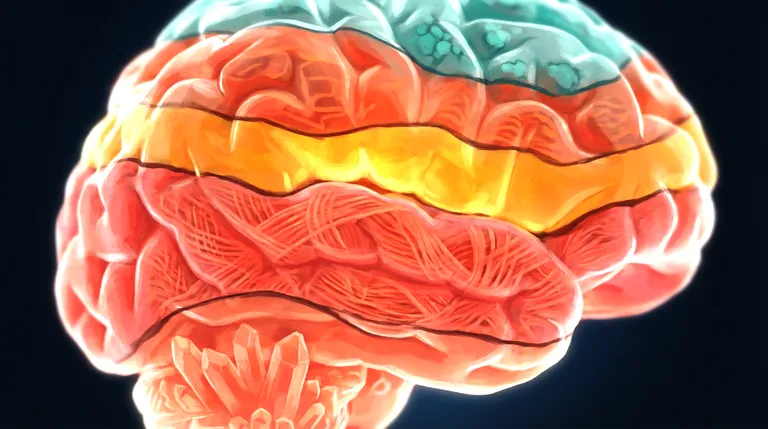

Here’s a fun experiment. Show someone a picture of a monkey, a panda, and a banana. Ask them which two go together.
If they grew up in the United States, they’ll probably say the monkey and the panda. Both are animals. Simple category logic.
But if they grew up in China, they’ll likely pair the monkey and the banana. Monkeys eat bananas. The relationship matters more than the category.
This isn’t a trick question. Psychologist Richard Nisbett ran this exact experiment and found that Americans were twice as likely to group by category. Chinese participants were twice as likely to group by relationship. Same picture. Same brain. Totally different answers.[1]
The difference? Culture. And it goes much deeper than you think.
The Cultural Operating System You Never Installed
You didn’t choose your thinking style. Your culture installed it for you, long before you could question anything.
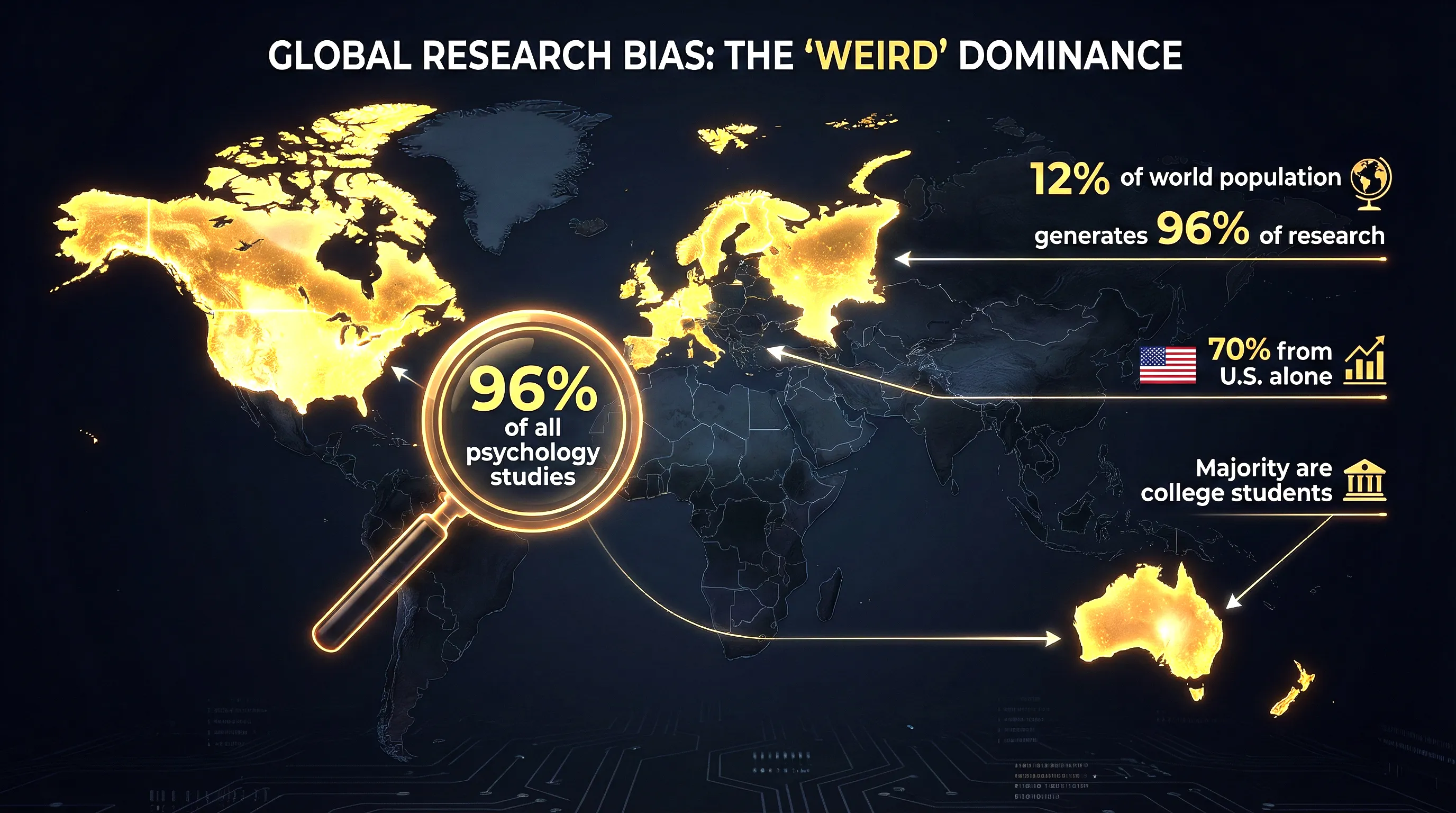
In 2010, psychologist Joseph Henrich dropped a bombshell on the entire field of psychology. He published a study showing that 96% of psychology research subjects came from Western, Educated, Industrialized, Rich, and Democratic societies. He called these people WEIRD.[2]
Here’s the problem. WEIRD societies represent just 12% of the world’s population. That means almost everything we “know” about human psychology comes from studying a tiny, unusual slice of humanity.
And it gets worse. Americans weren’t just typical of Western populations. Henrich found that American participants were “outliers among outliers.” The most psychologically unusual people on the planet were the ones generating nearly 70% of all psychology research data.
- 96% of psychology subjects came from WEIRD countries between 2003 and 2007
- WEIRD societies make up only 12% of the global population
- The U.S. alone provided nearly 70% of research participants
- Americans scored as the most psychologically unusual group even within WEIRD nations
“We Aren’t the World. What psychologists have been doing for decades is the equivalent of studying penguins while believing you’re learning about all birds.” — Joseph Henrich
This means the psychology you read about in self-help books, the cognitive biases you’ve memorized, the attachment styles you’ve identified with. All of it might only describe how Western brains work. Not how human brains work.
Recommended read: Tribal by Michael Morris — A deep dive into how group identity and cultural backgrounds wire our thinking in ways we rarely notice.
You Don’t Even See the Same World
Culture doesn’t just change what you believe. It changes what your eyes literally focus on.
In a landmark study, psychologist Takahiko Masuda showed Japanese and American participants the same animated underwater scenes. The scenes contained big fish (the obvious focal point) plus background elements like rocks, seaweed, and bubbles.
When asked to describe what they saw, Americans immediately talked about the big fish. “There were three large fish swimming to the left.” Japanese participants started with the context. “It looked like a pond. There was seaweed on the bottom.”
The Japanese participants recalled 60% more background details than the Americans. And when tested on recognition later, Japanese participants could only identify objects accurately when they appeared in their original backgrounds. Change the background, and their recognition dropped.[3][9]
Analytic vs. Holistic Thinking
These aren’t random quirks. They reflect two fundamentally different cognitive styles that map onto cultural values.
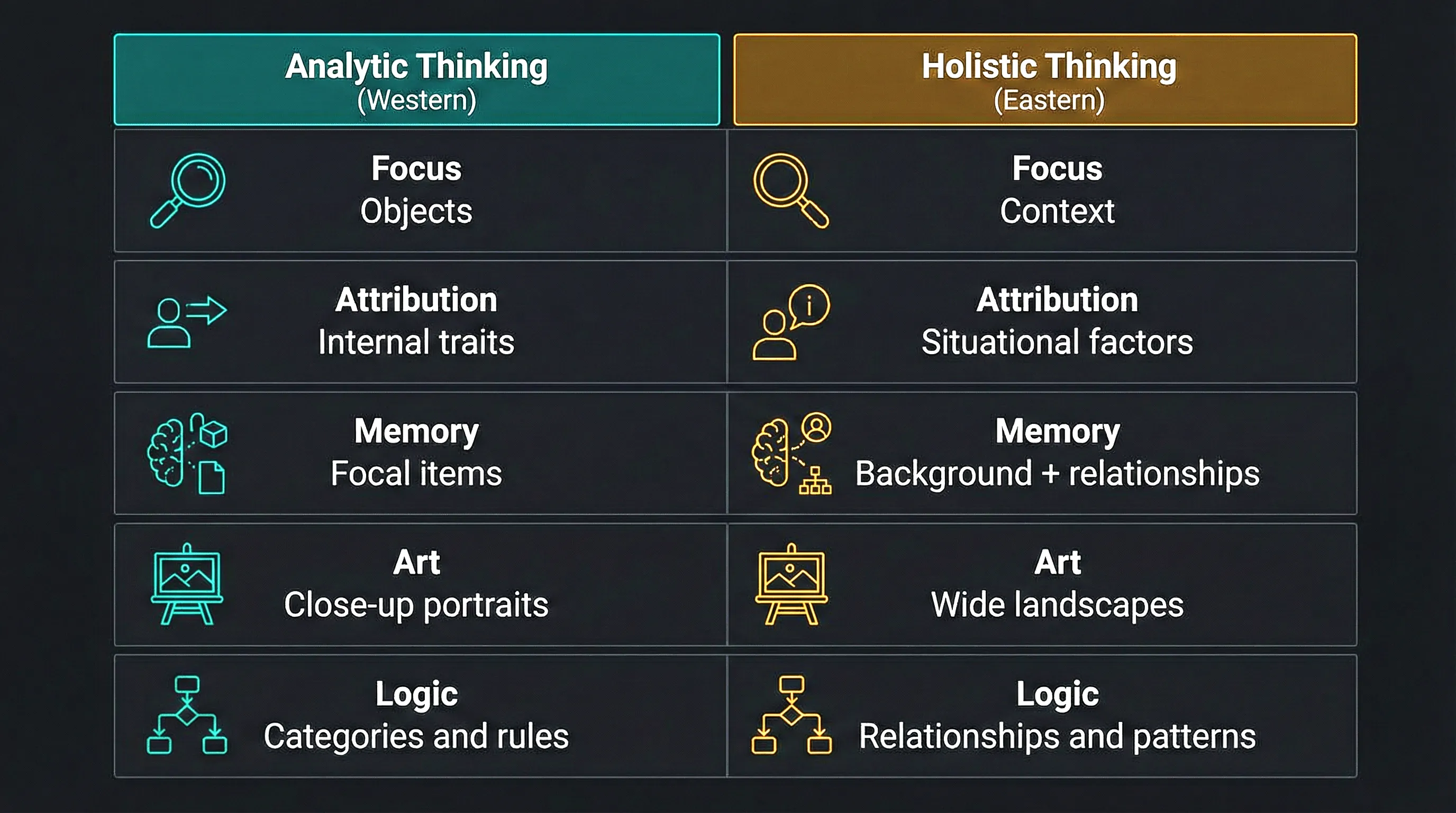
| Style | Focus | Common In | Example |
|---|---|---|---|
| Analytic | Individual objects, categories, rules | Western cultures | ”That fish is large and blue” |
| Holistic | Context, relationships, environment | East Asian cultures | ”The fish is swimming near the rocks” |
Western cultures value independence and individual achievement. So Western brains learn to isolate objects, break things into parts, and apply universal rules. East Asian cultures value harmony and social context. So those brains learn to see the whole picture and how things relate to each other.[4][8]
This shows up everywhere. In art, East Asian paintings have more background detail and wider perspectives. Western portraits focus tightly on faces. In legal thinking, Westerners attribute actions to individual character traits. East Asians consider the situation and environment first.
You think you’re seeing reality. But you’re seeing your culture’s version of it.
Your Brain Defines “You” Differently
Culture doesn’t just shape what you see. It shapes who you are. Literally, at the neural level.
In an fMRI study, researchers had Chinese and American participants think about themselves, their mothers, and a public figure while scanning their brains. Both groups activated the medial prefrontal cortex (MPFC) when thinking about themselves. That’s expected. The MPFC is your brain’s “self” center.
But here’s where it got interesting. When Chinese participants thought about their mothers, the MPFC lit up almost identically to when they thought about themselves. For American participants? Thinking about mom activated a completely different brain pattern. More like thinking about a stranger.[5]
This doesn’t mean Americans don’t love their mothers. It means their brains draw a sharper line between “self” and “other.” In collectivist cultures, the self literally overlaps with close relationships at the neurological level.
Two Versions of “Self”
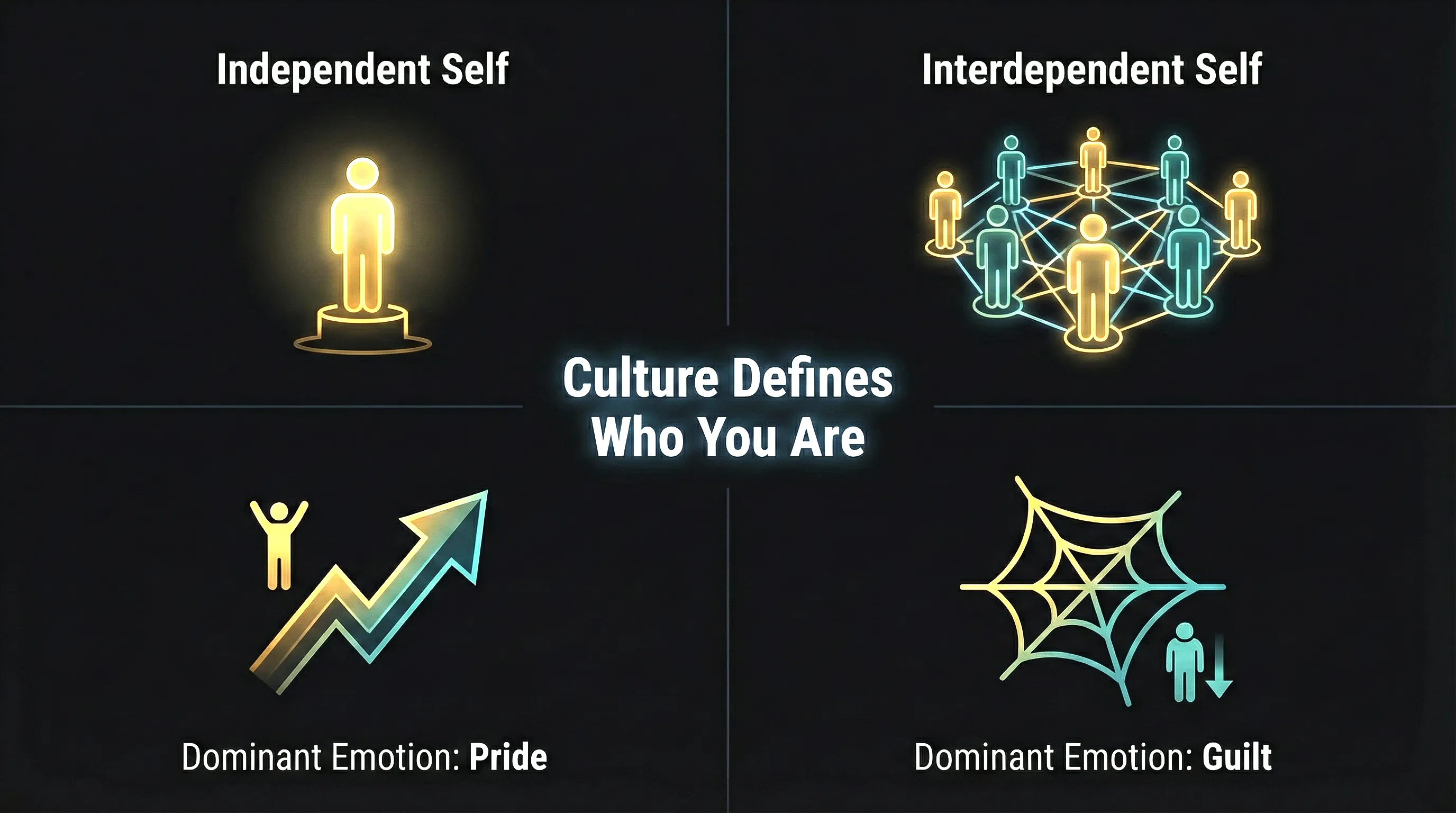
Psychologists call these two models of selfhood:
- Independent self (Western). You are your traits, achievements, and personal beliefs. You are the same person regardless of who you’re with.
- Interdependent self (East Asian). You are defined by your relationships and social roles. Who you “are” shifts depending on context.
Neither version is wrong. They’re different solutions to different cultural problems. But they create dramatically different emotional landscapes.
In individualist cultures, pride is one of the most common emotions. You did something. You earned it. In collectivist cultures, guilt shows up more often. Your actions affect others. You feel their consequences.
Recommended read: Selfless by Brian Lowery — Explores how our sense of self is built through social relationships, not individual willpower.
Even the way you follow the crowd looks different through a cultural lens. Conformity in Western studies is treated as weakness. In collectivist cultures, it’s a sign of social intelligence.
Where These Differences Come From
So if culture shapes everything from perception to selfhood, where do cultural differences actually come from? The answer might surprise you. It starts in the dirt.
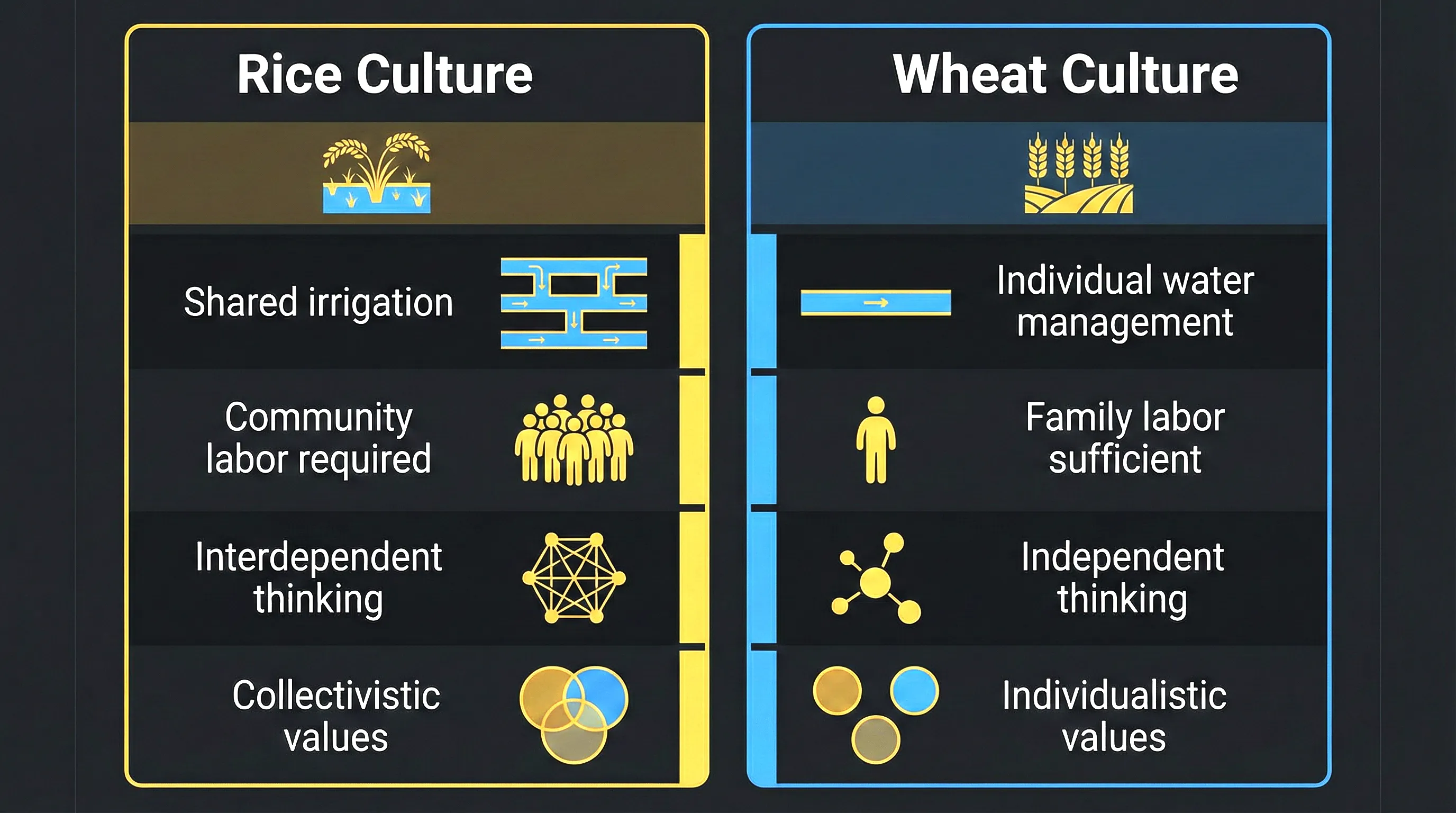
Psychologist Thomas Talhelm at the University of Chicago developed what he calls the rice theory of culture. His research shows that the type of crops a society historically farmed predicts whether that culture is individualistic or collectivistic.[6]
Rice farming requires massive cooperation. Paddies need shared irrigation systems. One family can’t manage a rice field alone. It takes twice as much labor per hectare as wheat. So rice-farming communities developed tight social bonds, shared resources, and interdependent thinking.
Wheat farming is the opposite. One family can plant, grow, and harvest wheat independently. No shared irrigation needed. So wheat-farming communities developed more individualistic, self-reliant cultures.
The China Test
Talhelm tested this within a single country. China’s south has historically grown rice. The north has grown wheat. Even though both regions share the same language, government, and national identity, they showed dramatically different psychological profiles.
- Southern (rice) Chinese were more collectivistic and relationship-focused
- Northern (wheat) Chinese were more individualistic and analytical
- The pattern held even in modernized cities with no actual farming
In 2024, Talhelm published even stronger evidence. The Chinese government had quasi-randomly assigned people to farm rice or wheat at two nearly identical state farms. The rice farmers showed less individualism, more loyalty to friends over strangers, and more relational thinking. The crop you farm literally shapes how you think.[7]
This is powerful because it shows culture isn’t just “tradition” or “values people choose.” It’s an adaptation to ecological conditions. Your ancestors’ farming methods shaped the cognitive biases that affect your decisions today.
Recommended read: You Are Not So Smart by David McRaney — A funny and sharp look at how your brain fools itself, including the cultural blind spots you never notice.
How to Think Beyond Your Cultural Blind Spots
Knowing that culture shapes your thinking is the first step. But what do you actually do with that knowledge?
You can’t step outside your cultural programming entirely. That’s like trying to see your own eyes without a mirror. But you can become more aware of when culture is doing the thinking for you.
5 Ways to Expand Your Cognitive Lens
-
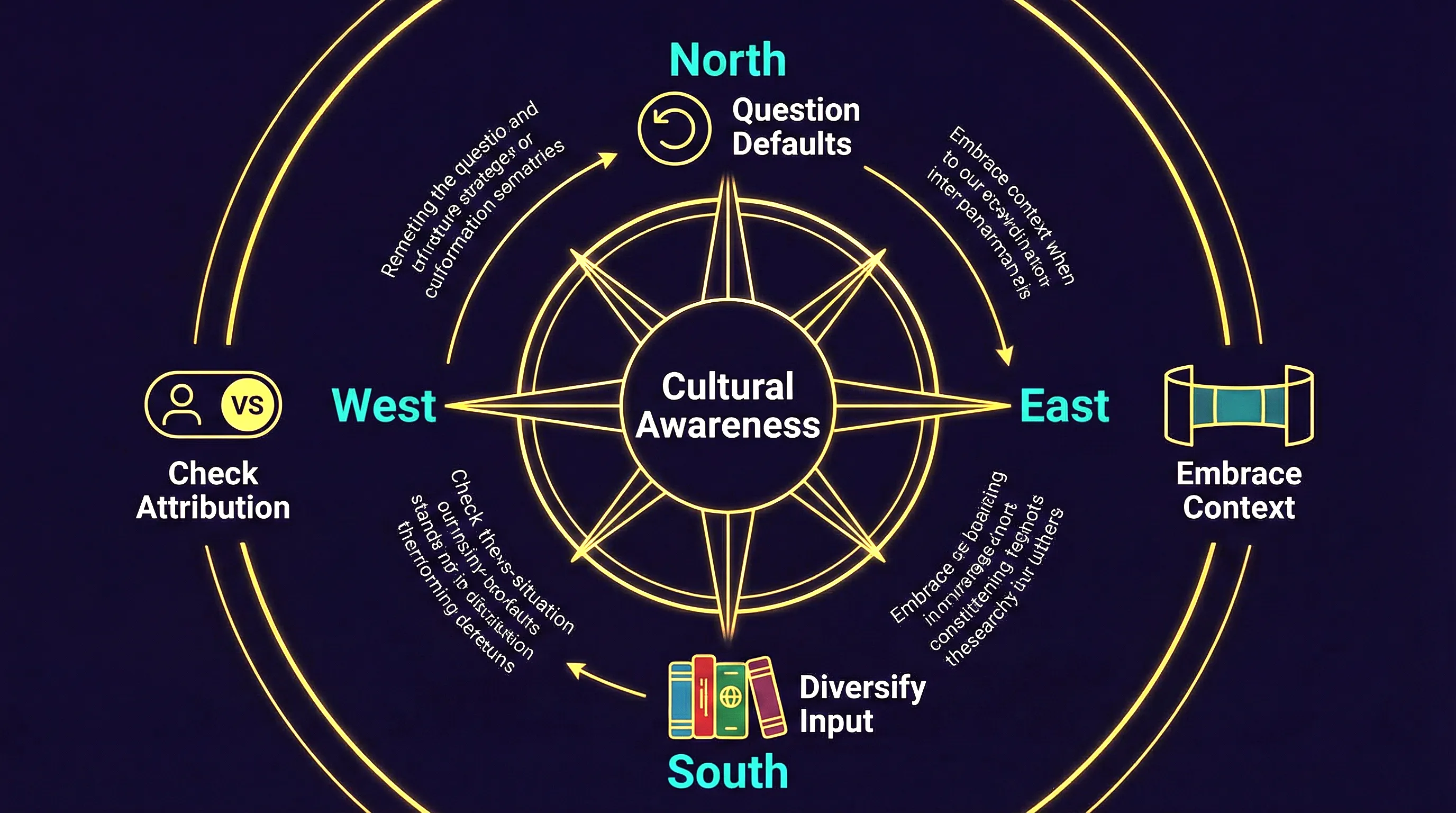
Question your “obvious” answers. When something feels obviously true, ask yourself if it would feel obvious to someone raised in a completely different culture. If not, you might be looking at a cultural assumption, not a universal truth.
-
Practice context-switching. When you evaluate someone’s behavior, try the holistic approach first. Instead of asking “what kind of person does that,” ask “what situation would cause that behavior?” This one shift can transform how you judge others.
-
Read outside your cultural bubble. Most self-help and psychology content is written by Western authors for Western audiences. Seek out perspectives from researchers and thinkers in other cultural contexts.
-
Watch for the fundamental attribution error. Westerners are especially prone to blaming individuals for problems that are really situational. Culture makes this feel natural. It isn’t.
-
Notice what you don’t notice. The Masuda fish study showed Americans literally miss background information. In conversations, relationships, and decisions, ask yourself what context you might be ignoring.
The goal isn’t to abandon your cultural thinking style. Analytic thinking and holistic thinking both have strengths. The goal is to recognize that your default isn’t the only option. And sometimes it isn’t the best one.
Your culture gave you a powerful cognitive toolkit. But it’s just one toolkit among many. The most adaptive thinkers are the ones who can reach for more than one.
Recommended read: The Art of Thinking Clearly by Rolf Dobelli — A practical guide to recognizing the thinking errors that trip up even the smartest people, many of which have cultural roots.
Sources
The Cultural Operating System You Never Installed
1. Culture and Systems of Thought: Holistic Versus Analytic Cognition (Psychological Review, 2001)
2. The Weirdest People in the World? (Behavioral and Brain Sciences, 2010)
You Don’t Even See the Same World
4. Culture and Point of View (PNAS, 2003)
Your Brain Defines “You” Differently
5. Neural Basis of Cultural Influence on Self-Representation (NeuroImage, 2007)