
You walk into a cafeteria. You’re hungry, maybe a little rushed. You grab whatever looks good at eye level.
But here’s the thing. Someone decided what goes at eye level. Someone chose the order of the food. Someone picked the size of the plates. And those tiny decisions changed what you ate today.
That someone is called a choice architect. And they’re everywhere. Not just in cafeterias. In your phone settings, your retirement plan, your insurance forms, and the ballot you fill out on Election Day.
The Invisible Designers of Your Daily Choices
Richard Thaler and Cass Sunstein coined the term choice architecture in their groundbreaking book Nudge. The idea is simple but powerful. The way options are arranged changes what people choose. Not by force. Not by taking anything away. Just by designing the environment.
Think about it this way. Every form you fill out, every app you download, every subscription you sign up for was designed by someone. That designer made hundreds of small decisions:
- Which option is pre-selected?
- What order do the choices appear in?
- How much effort does it take to switch?
- What information is shown upfront vs. buried?
Those decisions aren’t neutral. They shape behavior at massive scale.
Defaults Run the World
The most powerful tool in the choice architect’s toolkit is the default option. That’s whatever happens if you do nothing.
Most people never change their defaults. This isn’t laziness. It’s human nature. We’re busy. We assume the default is the recommended option. And we don’t want to deal with complexity if we don’t have to.
Thaler and Sunstein put it plainly:
“Well-chosen defaults work well. Active choosing is often a good idea, but in many domains, curation and well-designed defaults are a blessing.” - Richard Thaler and Cass Sunstein
Here’s where it gets interesting. Defaults don’t just help people avoid effort. They can save lives.
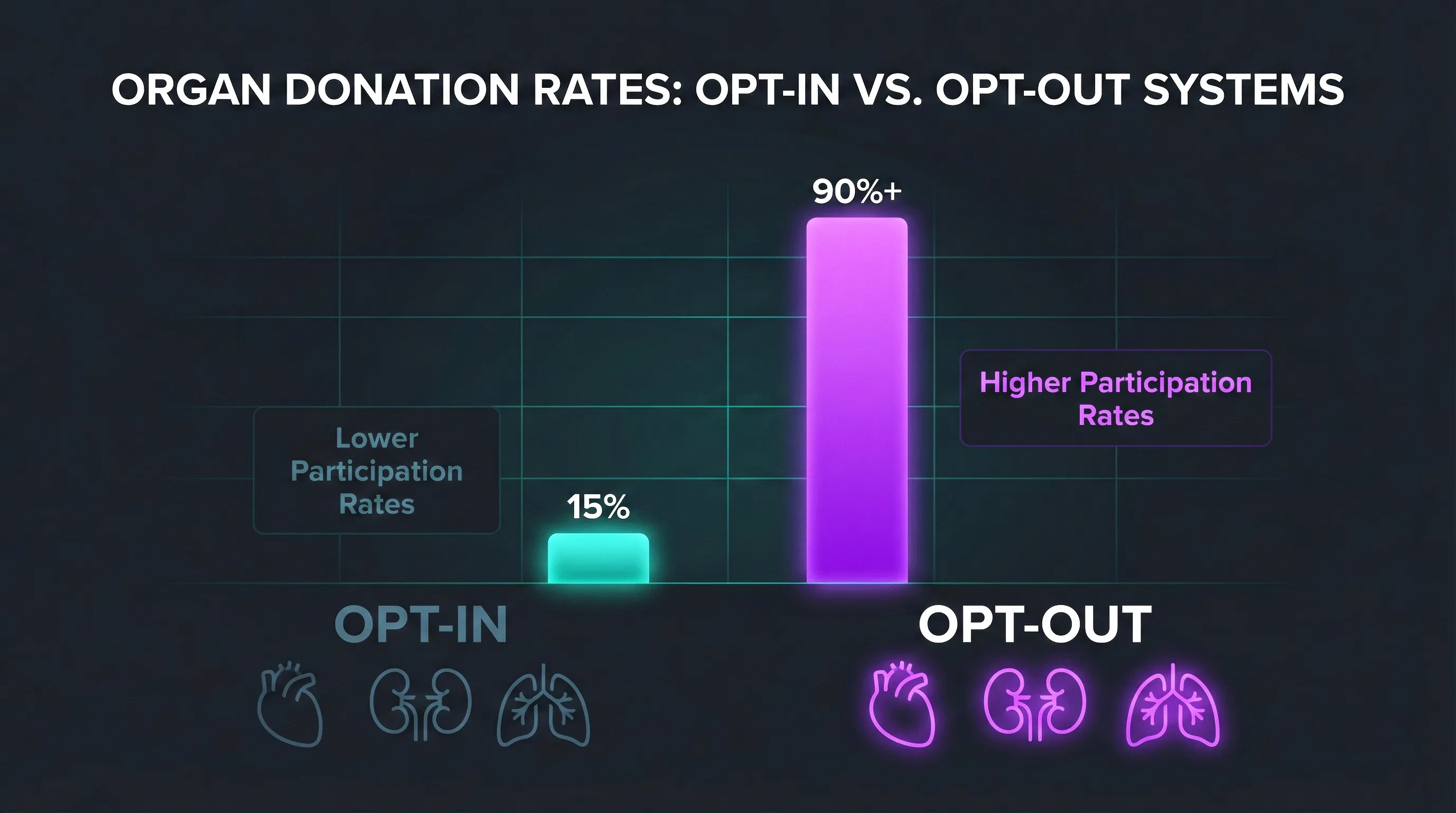
| Country Type | Organ Donation System | Consent Rate |
|---|---|---|
| Opt-in countries (US, UK, Germany) | You must actively sign up | ~15% |
| Opt-out countries (Austria, Spain, France) | You’re enrolled unless you decline | ~90%+ |
Same choice. Same freedom. Wildly different outcomes. The only difference? Which box is checked by default.[1]
Recommended read: Nudge: The Final Edition by Richard Thaler and Cass Sunstein. The definitive guide to how small design changes can transform behavior at scale.
How Governments Use Nudges at Scale
In 2010, the UK government created something called the Behavioural Insights Team. People called it the “Nudge Unit.” Its job was to apply behavioral science to public policy.[2]
It worked so well that today there are over 400 nudge units operating in governments worldwide. They’re redesigning everything from tax collection to public health campaigns.
The Greatest Hits of Government Nudges
Here are some of the biggest wins:
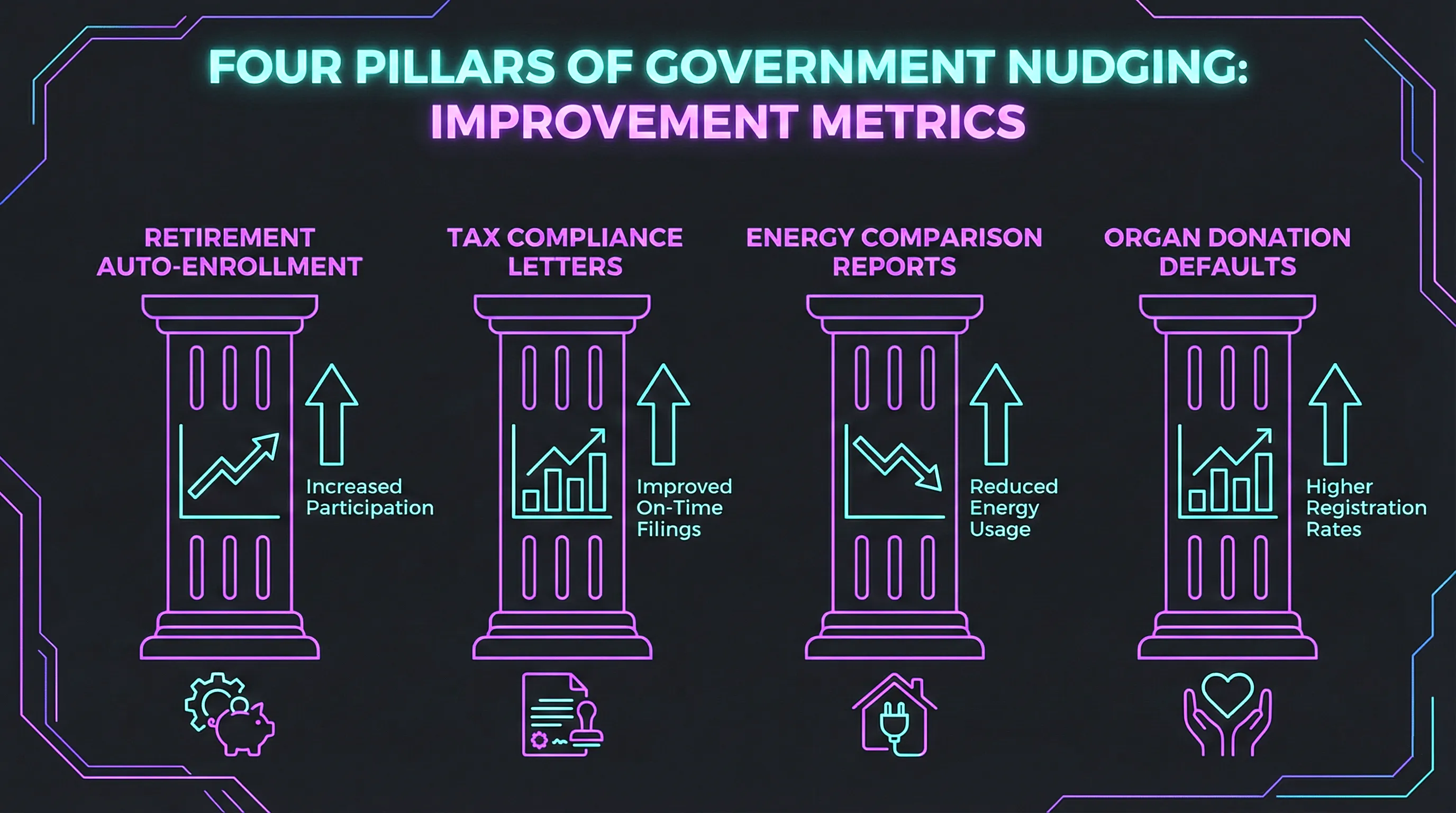
- Retirement savings. The US changed 401(k) plans from opt-in to auto-enrollment. Participation jumped from around 60% to over 90%.[3][4] People saved billions more for retirement without anyone being forced to do anything.
- Tax compliance. The UK Nudge Unit sent letters saying “most people in your area have already paid their taxes.” Late payments dropped significantly. Social proof is one of the hidden rules of persuasion that shapes behavior everywhere.
- Energy conservation. Utility companies started sending reports comparing your energy use to your neighbors’. Households that used more than average cut their consumption. Nobody mandated anything. The comparison did the work.
- Organ donation. Countries that switched from opt-in to opt-out saw consent rates climb from the teens to above 90%.
The Nudge Effectiveness Debate
Here’s what most nudge enthusiasts won’t tell you. A 2025 second-order meta-analysis published in the Journal of Behavioral Decision Making synthesized 13 articles containing 14 meta-analyses. That covered 1,638 primary studies and approximately 30 million participants. The most comprehensive look at nudging ever conducted.[5]
The headline finding? Nudges showed a small aggregated effect size of d = 0.27. But after adjusting for publication bias, that number dropped to d = 0.004. Essentially zero.[5]
Does this mean nudges don’t work? Not exactly. It means the picture is more complicated than the hype suggests:
- Some nudges are powerful. Defaults (like auto-enrollment) consistently produce large effects. The organ donation data is real.
- Many nudges are weak or overstated. Information-based nudges and social norm messages often show tiny effects that vanish when you correct for journals’ tendency to publish positive results.
- The field needs better research. The authors called urgently for higher quality, preregistered studies to separate what actually works from what’s been inflated by selective publishing.
This matters because governments are spending real money on nudge programs. Knowing which nudges genuinely work and which ones are wishful thinking is a question worth billions.
“Objecting to nudges per se makes as much sense as objecting to air and water. You can’t avoid them.” - Richard Thaler and Cass Sunstein
When Companies Design Choices Against You
Not all choice architecture is built to help you. Companies use the same principles to steer your behavior toward their bottom line. And they’re really good at it.
Dark Patterns, Dark Nudges, and Sludge
Thaler coined the term sludge for the evil twin of a nudge. Sludge is friction designed to stop you from doing something a company doesn’t want you to do.
A 2025 study published in Addiction created the first comprehensive taxonomy of deceptive design on online gambling platforms.[6] The researchers distinguished three overlapping categories:
- Sludge: detrimental frictions, like complicated withdrawal processes that make it hard to take your money out
- Dark patterns: deceptive user-interface design, including sludge-based features and things like high suggested deposit amounts
- Dark nudges: the broadest category, covering all deceptive design including presenting gambling as a harmless, fun activity
You’ve encountered these tactics if you’ve ever:
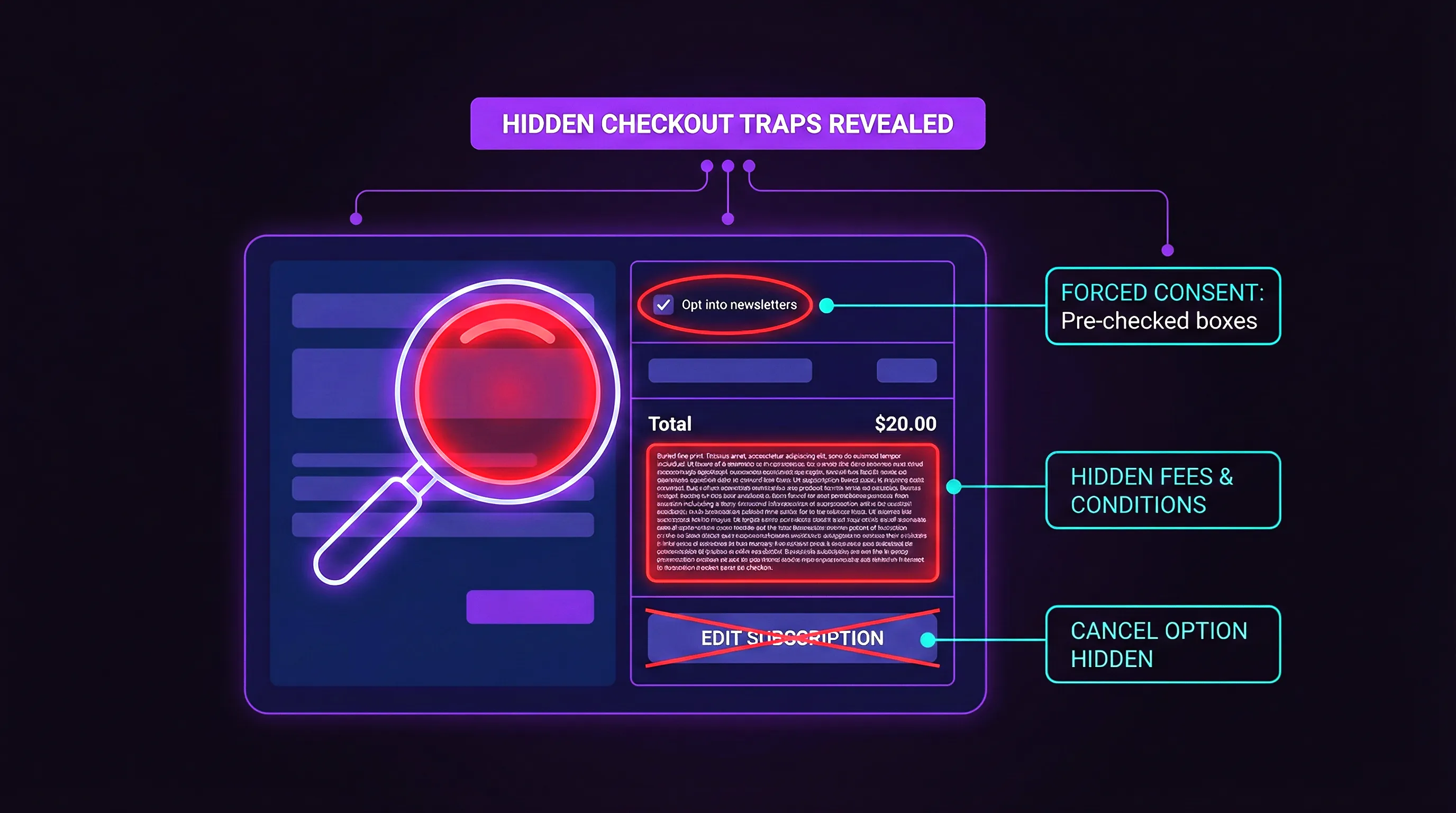
- Tried to cancel a subscription and been forced through a maze of screens, phone calls, and “are you sure?” prompts
- Signed up for a “free trial” that auto-enrolled you in a paid plan
- Attempted to opt out of marketing emails and found the unsubscribe link in 6-point gray text
- Been hit with hidden fees that only appear at checkout
These aren’t accidents. They’re designed. Someone sat in a meeting and decided to make that cancellation button harder to find. These tactics are part of a broader playbook of dark patterns that trick your brain into acting against your own interests.
The Decoy Effect in Action
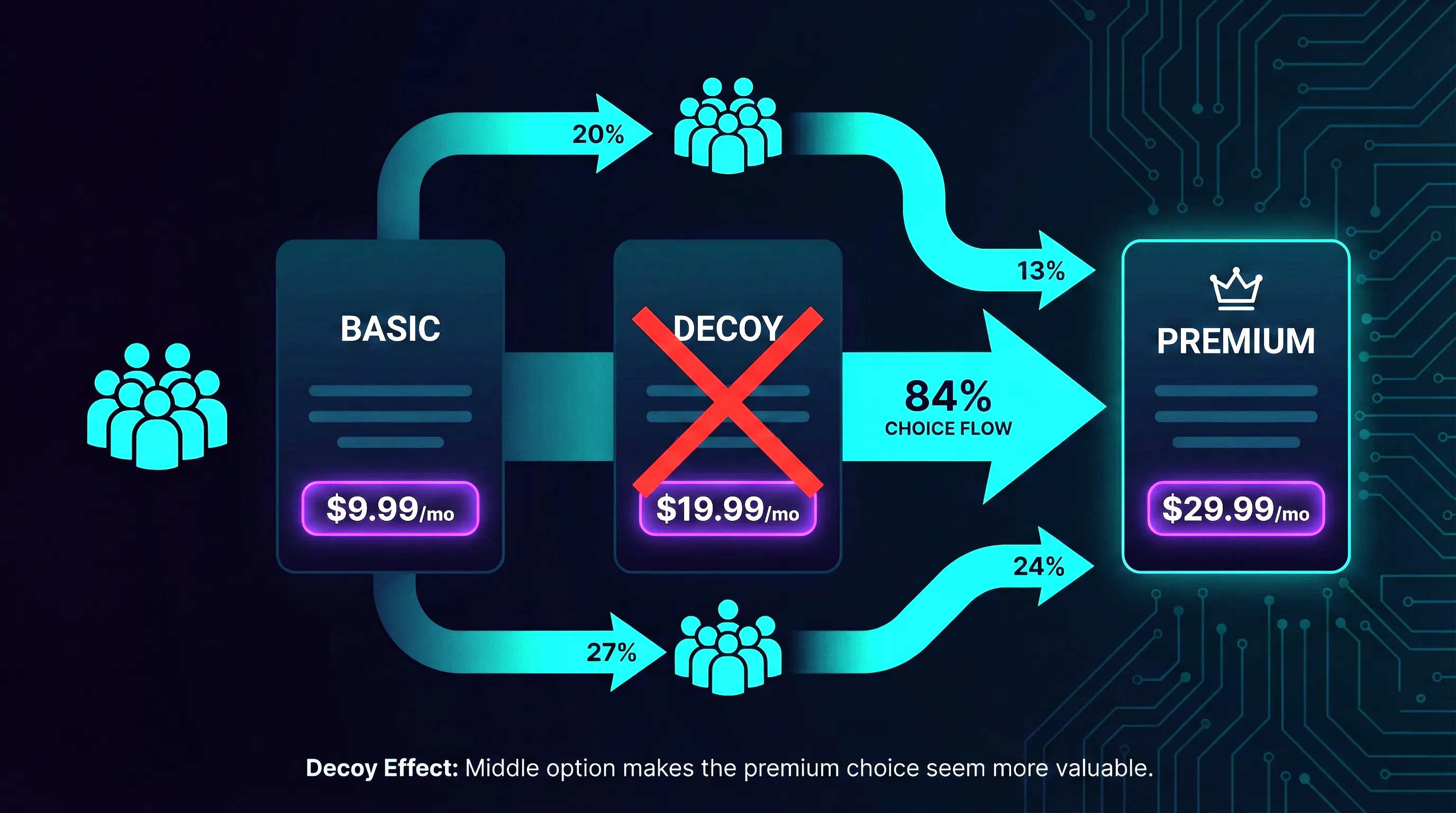
Dan Ariely, a behavioral economist, demonstrated one of the sneakiest tricks companies use. It’s called the decoy effect.
Here’s the classic example. The Economist once offered three subscription options:
| Option | Price | What You Get |
|---|---|---|
| Online only | $59 | Digital access |
| Print only | $125 | Print magazine |
| Print + online | $125 | Both print and digital |
Who would pick print only when print plus digital costs the same? Nobody. That’s the point. The middle option exists only to make the combo deal look irresistible.
When Ariely tested this with MIT students, removing the decoy option shifted choices dramatically. With the decoy present, 84% chose the combo. Without it, only 32% did.[7]
The useless option changed everything. But decoys are just one page from the playbook. Brands have a whole arsenal of psychological tricks that manipulate your brain below conscious awareness.
Recommended read: Predictably Irrational by Dan Ariely. A fascinating look at the hidden forces behind irrational choices and why companies exploit them.
The Data-Driven Nudge Machine
Choice architecture used to be about cafeteria layouts and form design. Not anymore. Today, companies use your personal data to build nudges customized just for you.
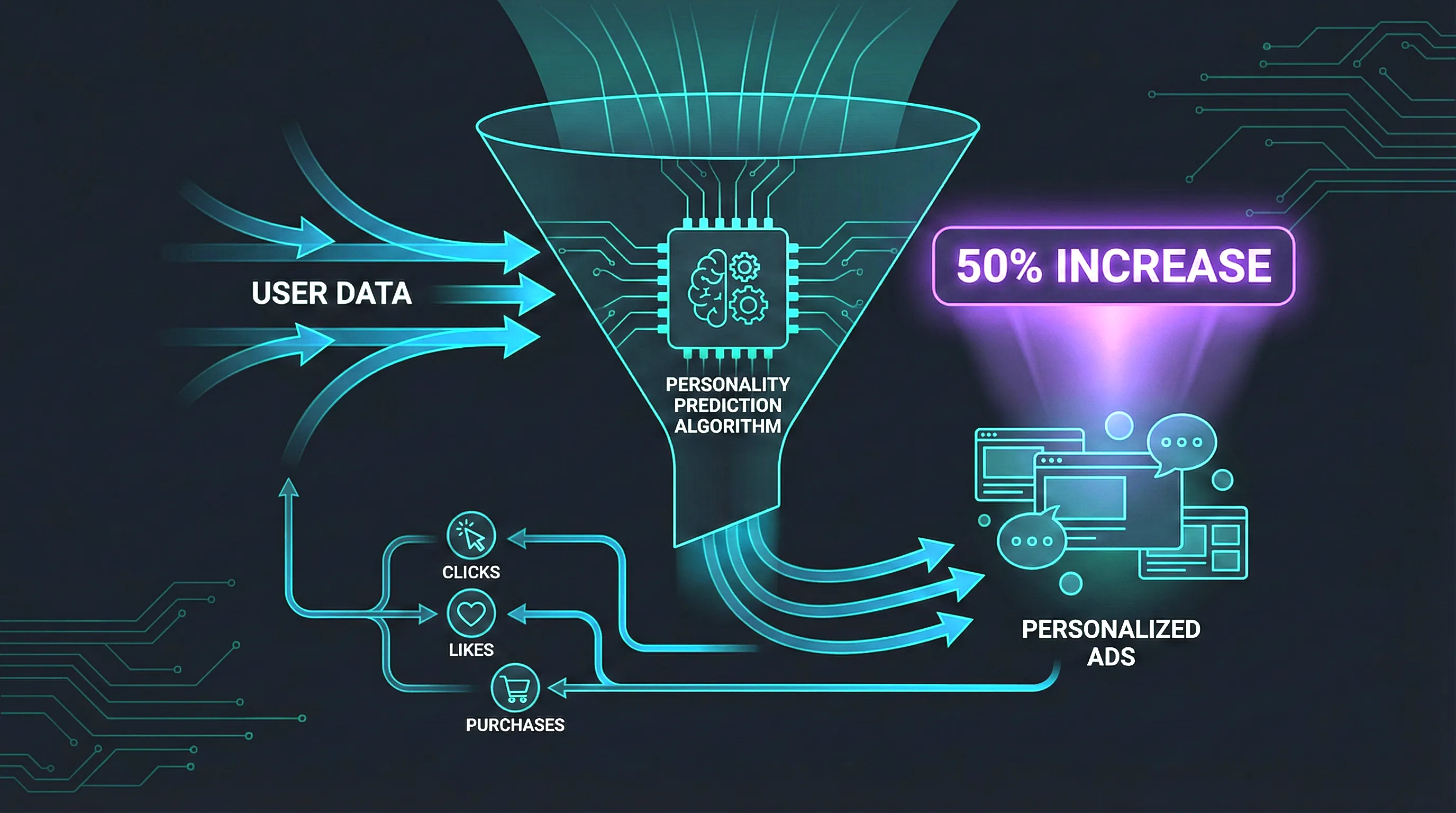
Sandra Matz, a behavioral scientist at Columbia, ran a revealing experiment. She worked with a beauty retailer to create ads targeting women based on their personality traits. Extroverted women saw bold, social ads. Introverted women saw quieter, reflective ones.
The result? Women who saw ads matched to their personality were 50% more likely to purchase.[8] And that was with a crude targeting approach. As Matz points out, the technology is getting more sophisticated every day.
How Personalized Nudges Work
The process looks like this:
- Data collection. Your clicks, likes, purchases, and browsing patterns create a behavioral profile.
- Personality prediction. Algorithms predict your personality traits from your digital footprint. Facebook filed a patent to predict personality from text back in 2012.
- Tailored presentation. The options you see, the order they appear in, and the language used to describe them are all customized to match your psychological profile.
- Behavior modification. You make decisions that feel like free choices. But the entire environment was engineered to push you in a specific direction.
Shoshana Zuboff, author of The Age of Surveillance Capitalism, warns that this goes far beyond marketing. She documents how companies extract what she calls behavioral surplus. That’s data about you that goes beyond what’s needed to improve the product. It gets fed into prediction machines designed to anticipate and influence your future behavior. The full story of how your data became the product is even more alarming than the nudges themselves.
The Cambridge Analytica scandal showed what happens when these tools move into politics. The firm used Facebook data to build psychological profiles of millions of voters. Then it targeted them with messages designed to exploit their specific fears and motivations.
Helpful Nudge vs. Dark Nudge
Not every personalized nudge is sinister. The key question is who benefits.
| Feature | Helpful Nudge | Dark Nudge |
|---|---|---|
| Intent | Help you reach your goals | Exploit you for profit |
| Transparency | You know it’s happening | Hidden or disguised |
| Opt-out | Easy to decline | Difficult or impossible |
| Who benefits | You do | The company does |
| Example | Auto-enrolling you in a savings plan | Auto-enrolling you in a paid subscription |
| Another example | Putting calorie counts on menus | Hiding cancellation buttons |
Recommended read: Mindmasters by Sandra Matz. An eye-opening look at how algorithms predict and change your behavior using your own data.
How to Spot and Resist Bad Choice Architecture
You can’t avoid choice architecture. Every interface design is a kind of choice architecture and has behavioral effects whether intended or not. Platforms like Netflix and Spotify use algorithmic nudges to recommend content, subtly influencing what you consume. But you can get better at recognizing when it’s working against you.
Here are practical steps:
-
Check the defaults. Whenever you sign up for something, look at what’s pre-selected. Uncheck boxes you didn’t choose. The default is almost never set up for your benefit.
-
Ask who benefits. If a choice feels obvious or easy, ask yourself why. Is this option good for you, or is it good for whoever designed the form?
-
Look for missing options. Choice architects don’t just arrange options. They decide which ones to show you. What’s missing from the menu might matter more than what’s on it.
-
Watch for sludge. If something is unreasonably hard to do, that’s probably intentional. Cancelling, unsubscribing, getting a refund. If there’s friction, someone put it there on purpose. Regulators are increasingly concerned about this. A 2024 study in Regulation & Governance proposed a principles-based approach to auditing deceptive choice architecture.[9]
-
Slow down at checkout. Hidden fees, auto-renewals, and pre-selected add-ons all live at the bottom of the page. Read before you click.
Richard Thaler has spent his career arguing that nudges should be transparent and easy to resist. As he writes in Misbehaving, the whole point of behavioral economics is to understand how real humans make decisions. Not the perfectly rational robots that traditional economics imagined.
Every choice you make happens inside an environment someone designed. The plates in the cafeteria. The checkboxes on the form. The order of options on the screen. None of it is random. Retail stores are some of the most carefully designed choice environments around, using layouts and displays to manipulate your shopping brain at every turn.
That doesn’t mean you’re powerless. It means you need to pay attention. The most important skill in a world full of nudges isn’t willpower. It’s awareness.
Recommended read: Misbehaving by Richard Thaler. The entertaining story of how behavioral economics challenged traditional thinking about rational decision-making.
Sources
The Invisible Designers of Your Daily Choices
1. Do Defaults Save Lives? (Science, 2003)
How Governments Use Nudges at Scale
2. Behavioural Insights Team (Institute for Government)
4. Influencing Retirement Savings Decisions with Automatic Enrollment and Related Tools (NBER, 2024)
When Companies Design Choices Against You
7. Prospect Theory: An Analysis of Decision under Risk (Econometrica, 1979)
The Data-Driven Nudge Machine
8. Psychological Targeting as an Effective Approach to Digital Mass Persuasion (PNAS, 2017)